Freshly Printed - allow 10 days lead
Couldn't load pickup availability
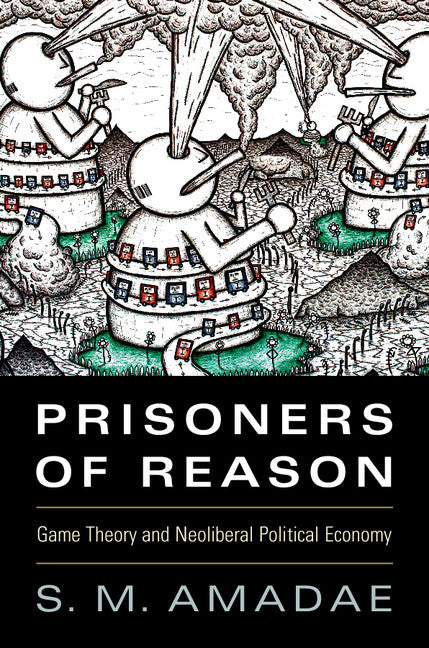
Prisoners of Reason
Game Theory and Neoliberal Political Economy
Using the theory of Prisoner's Dilemma, Prisoners of Reason explores how neoliberalism departs from classic liberalism and how it rests on game theory.
S. M. Amadae (Author)
9781107671195, Cambridge University Press
Paperback / softback, published 28 January 2016
364 pages, 11 b/w illus. 8 tables
22.8 x 15.2 x 2 cm, 0.52 kg
'… a thoughtful examination of the fundamental assumptions on which modern society is based.' Richard N. Cooper, Foreign Affairs
Is capitalism inherently predatory? Must there be winners and losers? Is public interest outdated and free-riding rational? Is consumer choice the same as self-determination? Must bargainers abandon the no-harm principle? Prisoners of Reason recalls that classical liberal capitalism exalted the no-harm principle. Although imperfect and exclusionary, modern liberalism recognized individual human dignity alongside individuals' responsibility to respect others. Neoliberalism, by contrast, views life as ceaseless struggle. Agents vie for scarce resources in antagonistic competition in which every individual seeks dominance. This political theory is codified in non-cooperative game theory; the neoliberal citizen and consumer is the strategic rational actor. Rational choice justifies ends irrespective of means. Money becomes the medium of all value. Solidarity and good will are invalidated. Relationships are conducted on a quid pro quo basis. However, agents can freely opt out of this cynical race to the bottom by embracing a more expansive range of coherent action.
Preliminaries: 1. Neoliberalism
2. Prisoner's Dilemma
Part I. War: Introduction
3. Assurance
4. Deterrence
Part II. Government: Introduction
5. Hobbesian anarchy
6. Social contract
7. Unanimity
8. Consent
9. Collective action
Part III. Evolution: Introduction
10. Selfish gene
11. Tit for tat
Conclusion
12. Pax Americana.
Subject Areas: Political science & theory [JPA]