Freshly Printed - allow 7 days lead
Couldn't load pickup availability
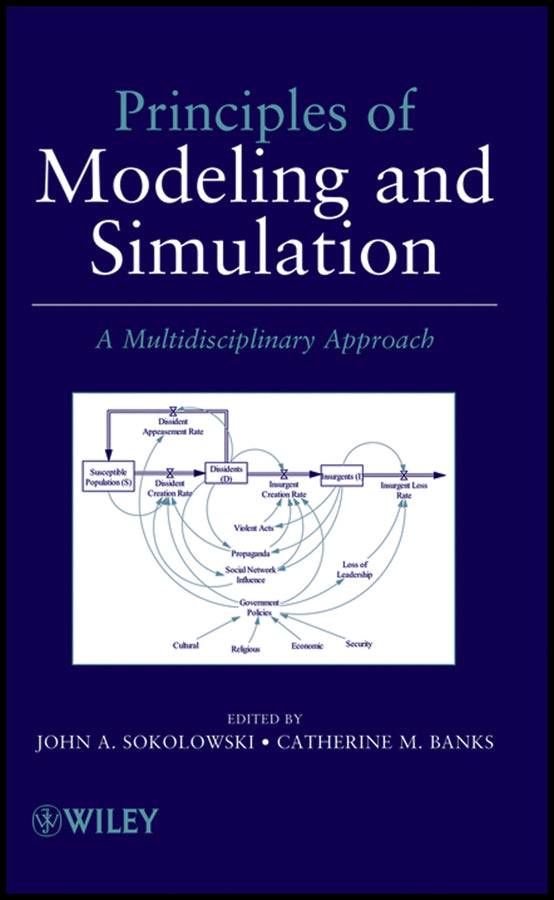
Principles of Modeling and Simulation
A Multidisciplinary Approach
John A. Sokolowski (Edited by), Catherine M. Banks (Edited by)
9780470289433, Wiley
Hardback, published 6 March 2009
288 pages, Charts: 17 B&W, 0 Color; Photos: 16 B&W, 0 Color; Drawings: 11 B&W, 0 Color; Screen captures: 19 B&W, 0 Color; Graphs: 15 B&W, 0 Color
24.1 x 16.5 x 1.8 cm, 0.531 kg
"This work could supplement a graduate course on modeling and simulation (selected chapters could supplement an undergraduate course) and would be of interest to graduate students and professionals wishing to learn some of the basics of modeling and simulation." (CHOICE, December 2009)
Explores wide-ranging applications of modeling and simulation techniques that allow readers to conduct research and ask "What if?" Principles of Modeling and Simulation: A Multidisciplinary Approach is the first book to provide an introduction to modeling and simulation techniques across diverse areas of study. Numerous researchers from the fields of social science, engineering, computer science, and business have collaborated on this work to explore the multifaceted uses of computational modeling while illustrating their applications in common spreadsheets. The book is organized into three succinct parts: Principles of Modeling and Simulation provides a brief history of modeling and simulation, outlines its many functions, and explores the advantages and disadvantages of using models in problem solving. Two major reasons to employ modeling and simulation are illustrated through the study of a specific problem in conjunction with the use of related applications, thus gaining insight into complex concepts. Theoretical Underpinnings examines various modeling techniques and introduces readers to two significant simulation concepts: discrete event simulation and simulation of continuous systems. This section details the two primary methods in which humans interface with simulations, and it also distinguishes the meaning, importance, and significance of verification and validation. Practical Domains delves into specific topics related to transportation, business, medicine, social science, and enterprise decision support. The challenges of modeling and simulation are discussed, along with advanced applied principles of modeling and simulation such as representation techniques, integration into the application infrastructure, and emerging technologies. With its accessible style and wealth of real-world examples, Principles of Modeling and Simulation: A Multidisciplinary Approach is a valuable book for modeling and simulation courses at the upper-undergraduate and graduate levels. It is also an indispensable reference for researchers and practitioners working in statistics, mathematics, engineering, computer science, economics, and the social sciences who would like to further develop their understanding and knowledge of the field.
Preface xi Contributors xiii Part One Principles of Modeling and Simulation: A Multidisciplinary Approach 1. What Is Modeling and Simulation? 3 Introduction 3 Models: Approximations of Real-World Events 5 A Brief History of Modeling and Simulation 7 Application Areas 15 Using Modeling and Simulation: Advantages and Disadvantages 21 Conclusion 22 Key Terms 23 Further Reading 23 References 23 2. The Role of Modeling and Simulation 25 Introduction 25 Using Simulations to Solve Problems 26 Uncertainty and Its Effects 34 Gaining Insight 37 A Simulation’s Lifetime 40 Conclusion 42 Key Terms 42 Further Reading 42 Part Two Theoretical Underpinnings 3. Simulation: Models That Vary over Time 47 Introduction 47 Discrete Event Simulation 48 Continuous Simulation 58 Conclusion 69 Key Terms 69 Reference 69 4. Queue Modeling and Simulation 71 Introduction 71 Analytical Solution 72 Queuing Models 74 Sequential Simulation 79 SimPack Queuing Implementation 81 Parallel Simulation 87 Conclusion 88 Key Terms 89 Further Reading 89 References 89 5. Human Interaction with Simulations 91 Introduction 91 Simulation and Data Dependency 91 Visual Representation 103 Conclusion 116 Key Terms 117 References 117 6. Verification and Validation 121 Introduction 121 Performing Verification and Validation 128 Verification and Validation Examples 141 Conclusion 147 Key Terms 147 References 147 Part Three Practical Domains 7. Uses of Simulation 153 Introduction 153 The Many Facets of Simulation 154 Experimentation Aspect of Simulation 156 Experience Aspect of Simulation 159 Examples of Uses of Simulation 160 Ethics in the Use of Simulation 170 Some Excuses to Avoid Using Simulation 170 Conclusion 171 Key Terms 171 Further Exploration 171 Appendix A Simulation Associations/Groups/Research Centers 172 References 178 8. Modeling and Simulation: Real-World Examples 181 Introduction 181 Transportation Modeling and Simulation 181 Business Modeling and Simulation 198 Medical Modeling and Simulation 209 Social Science Modeling and Simulation 230 Conclusion 241 Key Terms 242 Further Reading 242 References 242 9. The Future of Simulation 247 Introduction 247 A Brief and Selective History of Simulation 248 Convergent Simulations 249 Serious Games 249 Human-Simulator Interfaces 250 Computing Technology 253 The Role of Education in Simulation 253 The Future of Simulation 254 Key Terms 255 Index 257
Catherine M. Banks
Paul F. Reynolds, Jr.
John A. Sokolowski
Paul A. Fishwick and Hyungwook Park
Michael P. Bailey and Ahmed K. Noor
Mikel D. Petty
Tuncer I. Ören
Michael D. Fontaine, David P. Cook, C. Donald Combs, John A. Sokolowski, and Catherine M. Banks
R. Bowen Loftin
Subject Areas: Mathematics [PB]