Freshly Printed - allow 8 days lead
Couldn't load pickup availability
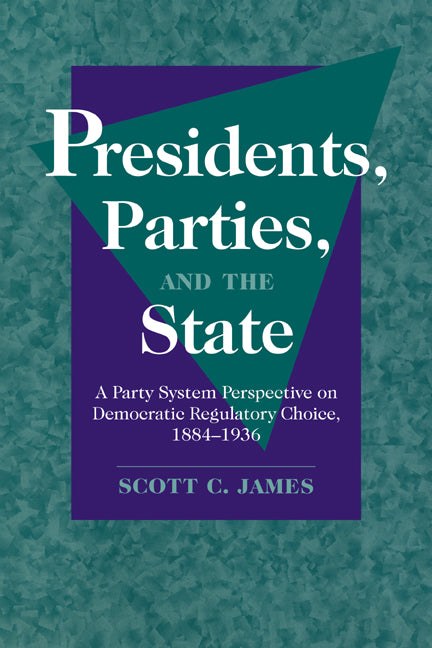
Presidents, Parties, and the State
A Party System Perspective on Democratic Regulatory Choice, 1884–1936
James challenges dominant theories of regulatory politics by placing presidential elections and national party leaders at the centre of American regulatory state development.
Scott C. James (Author)
9780521662772, Cambridge University Press
Hardback, published 24 July 2000
318 pages, 7 b/w illus. 31 tables
23.6 x 16.1 x 2.2 cm, 0.56 kg
"In Presidents, Parties and the State, Scott James offers a fresh, original, and convincing account of the development of some of the central parts of the progressive regulatory project. Neither a group-based nor new institutional account can adequately explain the passage of the Interstate Commerce Act, the creation of the Federal Trade Commission, or the politics of the Public Utility Holding Companies Act. Instead, a party systems perspective is needed, one that focuses on the attempt to form and hold national majorities, one that gives agency and leadership to the president, and one that, along the way, explains major changes of direction in party politics. It is an achievement to be able to say something so bold and persuasive about so important -- and heavily studied -- a period." John H. Aldrich, Duke University
Dominant theories of regulatory choice privilege the goals and actions of district-oriented legislators and organized groups. Presidents, Parties, and the State challenges this conventional frame, placing presidential elections and national party leaders at the centre of American regulatory state development. Historically the 'out-party' in national politics between 1884 and 1936, the Democratic party of Grover Cleveland, Woodrow Wilson and Franklin Roosevelt confronted a severe political quandary, one which pit long-term ideological commitments against short-term electoral opportunities. In short, Democrats, when in power, were forced to choose between enacting the regulatory agenda of their traditional party base, or legislating the programs of voting blocs deemed pivotal to the consolidation of national party power. Coalition-building imperatives drove Democratic leaders to embrace the latter alternative, prompting legislative intervention to secure outcomes consistent with national party needs. In the end, the electoral logic that fuelled Democratic choice proved consequential for the trajectory of American state development.
Acknowledgments
1. Introduction: parties, presidential elections, and regulatory choice - a party system perspective
2. Swing states, business Mugwumps, and the Interstate Commerce Act of 1887
3. The Progressive party vote and the Federal Trade Commission Act of 1914
4. Progressive Republicans and the 'Death Sentence' for public utility holding companies during America's second New Deal
5. Conclusion: parties and the American regulatory state
Bibliography
Index.
Subject Areas: History of the Americas [HBJK]