Freshly Printed - allow 7 days lead
Couldn't load pickup availability
Preadjusted Edgewise Fixed Orthodontic Appliances
Principles and Practice
Farhad B. Naini (Edited by), Daljit S. Gill (Edited by)
9781118817698, Wiley
Hardback, published 23 December 2021
480 pages
27.7 x 22.1 x 2.3 cm, 1.383 kg
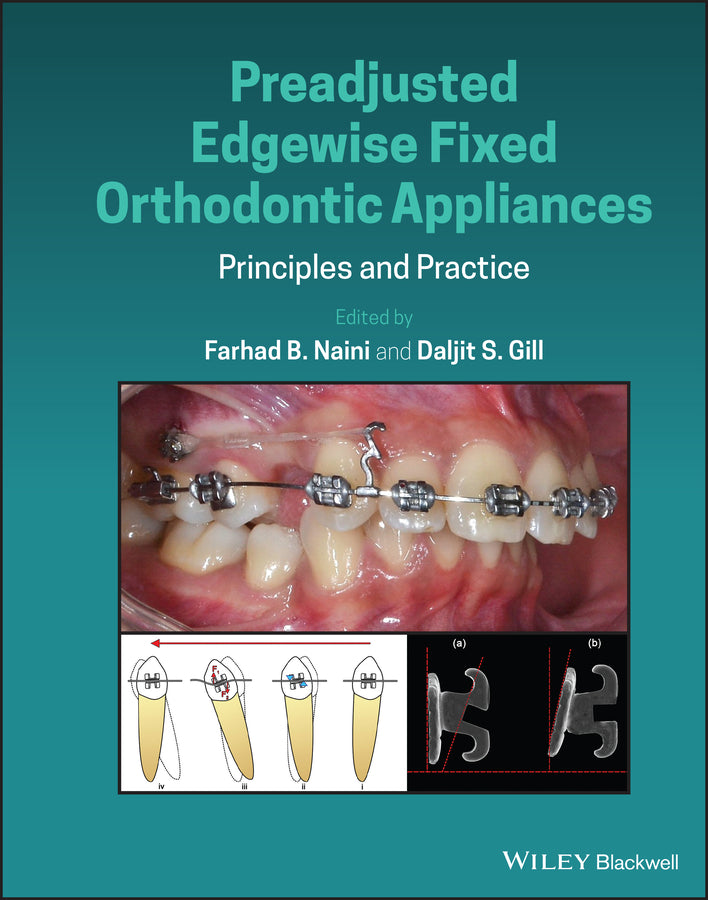
Preadjusted Edgewise Fixed Orthodontic Appliances Explore the possibilities of preadjusted edgewise appliances in orthodontics with this essential resource Preadjusted Edgewise Fixed Orthodontic Appliances: Principles and Practice comprehensively covers the increasingly popular preadjusted edgewise technique in orthodontics. The book integrates clinical practice and research findings, focusing on the biomechanics and clinical management of patients with preadjusted edgewise appliances. A unique learning resource for specialists and trainees in orthodontics, the book is highly illustrated and broad in scope, covering everything from informed patient consent to clinical techniques to information about how to manage patient malocclusions. Core topics include: Perfect for postgraduate dentists undergoing specialist training in orthodontics, specialist practitioners, and hospital consultant orthodontists, Preadjusted Edgewise Fixed Orthodontic Appliances: Principles and Practice will also be useful to dentists with a special interest in orthodontics, orthodontic therapists, and orthodontic nurses who seek a comprehensive manual of the most popular fixed orthodontic appliance technique.
Preface xxi Acknowledgements xxiii Contributorsxxv Introduction: What is the Preadjusted Edgewise Appliance? xxix What Does ‘Edgewise’ Mean xxix What Does ‘Preadjusted’ Mean xxxiv Preadjusted Edgewise Appliance Components xxxix Bracket Design Features xl Bracket Positioning xliii Stages of Treatment xliv Conclusion xliv References xliv Part I Principles 1 1 Principles of Treatment Planning 3 Introduction 3 Patient Concerns 4 Patient Motivation and Compliance 4 Handling Patient Expectations 4 Medical History 6 General Dental Health 6 Previous Orthodontic Treatment 7 Treatment Timing: When Should Treatment be Undertaken? 7 Problem List 9 Treatment Aims 11 Presenting the Treatment Options 14 How do we decide whether or not to Extract Teeth? 15 Space Analysis and Space Planning 17 Informed Consent 21 What Should be Included in a Treatment Plan 23 Treatment Mechanics 23 References 26 2 Principles of Orthodontic Biomechanics 29 Introduction 29 Basic Concepts and Principles 30 Newton’s Laws of Motion and Static Equilibrium 38 Displacement of Rigid Bodies 39 Control of Tooth Movement 41 Types of Tooth Movement 44 Clinical Applications and Relevance 47 Conclusion 54 References 55 3 Anchorage 57 Introduction 57 Anchorage Value 59 Assessment of Anchorage Need 61 Classifications of Anchorage 61 Anchorage Control with Fixed Appliances 62 Anchorage Creation 73 Anchorage Loss 74 References 75 4 Consent 79 Introduction 79 Types of Consent 80 Valid Consent 80 Withdrawal of Consent 81 Treatment Options 81 Key Factors to be Communicated with Patients 82 Treatment Benefits 83 Treatment Risks 84 Effective Communication 88 Conclusions 89 References 90 5 Dentolegal Aspects of Orthodontic Treatment 93 Introduction 93 Advertising 94 The Initial Consultation 94 Pretreatment Records 97 Dentolegal and Ethical Issues that may Arise During Treatment Planning 99 Obtaining Consent 100 Dentolegal Issues Arising During Active Orthodontic Treatment 102 Retention 106 Relapse 107 Duty of Candour 107 Responding to a Complaint 108 References 109 Part II The Preadjusted Edgewise Appliance 111 6 BracketDesign 113 The Origins of Fixed Appliance Bracket Design 113 Preadjusted Edgewise Straight-wire Appliance 117 Straight-wire Appliance: Bracket Prescriptions 121 Straight-wire Appliance: Bracket Modifications 129 Acknowledgements 135 References 135 7 Bracket Placement 137 Introduction 137 Design Features of Preadjusted Edgewise Appliance Brackets 137 Direct versus Indirect Bonding 140 Direct Bonding Technique 141 Indirect Bonding Technique 142 Banding Molars and Premolars 143 Tips for Bracket Selection in Certain Situations 145 References 146 8 Bonding in Orthodontics 147 History 147 Bonding Procedure 148 Bonding to Artificial Substrates 151 Indirect Bonding 151 Bonding Adhesives 152 Health Risks Associated with Bonding 154 Effectiveness of Adhesives 154 Debonding 156 Bonded Retainers 157 Additional Uses of Bonding in Orthodontics 158 Future Possibilities of Orthodontic Bonding 158 Summary 158 Acknowledgements 159 Further Reading 159 References 159 9 Debonding 165 Introduction 165 Preparation 166 Stainless Steel Brackets 166 Ceramic Brackets 166 Self-ligating Brackets 168 Lingual Appliances and Bite Turbos 168 Solvent Use 168 Electrothermal Debonding 168 Laser Debonding 168 Band Removal 169 Composite Resin Removal 169 Finishing Techniques 169 Iatrogenic Damage 171 Particulates 171 Conclusions 172 References 172 10 Archwires 175 Introduction 175 Properties of Archwires 176 Archwire Shape and Arch Form 179 Archwire Materials 180 Aesthetic Archwires 185 Fatigue 187 Corrosion of Metal Alloys 188 Which is the Best Aligning Archwire or Archwire Sequence? 191 Pain from Initial Archwires 192 Root Resorption from Different Archwires 194 Allergy to Nickel 195 Acknowledgements 197 References 197 11 The Use of Auxiliaries in Orthodontics 203 Introduction 203 Anchorage and Space Management 203 Class II Correction 208 Tooth Movement 211 Conclusion 217 References 218 12 Optimising Fixed Appliance Treatment with Orthodontic Mini-implants 219 Introduction 219 OMI Advantages 220 OMI Disadvantages 220 Where Does OMI anchorage Come From? 221 Anchorage Options: Direct Versus Indirect 223 Key Clinical Steps Involved in OMI Usage with Fixed Appliances 226 Three-dimensional Anchorage Applications 228 References 231 13 Care of Fixed Appliances 235 Introduction 235 Before Fixed Appliance Treatment 236 During Fixed Appliance Treatment 237 After Fixed Appliance Treatment 245 Conclusions 245 References 245 Part III Stages of Treatment with Preadjusted Edgewise Appliances 247 14 Alignment and Levelling 249 Introduction 249 Anchorage Requirements and Preparation 250 Arch Form 255 Tooth Movement with Preadjusted Fixed Appliances 256 Alignment 257 Levelling 293 Conclusion 294 References 294 15 Controlled Space Closure 297 Introduction 297 At Completion of Alignment and Levelling 298 Objectives during Space Closure 298 Classification of Anchorage 299 Types of Space Closure 299 Sliding Mechanics with the Preadjusted Edgewise Appliance 300 Frictionless Mechanics with the Preadjusted Edgewise Appliance 306 Monitoring Space Closure 308 Conclusion 309 References 309 16 Finishing 311 Introduction 311 Aims and Objectives of Orthodontic Treatment 312 Common Errors Encountered at the Finishing Stages of Treatment 312 Efficient Finishing: the Importance of Diagnosis and Treatment Planning 317 Conclusion 318 References 318 17 Retention 321 Introduction 321 Historical background 322 Aetiology of Post-treatment Changes 323 Reducing Relapse During Treatment 324 Choice of Retainers 324 Fixed Retainers 324 Removable Retainers 327 Responsibilities in Retention 329 Conclusions 329 Acknowledgements 329 References 329 Part IV Management of Malocclusions with Preadjusted Edgewise Appliances 331 18 Management of Class II Malocclusions 333 Introduction 333 Management Options 334 Growth Modification 336 Orthodontic Camouflage 342 Orthodontics and Orthognathic Surgery 356 References 356 19 Management of Class III Malocclusions 359 Introduction 359 Treatment Timing for Class III Malocclusion in Relation to Facial Growth 360 Comprehensive, Camouflage or Compromise Treatment for Class III Cases 362 Managing the Class III Surgical/Orthodontic Patient with Fixed Appliances 366 Class III Malocclusion Occurring with Cleft Lip and/or Palate 370 References 370 20 Management of Deep Incisor Overbite 371 Introduction 371 Aetiology 372 Indications for Treatment 373 Considerations in Treatment Planning 374 Methods of Overbite Reduction 375 Appliances and Techniques for Overbite Reduction 376 Stability of Overbite Correction 382 Conclusion 384 References 384 21 Management of Anterior Open Bite 385 Introduction 385 Prevalence and Incidence 385 Aetiology 385 Characteristics 388 Clinical Treatment 389 Retention and Stability 394 Conclusion 394 References 394 22 Management of the Transverse Dimension 397 Introduction 397 Crossbites 398 Indications for Maxillary Expansion 398 Removable Appliances 399 Functional Appliances 400 Aligners 400 Fixed Appliances 400 Mid-Palatal Suture 404 Surgical Expansion 409 Retention 411 References 411 Part V Appendices 413 Appendix 1 Orthodontic Instruments 415 Appendix 2 Orthodontic Elastics and Elastomeric Materials 423 Introduction 423 Intraoral Elastic Configurations 423 Points of Application 424 Instructions for Use of Intraoral Elastics 424 Elastomeric Materials 425 Index 427
Farhad B. Naini and Daljit S. Gill
Farhad B. Naini and Daljit S. Gill
Farhad B. Naini and Daljit S. Gill
Zaid B. Al-Bitar
Gavin J. Mack
Alison Williams
Chris D. Donaldson
Hemendranath V. Shah, Daljit S. Gill, and Farhad B. Naini
Declan Millett
Lucy Davenport-Jones
Leila Khamashta-Ledezma
Andrew T. DiBiase and Jonathan Sandler
Richard R. J. Cousley
Nazan Adali, Daljit S. Gill, and Farhad B. Naini
Farhad B. Naini and Daljit S. Gill
Daljit S. Gill and Farhad B. Naini
Mohammad Owaise Sharif and Stephen M. Chadwick
Simon J. Littlewood
Martyn T. Cobourne and Mithran S. Goonewardene
Grant T. McIntyre
Farhad B. Naini, Daljit S. Gill, and Umberto Garagiola
Chung H. Kau and Tim S. Trulove
Lucy Davenport-Jones
Farhad B. Naini and Daljit S. Gill
Farhad B. Naini and Daljit S. Gill
Subject Areas: Medicine: general issues [MB]