Freshly Printed - allow 10 days lead
Couldn't load pickup availability
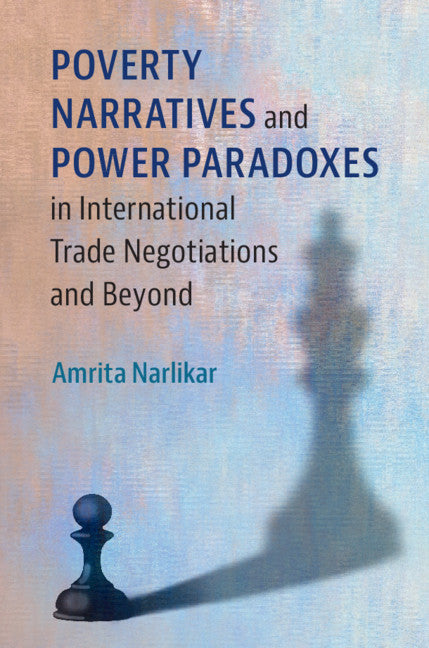
Poverty Narratives and Power Paradoxes in International Trade Negotiations and Beyond
Poverty narratives have become an unprecedented source of empowerment. Yet, indiscriminate misuse risks devastating repercussions for the weakest members of society.
Amrita Narlikar (Author)
9781108415569, Cambridge University Press
Hardback, published 7 May 2020
220 pages, 1 table
23.5 x 15.8 x 1.6 cm, 0.43 kg
'Narlikar has elegantly connected such a wide range of topics in a relatively succinct book. This rich and truly engaging text will make for fascinating reading for a range of readers. Those interested in international political economy will find it a substantive contribution that provides a highly original perspective. Those interested in global governance will also find a unique appeal as it nicely explains the interplay between actors on the intersection of norms, institutions, and political change. In brief, Amrita Narlikar's book is an absolute delight to read and opens up the possibility for future research and discussion.' Gonca Oguz Gok, International Journal
In this work, Amrita Narlikar argues that, contrary to common assumption, modern-day politics displays a surprising paradox: poverty - and the powerlessness with which it is associated - has emerged as a political tool and a formidable weapon in international negotiation. The success of poverty narratives, however, means that their use has not been limited to the neediest. Focusing on behaviours and outcomes in a particularly polarising area of bargaining - international trade - and illustrating wider applications of the argument, Narlikar shows how these narratives have been effectively used. Yet, she also sheds light on how indiscriminate overuse and misuse increasingly run the risk of adverse consequences for the system at large, and devastating repercussions for the weakest members of society. Narlikar advances a theory of agency and empowerment by focusing on the life-cycles of narratives, and concludes by offering policy-relevant insights on how to construct winning and sustainable narratives.
1. Introduction: poverty narratives and power paradoxes
2. The disempowered many: when the weak suffered what they must
3. Winning against the odds: a growing empowerment
4. When fair is foul and foul is fair: overuse and misuse of the poverty narrative
5. Conclusion: how to sustain the power of the powerless and build winning narratives.
Subject Areas: International economic & trade law [LBBM], Public international law [LBB], Political economy [KCP], International institutions [JPSN], Geopolitics [JPSL], International relations [JPS]