Special Order - allow 2+ weeks lead
Couldn't load pickup availability
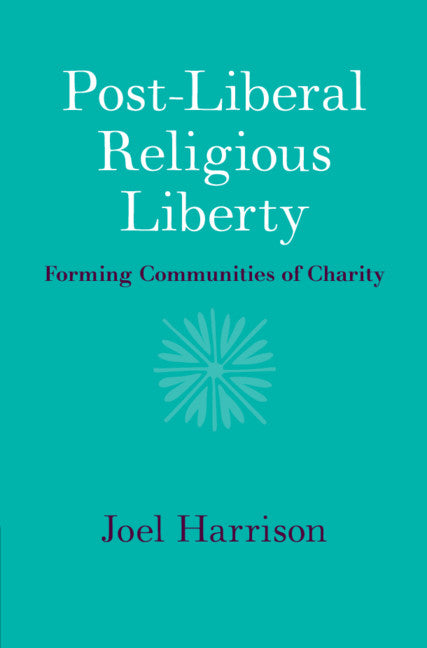
Post-Liberal Religious Liberty
Forming Communities of Charity
A radically theological-political account of religious liberty, challenging secularisation narratives and liberal egalitarian arguments.
Joel Harrison (Author)
9781108836500, Cambridge University Press
Hardback, published 9 July 2020
280 pages
15.5 x 23.5 x 2 cm, 0.57 kg
'An engaging read …' Edward A. David, Studies in Christian Ethics
Why should we care about religious liberty? Leading commentators, United Kingdom courts, and the European Court of Human Rights have de-emphasised the special importance of religious liberty. They frequently contend it falls within a more general concern for personal autonomy. In this liberal egalitarian account, religious liberty claims are often rejected when faced with competing individual interests – the neutral secular state must protect us against the liberty-constraining acts of religions. Joel Harrison challenges this account. He argues that it is rooted in a theologically derived narrative of secularisation: rather than being neutral, it rests on a specific construction of 'secular' and 'religious' spheres. This challenge makes space for an alternative theological, political, and legal vision. Drawing from Christian thought, from St Augustine to John Milbank, Harrison develops a post-liberal focus on association. Religious liberty, he argues, facilitates creating communities seeking solidarity, fraternity, and charity – goals that are central to our common good.
1. Introduction
2. The liberal egalitarian account
3. Secularisation challenged
4. Modern (Christian) responses
5. The ecclesiological account
6. Pluralism and disagreement
7. Conclusion.
Subject Areas: Sociology: customs & traditions [JHBT], Religious institutions & organizations [HRLP], Philosophy of religion [HRAB], Ethics & moral philosophy [HPQ]