Freshly Printed - allow 10 days lead
Couldn't load pickup availability
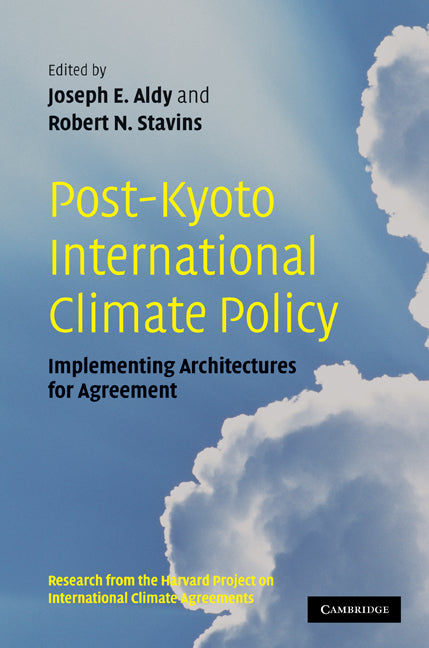
Post-Kyoto International Climate Policy
Implementing Architectures for Agreement
The most authoritative analysis of the full range of options open for a world climate agreement to succeed the Kyoto Protocol.
Joseph E. Aldy (Edited by), Robert N. Stavins (Edited by)
9780521137850, Cambridge University Press
Hardback, published 3 December 2009
1022 pages, 73 b/w illus. 51 tables
23.4 x 16 x 5 cm, 1.7 kg
'Global climate regime building requires intellectual inputs. This timely volume of highly essential and constructive elements provides a wide readership with an in-depth understanding of equity, sustainability, and efficiency approaches to a successful conclusion of an international climate agreement at the UN Climate Conference in Copenhagen, December 2009.' Pan Jiahua, Director, Research Centre for Sustainable Development, Chinese Academy of Social Sciences
The Harvard Project on International Climate Agreements is a global, multi-disciplinary effort intended to help identify the key design elements of a scientifically sound, economically rational, and politically pragmatic post-2012 international policy architecture for addressing the threat of climate change. It has commissioned leading scholars to examine a uniquely wide range of core issues that must be addressed if the world is to reach an effective agreement on a successor regime to the Kyoto Protocol. The purpose of the project is not to become an advocate for any single policy but to present the best possible information and analysis on the full range of options concerning mitigation, adaptation, technology, and finance. The detailed findings of the Harvard Project are reported in this volume, which contains twenty-seven specially commissioned chapters. A companion volume summarizing the main findings of this research is published separately as Post-Kyoto International Climate Policy: Summary for Policymakers.
Foreword Timothy Wirth
1. Introduction: the Harvard Project on International Climate Agreements Joseph E. Aldy and Robert N. Stavins
Part I. Alternative International Policy Architectures: 2. A proposal for specific formulas and emission targets for all countries in all decades Jeffrey Frankel
3. EU emission trading scheme: a prototype global system? A. Denny Ellerman
4. Linkage of tradable permit systems in international climate policy architecture Judson Jaffe and Robert N. Stavins
5. The case for charges on greenhouse gas emissions Richard Cooper
6. Towards a global compact for managing climate change Ramgopal Agarwala
7. A sectoral approach as an option for a post-Kyoto framework Akihiro Sawa
8. A portfolio system of climate treaties Scott Barrett
Part II. Negotiation, Assessment, and Compliance: 9. How to negotiate and update climate agreements Bård Harstad
10. Metrics for evaluating policy commitments in a fragmented world: the challenges of equity and integrity Carolyn Fischer and Richard Morgenstern
11. Justice and climate change Eric Posner and Cass Sunstein
12. Toward a post-Kyoto climate change architecture: a political analysis Robert Keohane and Kal Raustiala
Part III. The Role and Means of Technology Transfer: 13. International climate technology strategies Richard Newell
14. Resource transfers to developing countries: improving and expanding greenhouse gas offsets Andrew Keeler and Alexander Thompson
15. Possible development of a technology clean development mechanism in a post-2012 regime Wenying Chen, Jiankun He and Fei Teng
Part IV. Global Climate Policy and International Trade: 16. Global environmental policy and global trade policy Jeffrey Frankel
17. Kyoto's successor Larry Karp and Jinhua Zhao
Part V. Economic Development, Adaptation, and Deforestation: 18. Reconciling human development and climate protection Jing Cao
19. What do we expect from an international climate agreement? A low-income country perspective E. Somanathan
20. Climate accession deals for taming growth of greenhouse gases in developing countries David Victor
21. Policies for developing country engagement Daniel Hall, Michael Levi, Wiliam Pizer and Takahiro Ueno
22. International forest carbon sequestration in a post-Kyoto agreement Andrew Plantinga and Kenneth Richards
Part VI. Modeling Impacts of Alternative Allocations of Responsibility: 23. A quantitative and comparative assessment of architectures for agreement Valentina Bosetti, Carlo Carraro, Alessandra Sgobbi and Massimo Tavoni
24. Sharing the burden of GHG reductions Mustafa H. Babiker, Henry D. Jacoby, Sergey Paltsev and John M. Reilly
25. Technology and international climate policy Kate Calvin, Leon Clarke, Jae Edmonds, Page Kyle and Marshall Wise
26. Revised emissions growth projections for China: why post-Kyoto climate policy must look east Geoffrey J. Blanford, Richard G. Richels and Thomas F. Rutherford
27. Expecting the unexpected: macroeconomic volatility and climate policy Warwick J. McKibbin, Adele Morris and Peter J. Wilcoxen
Part VII. Synthesis and Conclusion: 28. Epilogue: implementing architectures for agreement Richard Schmalansee
29. A synthesis from the Harvard Project on International Climate Agreements Joseph E. Aldy and Robert N. Stavins
Glossary and abbreviations
Index.
Subject Areas: Environmental economics [KCN], Economics [KC]