Freshly Printed - allow 10 days lead
Couldn't load pickup availability
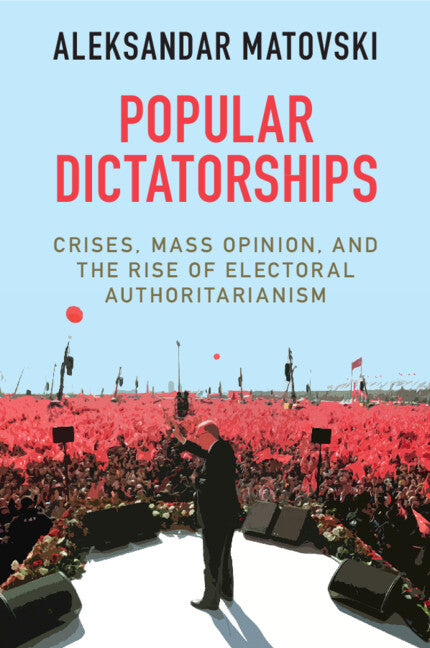
Popular Dictatorships
Crises, Mass Opinion, and the Rise of Electoral Authoritarianism
Shows that the most widespread and malignant dictatorships today emerge by attracting genuine popular support in societies plagued by crises.
Aleksandar Matovski (Author)
9781009048477, Cambridge University Press
Paperback / softback, published 8 February 2024
320 pages, 26 b/w illus. 8 tables
22.9 x 15.2 x 1.7 cm, 0.465 kg
'Matovski provides a full-fledged and thoroughly tested theory that is sensitive to lived experiences and acknowledges that societies might reluctantly prioritize EARs amidst violent conflicts. A refreshing step forward from the institutional narrative that dominates the research on EARs, Matovski's theory incorporates the long-term legacies of collective hardship. This move pays off: the EAR rhetoric alone predicts whether a country is an electoral autocracy better than structural correlates of electoral authoritarianism (such as resource dependence and coercive potential of the state)-a thought-provoking-finding that underscores the oft-neglected power of narratives in regime transitions.' Irina Soboleva, Slavic Review
Electoral autocracies – regimes that adopt democratic institutions but subvert them to rule as dictatorships – have become the most widespread, resilient and malignant non-democracies today. They have consistently ruled over a third of the countries in the world, including geopolitically significant states like Russia, Turkey, Venezuela, Egypt, Indonesia, Nigeria and Pakistan. Challenging conventional wisdom, Popular Dictators shows that the success of electoral authoritarianism is not due to these regimes' superior capacity to repress, bribe, brainwash and manipulate their societies into submission, but is actually a product of their genuine popular appeal in countries experiencing deep political, economic and security crises. Promising efficient, strong-armed rule tempered by popular accountability, elected strongmen attract mass support in societies traumatized by turmoil, dysfunction and injustice, allowing them to rule through the ballot box. Popular Dictators argues that this crisis legitimation strategy makes electoral authoritarianism the most significant threat to global peace and democracy.
1. A 'perfect dictatorship?' The puzzle of electoral authoritarianism
2. Crises, popular opinion and electoral authoritarianism
3. Crises, popular opinion and electoral authoritarianism
4. The 'strongman' electoral authoritarian appeal: a comparative analysis
5. Crises, popular opinion and the re-alignment of political competition in Russia
6. Is Russia unique? The strongman heresthetic in comparative perspective
7. Conclusions and implications
Bibliography
Index.
Subject Areas: Political structures: totalitarianism & dictatorship [JPHX], Political structures: democracy [JPHV], Constitution: government & the state [JPHC], Comparative politics [JPB]