Freshly Printed - allow 8 days lead
Couldn't load pickup availability
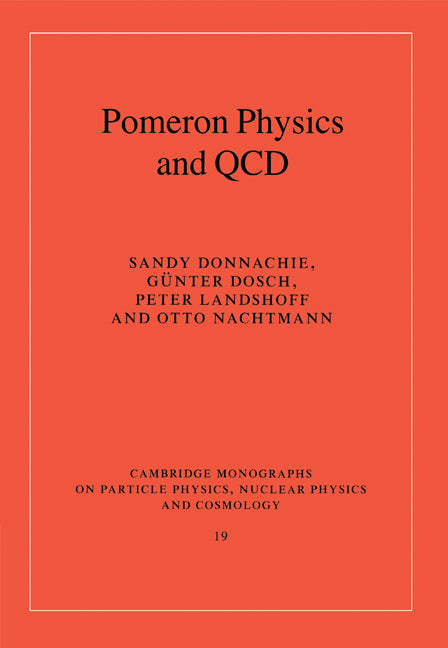
Pomeron Physics and QCD
This book describes the underlying ideas and modern developments of Regge theory, covering phenomenology, theory and experiment.
Sandy Donnachie (Author), Günter Dosch (Author), Peter Landshoff (Author), Otto Nachtmann (Author)
9780521675703, Cambridge University Press
Paperback, published 14 July 2005
360 pages, 159 b/w illus. 3 tables
24.4 x 17 x 1.9 cm, 0.57 kg
'The authors have considerable expertize and experience, which they particularly bring to bear when presenting their ideas on the use of non-perturbative techniques to study the pomeron. They are also the principal advocates of the idea that there may be two pomerons, with one pomeron dominant in soft interactions and the other dominant in hard interactions … such a well written and accessible book as this is most welcome. … high-energy processes. … provides an excellent introduction to the subject.' Cern Courier
This book describes the underlying ideas and modern developments of Regge theory, confronting the theory with quantum chromodynamics and a huge variety of experimental data. It covers forty years of research and provides a unique insight into the theory and its phenomenological development. The authors review experiments that suggest the existence of a soft pomeron, and give a detailed discussion of attempts at describing this through nonperturbative quantum chromodynamics. They suggest that a second, hard pomeron is responsible for the dramatic rise in energy observed in deep inelastic lepton scattering. The two-pomeron hypothesis is applied to a variety of interactions and is compared and contrasted with perturbative quantum chromodynamics, as well as with the dipole approach. This book will provide a valuable reference for experimental particle physicists all over the world. It is also suitable for graduate courses in particle physics, high-energy scattering, QCD and the standard model.
1. Properties of the S-matrix
2. Regge poles
3. Introduction to soft hadronic processes
4. Duality
5. Photon-induced processes
6. QCD: perturbative and nonperturbative
7. Hard processes
8. Soft diffraction and vacuum structure
9. The dipole approach
10. Questions for the future
Appendix A. Sommerfeld-Watson transform
Appendix B. The Group SU(3)
Appendix C. Feynman rules of QCD
Appendix D. Pion-nucleon amplitudes
Appendix E. The density matrix of vector mesons.
Subject Areas: Particle & high-energy physics [PHP]