Freshly Printed - allow 7 days lead
Couldn't load pickup availability
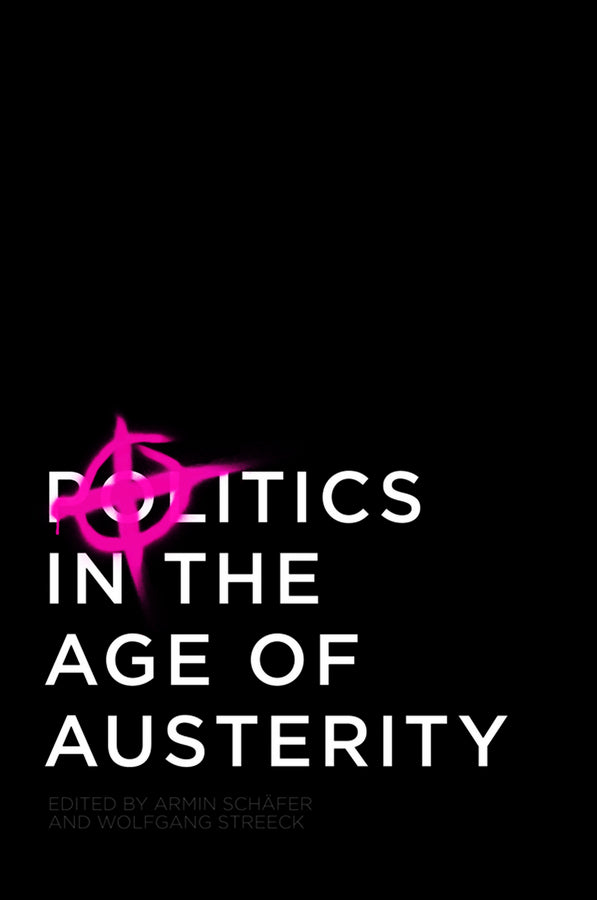
Politics in the Age of Austerity
Wolfgang Streeck (Edited by), Armin Schäfer (Edited by)
9780745661681, Polity Press
Hardback, published 29 March 2013
240 pages
23.6 x 16 x 2.9 cm, 0.612 kg
"Poses (very well) the questions that will shape our world for many years to come."
European Voice
"Nothing less than a novel, comprehensive and syncretic analysis of what has changed in the relationship between capitalism and democracy over the past thirty years - and into the future."
Philippe C. Schmitter, European University Institute
"Insightful and engaging, the essays in this volume cover a remarkably wide range of topics related to the fundamental question of our time: what happens to democracy when governments have so little fiscal room to manoeuvre? A great read that will inspire new thinking and research."
Jonus Pontusson, University of Geneva
"Politics in the Age of Austerity is a hugely important contribution to the contemporary literature on the political economy of the advanced capitalist countries. Featuring a series of penetrating essays by some of the field’s foremost theorists, the book offers a powerful – and sobering – picture of the dilemmas and constraints that governments face as they seek to reconcile the increasingly conflicting demands of two constituencies – voters and 'the markets'. As such, it sheds new light on the enduring question of the evolving relationship between democracy and capitalism."
Kathleen Thelen, MIT
In a world of increasing austerity measures, democratic politics comes under pressure. With the need to consolidate budgets and to accommodate financial markets, the responsiveness of governments to voters declines. However, democracy depends on choice. Citizens must be able to influence the course of government through elections and if a change in government cannot translate into different policies, democracy is incapacitated.
Many mature democracies are approaching this situation as they confront fiscal crisis. For almost three decades, OECD countries have - in fits and starts - run deficits and accumulated debt. As a result, an ever smaller part of government revenue is available today for discretionary spending and social investment and whichever party comes into office will find its hands tied by past decisions. The current financial and fiscal crisis has exacerbated the long-term shrinking government discretion; projects for political change have lost credibility. Many citizens are aware of this situation: they turn away from party politics and stay at home on Election Day.
With contributions from leading scholars in the forefront of sociology, politics and economics, this timely book will be of great interest to students and scholars throughout the social sciences as well as general readers.
Contributors vii 1 Introduction: Politics in the Age of Austerity 1 2 Public Finance and the Decline of State Capacity in Democratic Capitalism 26 3 Tax Competition and Fiscal Democracy 59 4 Governing as an Engineering Problem: The Political Economy of Swedish Success 84 5 Monetary Union, Fiscal Crisis and the Disabling of Democratic Accountability 108 6 Smaghi versus the Parties: Representative Government and Institutional Constraints 143 7 Liberalization, Inequality and Democracy’s Discontent 169 8 Participatory Inequality in the Austerity State: A Supply-Side Approach 196 9 From Markets versus States to Corporations versus Civil Society? 219 10 The Normalization of the Right in Post-Security Europe 239 11 The Crisis in Context: Democratic Capitalism and its Contradictions 262 Notes 287 Index 303
Armin Schäfer and Wolfgang Streeck
Wolfgang Streeck and Daniel Mertens
Philipp Genschel and Peter Schwarz
Sven Steinmo
Fritz W. Scharpf
Peter Mair
Armin Schäfer
Claus Offe
Colin Crouch
Mabel Berezin
Wolfgang Streeck
Subject Areas: Economics [KC]