Freshly Printed - allow 10 days lead
Couldn't load pickup availability
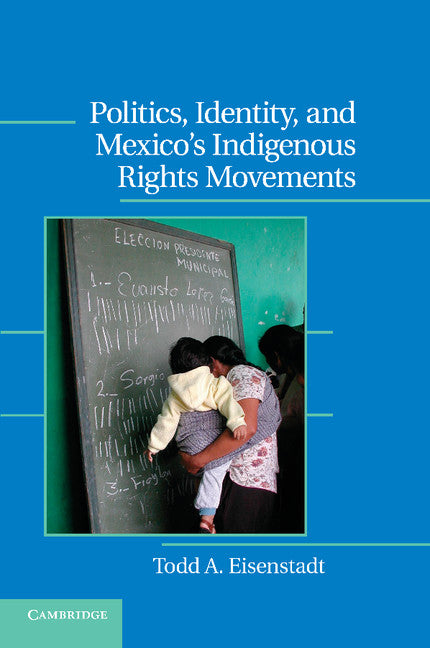
Politics, Identity, and Mexico’s Indigenous Rights Movements
Argues that indigenous and non-indigenous individuals in southern Mexico have been united by socioeconomic and land tenure institution variables as well as by ethnic identity.
Todd A. Eisenstadt (Author)
9781107696761, Cambridge University Press
Paperback / softback, published 22 August 2013
226 pages, 6 maps 10 tables
22.9 x 15.2 x 1.3 cm, 0.34 kg
'… it presents not only a detailed comparative analysis of the origins and developments of these two movements, but also a comparison between the political, social and economic conditions that influenced the way in which claims for indigenous rights were presented by each movement.' Latin American Studies
Drawing on an original survey of more than 5,000 respondents, this book argues that, contrary to claims by the 1994 Zapatista insurgency, indigenous and non-indigenous respondents in southern Mexico have been united by socioeconomic conditions and land tenure institutions as well as by ethnic identity. It concludes that - contrary to many analyses of Chiapas's 1994 indigenous rebellion - external influences can trump ideology in framing social movements. Rural Chiapas's prevalent communitarian attitudes resulted partly from external land tenure institutions, rather than from indigenous identities alone. The book further points to recent indigenous rights movements in neighboring Oaxaca, Mexico, as examples of bottom-up multicultural institutions that might be emulated in Mexico and elsewhere in Latin America.
1. Indians by choice?: traditional societies, indigenous rights movements, and the state in post-Zapatista southern Mexico
2. A tale of two movements: the salience of indigenous rights in Chiapas 1994 but not in Oaxaca 2006
3. Agrarian tenure institutions, conflict frames, and communitarian identities in indigenous southern Mexico
4. Agrarian conflicts, armed rebellion, and the individual versus collective rights tension in Chiapas' Lacandon jungle
5. Individual rights and communal elections in Oaxaca, Mexico: a challenge to multiculturalism and women's rights
6. From balaclavas to baseball caps: wearing many hats in the exercise of 'real world' identities
7. Reconciling individual rights, communal rights, and autonomy institutions: broader lessons from Chiapas and the 'Oaxaca experiment'.
Subject Areas: Comparative politics [JPB], Politics & government [JP]