Special Order - allow 2+ weeks lead
Couldn't load pickup availability
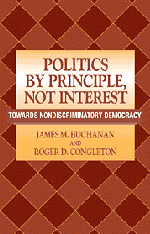
Politics by Principle, Not Interest
Towards Nondiscriminatory Democracy
This book focuses on the effects of applying a generality constraint on the political process.
James M. Buchanan (Author), Roger D. Congleton (Author)
9780521621878, Cambridge University Press
Hardback, published 28 April 1998
190 pages, 18 b/w illus. 2 tables
22.9 x 15.2 x 1.4 cm, 0.45 kg
"This book has more depth, breadth, and importance than some shelves full of work I have looked at. Buchanan and Congleton have managed, in a very short space, to make an argument that is both plausible and revolutionary. Politics by principle, not interest is a new benchmark in the application of public choice reasoning to political theory." Michael C. Munger, Public Choice
The very logic of majority rule implies unequal treatment or discrimination. If left unconstrained, majority coalitions will promote the interests of their own members at the expense of other persons. This book focuses on the effects of applying a generality constraint on the political process. Under this requirement, majorities would be constitutionally prohibited from treating different persons and groups differently. The generality principle is familiar in that all persons are to be treated equally. In summary, this book extends the generality norm to politics. Several defences of equal treatment or generality are developed and applied. These include the familiar intuition that invokes fairness. But the primary argument here is centred on political efficiency, which is increased when governments are constrained to treat persons or groups generally rather than differentially. The political efficiency defence of the generality constraint is based on a public choice analysis of the implication of majoritarian discrimination.
List of figures and tables
Preface
Acknowledgements
Part I. Introduction: 1. Generality, law, and politics
Part II. Analysis: 2. Majoritarian democracy
3. Eliminating the off-diagonals
4. Extending the argument
5. Generality and the political agenda
Part III. Application: 6. Generality and externality
7. Market restriction and the generality norm
8. The political efficiency of general taxation
9. Deficit financing and intertemporal discrimination
10. Generality and the supply of public services
11. Generality and redistribution
12. Generality without uniformity: social insurance
13. Generality without uniformity: federalism
Part IV. Prospect: 14. The political shape of constitutional order
Endnotes
References
Index.
Subject Areas: Political economy [KCP]