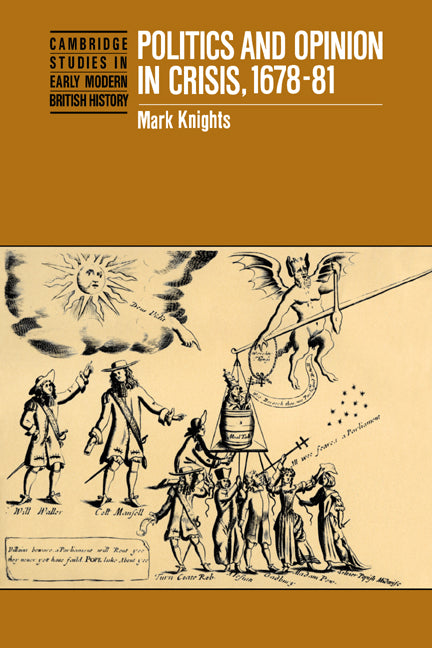
Freshly Printed - allow 10 days lead
Couldn't load pickup availability
Politics and Opinion in Crisis, 1678–81
A reassessment of the succession crisis (1678–81) and the political crisis it provoked.
Mark Knights (Author)
9780521024396, Cambridge University Press
Paperback / softback, published 9 March 2006
444 pages, 5 b/w illus.
22.9 x 15.3 x 2.6 cm, 0.678 kg
The aftermath of the Popish Plot and the subsequent succession crisis of the years 1678 to 1681 are the context for this new study. It asks two key questions: was there an exclusion crisis? and did these years witness the birth of modern political parties? The author argues that the unrest was not simply due to a centrally organized party machine based around the single issue of exclusion; but was a broad-based controversy about the succession, fears of popery and arbitrary government which produced ideological polarization and political sophistication. Part One examines central politics to explore the succession crisis within the context of the court and an emergent political structure. Part Two explores public opinion in the country as a whole, and argues that propaganda electioneering, religious conflict and petitions committed men to organized networks of belief.
Acknowledgments
List of abbreviations
Part One. 'A Great Crisis in Politics': 1. Introduction
2. Politics and the succession 1678–9
3. 'A King at Chess': politics and the succession between parliaments, May 1679–Ocotober 1680
4. Politics and the succession 1680–1
5. The structure of politics
Part II. Public Opinion, 1679–81: The Succession, Popery and Arbitary Government: 6. 'This outrageous liberty of the press'
7. Public opinion in 1679
8. 'The popular humour of petitioning': public opinion 1679–80
9. Petitioners, abhorrers and addressers: public opinion February 1680–February 1681
10. 'The scene begins to turne': propaganda and ideology in 1681
11. Conclusion
Bibliography
Index.
Subject Areas: Early modern history: c 1450/1500 to c 1700 [HBLH], British & Irish history [HBJD1]