Freshly Printed - allow 10 days lead
Couldn't load pickup availability
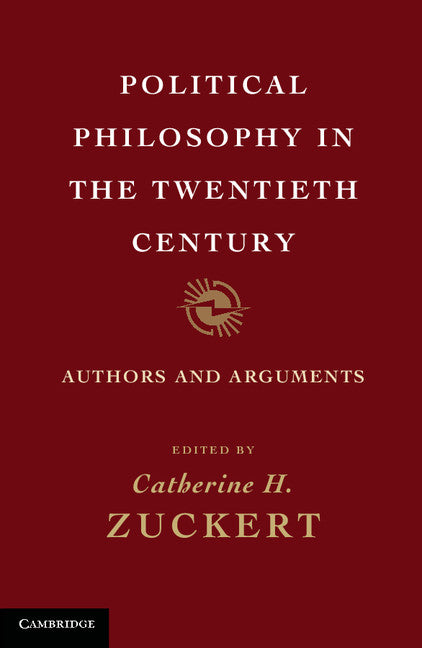
Political Philosophy in the Twentieth Century
Authors and Arguments
Well-known scholars present the arguments of individual political philosophers they know and admire.
Catherine H. Zuckert (Edited by)
9780521185066, Cambridge University Press
Paperback / softback, published 29 August 2011
292 pages
22.8 x 15.2 x 1.6 cm, 0.39 kg
'This collection of essays provides an overview of the work and lives of eighteen thinkers who made significant contributions to the development of political philosophy in the last century...Zuckert's volume deserves a wide readership to help us acquire a better sense of the discipline's past, keeping the post-Rawlsian achievement in perspective.' Philosophy in Review
This book demonstrates the rich diversity and depth of political philosophy in the twentieth century. Catherine H. Zuckert has compiled a collection of essays recounting the lives of political theorists, connecting each biography with the theorist's life work and explaining the significance of the contribution to modern political thought. The essays are organized to highlight the major political alternatives and approaches. Beginning with essays on John Dewey, Carl Schmitt and Antonio Gramsci, representing the three main political alternatives - liberal, fascist and communist - at mid-century, the book proceeds to consider the lives and works of émigrés such as Hannah Arendt, Eric Voegelin, and Leo Strauss, who brought a continental perspective to the United States after World War II. The second half of the collection contains essays on recent defenders of liberalism, such as Friedrich Hayek, Isaiah Berlin and John Rawls and liberalism's many critics, including Michel Foucault, Jürgen Habermas and Alasdair MacIntyre.
Introduction Catherine H. Zuckert
Part I. The Three Basic Alternatives in the Early Twentieth Century: 1. John Dewey: philosophy as theory of education David Fott
2. Carl Schmitt political theology and the concept of the political Tracy B. Strong
3. Antonio Gramsci: liberation begins with critical thinking Joseph Buttigieg
Part II. Émigré Responses to World War II: 4. Philosophy as a way of life Steven B. Smith
5. The philosopher's vocation: the Voegelinian paradigm Ellis Sandoz
6. Yves R. Simon: a philosopher's quest for science and prudence Walter Nicgorski
7. Hannah Arendt: from philosophy to politics Dana R. Villa
Part III. The Revival of Liberal Political Philosophy: 8. Friedrich Hayek on the nature of social order and law Eric Mack
9. Michael Oakeshott: the philosophical skeptic in an impatient age Timothy Fuller
10. Moral pluralism and liberal democracy: Isaiah Berlin's heterodox liberalism William Galston
11. H. L. A. Hart: a twentieth-century Oxford political philosopher John M. Finnis
Part IV. Critiques of Liberalism: 12. John Rawls and the task of political philosophy Paul Weithman
13. Richard Rorty: liberalism, irony, and social hope Michael Bacon
14. Jean-Paul Sartre: 'in the soup' William Leon McBride
15. Michel Foucault: an ethical politics of care of self and others Alan Milchman and Alan Rosenberg
16. Jürgen Habermas: postwar German critical debates and the making of a theorist William E. Scheuerman
17. Alasdair MacIntyre on political thinking and the tasks of politics Arthur Madigan, SJ
18. Another philosopher-citizen: the political philosophy of Charles Taylor Ruth Abbey.
Subject Areas: Political science & theory [JPA], Social & political philosophy [HPS], Philosophy [HP]