Freshly Printed - allow 10 days lead
Couldn't load pickup availability
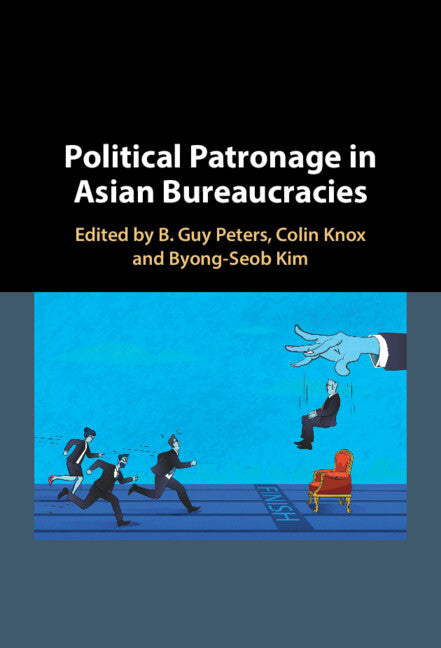
Political Patronage in Asian Bureaucracies
Explores how political actors engage in patronage practices across a rich variety of regime types in Asia.
B. Guy Peters (Edited by), Colin Knox (Edited by), Byeong Seob Kim (Edited by)
9781009208062, Cambridge University Press
Hardback, published 19 October 2023
360 pages
23.5 x 15.8 x 2.4 cm, 0.66 kg
'This collective volume is a formidable effort to systematically map and document patronage appointments in public bureaucracies of Asian countries. Drawing on a carefully defined analytical framework previously developed for the study of Latin American bureaucracies, the authors draw on a wide range of primary and secondary data to explore the motivations why political patrons make appointments, what roles patronage appointees play, and the reasons for these forms of patronage to emerge. Comparative lessons are drawn from exploring patronage patterns in a range of multi-party democracies, but also in one-party dominant and autocratic political systems.' Petr Kopecky, Professor of Comparative Studies Political Parties and Party Systems, Leiden University
Political patronage is defined as political actors appointing individuals at their discretion to key positions in the public sector. The book examines this practice in the bureaucracies of 11 Asian countries through the use of a typological framework of patronage types. The framework is based on two key criteria: basis of trust and the major role of political appointees. Several countries with well-developed civil service systems showed minimal levels of patronage (Japan, Singapore and South Korea). Two countries with a weak civil service showed very high levels of patronage appointments (Bangladesh and India). Sandwiched between those extremes are countries with formal civil service systems that are heavily influenced by political parties and by social ties to society (Vietnam, Kazakhstan, and China). The book concludes that not all patronage is the same and what is important is the tasks being performed by appointees and the nature of the trust relationship.
1. Patronage in Asian political systems: a framework for research B. Guy Peters
Part I. One-party Dominated Systems: 2. Governing the global city's mandarinate: politically motivated appointments in Singapore's public sector Assel Mussagulova and George Wong
3. Patronage and politicisation in the Indian administrative service Naresh Chandra Saxena
4. Political patronage, civil service politicisation and the ordeals of career civil servants: insights from Bangladesh Mohammad Mizanur Rahman
Part II. Two-party/Multi-party Systems: 5. Patronage appointment in Japanese politics: political representation in a large bureaucracy Masao Kikuchi
6. Patronage in Mongolia Oyunsuren Damdinsuren, Julian Dierkes and Byambakhand Luguusharav
7. Loyalty or expertise? The practice of political patronage in Taiwan Tong-yi Huang and Zong-xian Huang
8. Patronage in South Korea Min Han Kim, Byongseob Kim and Hyejin Kang
9. Patronage appointments in the Philippine public service Maria Fe Villamejor-Mendoza
Part III. Autocracies: 10. Varieties of patronage in a single party state: ministers in China Jiangnan Zhu, Siqin Kang and Yaowensong Song
11. Party patronage in Kazakhstan Colin Knox and Saltanat Janenova
12. Political patronage in Vietnam Minh-Quang Le, Chi-Kien Phung and Quang-Minh Le
13. Conclusions Colin Knox and B. Guy Peters
Index.
Subject Areas: Political economy [KCP], Political corruption [JPZ], Public administration [JPP], Comparative politics [JPB], Politics & government [JP]