Freshly Printed - allow 8 days lead
Couldn't load pickup availability
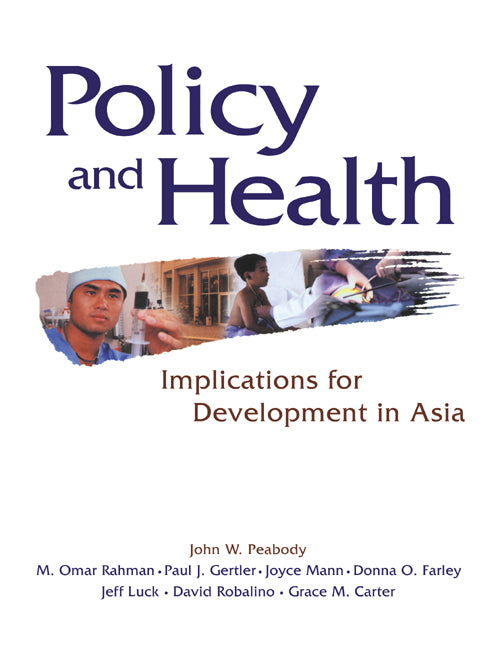
Policy and Health
Implications for Development in Asia
This volume provides a comprehensive look at how policy leads to better health in Asia.
John W. Peabody (Edited by), M. Omar Rahman (Edited by), Paul J. Gertler (Edited by), Joyce Mann (Edited by), Donna O. Farley (Edited by), Jeff Luck (Edited by)
9780521619905, Cambridge University Press
Paperback, published 17 February 2005
464 pages, 35 b/w illus. 59 tables
24.6 x 18.9 x 2.4 cm, 0.82 kg
'The clear thinking and thoughtful writing in Policy and Health: Implications for Development in Asia simultaneously tell how much can be accomplished and how much there is to learn. This book never loses its focus or its scientific rigor. Drawing on experience in Asia, policymakers and accomplished scholars alike will find this essential reading - it is perhaps one of the most comprehensive references for health sector policy I have ever seen.' Dr. Margaret Chan, Director of Health, Hong Kong Special Administrative Region
This rich volume provides a comprehensive look at how policy leads to better health in Asia. Leading RAND thinkers, working in different disciplines, create an all-encompassing framework for students, scholars, and policymakers, clarifying what is known and still needs to be known about how policy and practice lead to better health outcomes in developing countries. Drawing on their broad experience, the authors explore the health effects of macroeconomic development, education, and technology. After making compelling arguments about the need for policymakers to use and demand evidence-based policy, they investigate the epidemiology of persistent infectious diseases and the rapid ascendancy of chronic diseases in the elderly, showing how effectively appropriate clinical medicine addresses illness and promotes well-being. Emphasis is placed on examining equity-improving solutions to ascertain how and where they have helped the poor, women, and other vulnerable populations. The book concludes with a discussion of politics, priorities, the private sector, and what role health departments should play to translate policy objectives into better health.
Foreword by Dean T. Jamison
Preface
Tables
Figures
Boxes
1. Overview: the role and responsibility of governments in the health sector
2. Evidence-based policy: using data to inform policy and improve health outcomes
3. Prioritizing medical interventions: defining burden of disease and cost-effective interventions in the pursuit of universal primary care
4. Financing and allocating public expenditures: leveraging public resources to meet objectives and increase private participation
5. Toward better equity and access: persistent poverty, inadequate interventions, and the need for better data and solutions
6. Government and the improvement of health behaviors
7. Implementing policy objectives: the role and responsibilities of the ministry of health
Acronyms
Data Notes and Glossary - Chapter Two
References
Authors
Index.
Subject Areas: Political science & theory [JPA]