Freshly Printed - allow 7 days lead
Couldn't load pickup availability
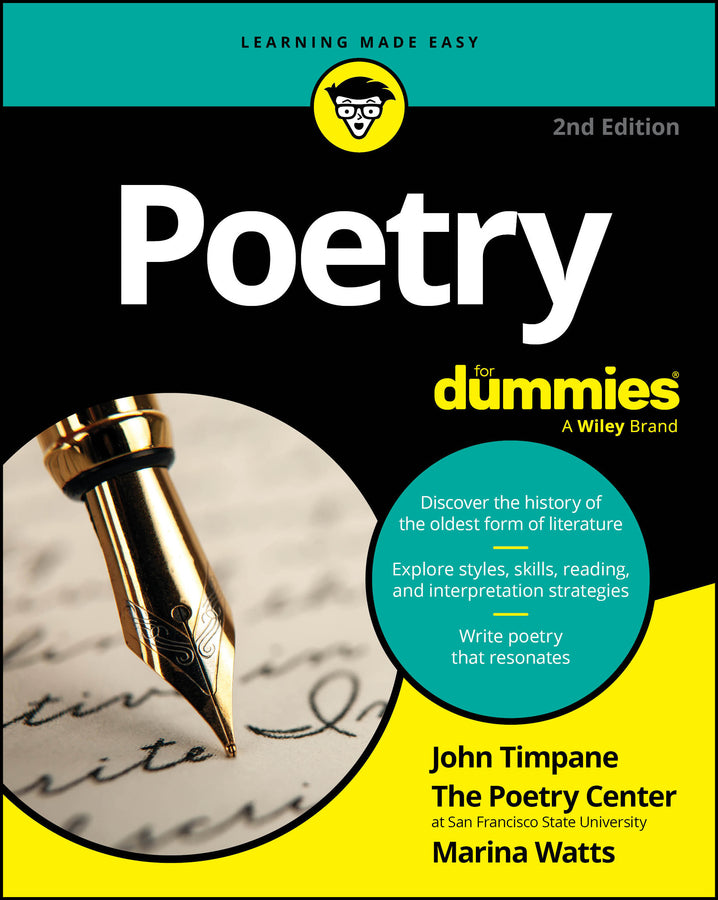
Poetry For Dummies
John Timpane (Author), (Author), Marina Watts (Author)
9781394375554, Wiley
Paperback / softback, published 7 May 2026
352 pages
23.4 x 18.8 x 2.5 cm, 0.499 kg
Explore the mystique, power, and beauty of poetry with this easy-to-read guide Poetry For Dummies, 2nd Edition is an easy-to-follow and insightful guide to poetry designed to unlock your innate ability to understand and appreciate this powerful art form. The authors offer clear discussions of the fundamentals of poetry – including common poetic techniques, key styles of poetry, and effective interpretation strategies – and useful tools and exercises you can use today to improve the ways you write and read poetry. You’ll explore the rich history of poetry and find out what genres and styles of this oldest form of literature speak directly to you. You’ll also discover how to understand the themes, metaphors, and meanings that animate all sorts of poetry and help you uncover new depths of substance in your favorite writings. Inside: An eye-opening and exciting guide for anyone interested in poetry, Poetry For Dummies, 2nd Edition is also a must-read for aspiring poets, practicing writers, people who already love poetry, and English teachers everywhere.
Introduction 1 About This Book 2 Icons Used in This Book 3 Beyond the Book 4 Where to Go from Here 4 Part 1: Reading and Understanding Poetry 5 Chapter 1: Knowing Poetry When You See It 7 Poetry as Art and Exploration 8 Why Do People Write Poetry? 9 Creating an intense emotional experience 10 Drawing attention to something real 12 Bringing Poetry into Your Life 13 Online is just fine 13 Checking out libraries 15 Browsing through bookstores 16 Attending readings 17 Writing Poetry 18 Becoming a poet 18 Keeping a poetry journal 19 Chapter 2: Reading Poetry Aloud 21 Why You Should Read Poems Aloud 21 Good Habits for Good Reading 23 Having the right tools handy 23 Reading silently first 24 Noting surprises and unfamiliar words 24 Finding an engaged, conversational tone 25 Resisting the urge to rush 25 Pausing for power 27 Paying attention to line-endings 28 Treating white space as time 29 Doing it more than once 31 Chapter 3: Identifying Subject, Tone, and Narrative 33 Understanding Subject and Tone 34 Subject: A natural starting point 34 Tone: It’s got attitude 35 Reading for subject and tone 38 Figuring Out a Poem’s Narrative 39 Speaker: The person we’re listening to 39 Setting: Knowing where you are 41 Situation: Circumstances and their victims 42 Plot: What goes on 42 Character: What kind of person would do a thing like that? 42 Chapter 4: Tuning in to Language 45 Understanding Figurative Language 46 Opening the Poet’s Figurative Toolbox 48 Symbols: When A stands for B, which brings in C 48 Similes: My love is like a can of tuna 52 Metaphors: My love is a can of tuna 53 Allusions: If you know, you know 55 Music: What You Hear, Feel, and See 56 Orchestrating sound 57 Recognizing the varieties of rhyme 59 Feeling rhythm and measuring meter 61 Shape and flow: Visual rhythm 65 Chapter 5: Practicing the Art of Interpretation 67 Reading for Discovery 68 Sense: Getting direct and literal 68 Music: Sounds and rhythms that lead to meaning 73 Speculating as You Read 77 Mastering Speculation 78 Understanding the literal 79 Getting at what’s implied 80 Speculating about what’s implied 80 Searching for the Subject 81 Tuning In to Tone 82 Being Alive to Language 83 Following the Music 83 Considering Narrative Elements 85 Interpreting “The Knot” by Susan Stewart 87 Part 2: An Intelligent Hustle Through Poetic History 89 Chapter 6: Connecting with Poems from the Past 91 Gathering the Tools You Need 92 Understanding Older Poetry 93 Meeting the poet 93 Discovering the poet’s life and times 95 Mastering unfamiliar language 98 Reading Older Poetry: Three Basics 102 Chapter 7: From Enheduanna to the Golden Ages 105 The Pre-Homeric Period (3000 bc–1000 bc) 106 Mesopotamian poetry 106 Egyptian poetry 107 The beginnings of poetry in India 107 The Biblical and Homeric Periods (1000 bc–400 bc) 110 Biblical poetry 110 Homeric poetry 111 The beginnings of Chinese poetry 113 The Archaic and Classical Periods (750 bc–ad 476) 113 Greek poetry 113 Latin poetry 115 Late Antiquity and Golden Ages (ad 476–1000) 116 The Manyoshu and Japanese poetry 116 The poetry of India 117 Arabic poetry 117 China: The T’ang Dynasty 118 Old English 119 Chapter 8: The Middle Ages through the 18th Century 121 Poetry of the Middle Ages (1000–1450) 122 Arabic and Persian verse — and the Rūmī supernova 123 Chinese and Japanese poetry 126 The European Renaissance (1450–1674) 127 The English Renaissance 127 Poetry on three continents 127 The 18th Century 129 Reason, science, and a changing world: The English Enlightenment 129 Japan: The haiku tradition continues 130 Chapter 9: Poetry During the Industrial Revolution 131 The Romantic Period 131 The Victorian Period 134 The Symbolist movement 135 American poetry: Whitman and Dickinson 136 Shiki and the New Style in Japan 138 Chapter 10: The Century of Poetry 139 The Modern Era (1901–1945) 140 Rabindranath Tagore 140 William Butler Yeats 141 Ezra Pound 142 Hilda Doolittle 143 Marianne Moore 143 T.S Eliot 144 Marina Tsvetaeva 145 André Breton 146 Pablo Neruda 146 Léopold Sédar Senghor 147 The Postmodern Era (1945–1989) 148 Poetry from the Spanish-speaking world 151 Women’s voices 153 Experimental poetry 154 Performance poetry 157 The Global Era (1989–2001) 160 Chapter 11: Poetry in the Digital Age. 163 New Voices and Viewpoints 164 Collaborative Poetry 165 Poetry and the Other Arts 166 Translation 166 New and Old Forms 167 Chill subs and Other Poetry Communities Online 169 Part 3: Writing Poetry and Finding Community 173 Chapter 12: Calling the Muse 175 How to Live If You Want to Be a Poet 176 Reading Like a Poet 176 Writing Like a Poet 177 Finding the right time and place to write 177 Recognizing the creative urge 179 Empty page, full imagination: Getting started 180 Keeping a journal (again!) 181 Moving from journal entry to poem 182 Choosing subjects 185 Rewriting until it hurts a lot better 186 From “City Bus” to “City Bus”: A case study in revision 187 Getting Connected to the World of Poetry 190 Chapter 13: Working with Traditional Forms of Verse 193 Ballads 194 Psalms 195 Sonnets 196 Ghazals 200 Haiku and Tanka 201 Chapter 14: Writing Open-Form Poetry 203 Working Toward a Definition 203 What open-form poetry is 205 What open-form poetry isn’t 206 Knowing What Makes It Poetry 206 Using Open Forms in Your Own Poetry 209 Going for the breath: Framing individual lines 209 Treating the page as a field 211 Chapter 15: Writing Exercises and Prompts for Poets 217 Making Your Journal Your Office 218 Trying a Journal Exercise 218 Spotting and Breaking Habits 220 Using Description 221 Unleashing Divergent Thinking 221 Mining descriptive texts to find your own way of writing 222 Experimenting with different forms 222 Starting with a prose essay 222 Rewriting well-known texts 222 Pulling from a grab-bag of ideas 223 Using techniques of chance and collage 223 Mistranslating (on purpose) 224 Thinking about transitions 225 Getting ideas by taking a walk 225 Using language from one subject to write about another 226 From Poems for the Writing: Three Prompts, Poems, and Processes 226 “The unanswerable letter”; Response by Karen Chase 226 “Bibliomancy”; Response by Luray Gross 228 “Fibonacci Poem”: Response by Don Riggs 231 Revising Your Poetry 232 Hiding half of your poem from sight 232 Reworking poems you don’t like 233 Collaborating with Other Writers 233 Chapter 16: Going Public 235 Starting a Reading or Writing Group 235 Getting started 236 Discovering ways to spend your meetings 236 Reading Your Poetry in Public 237 Readings for everybody 238 Open mics 242 Poetry slams 243 Participating in Your Local Poetry Community: Good Old Analog! 245 Being an Entrepreneurial Poet 248 Eyeballs and ears 248 The post-Pandemic poetry world 252 Finding Resources and Community 256 Chapter 17: Getting Published 259 Submitting Your Poetry to Lit Mags 260 Knowing when you’re ready 260 Following the Poetry For Dummies action plan for poetry market research 262 Submitting your poetry 271 Keeping a submissions journal 276 Pursuing Other Kinds of Publication 277 Collections and contests 278 Chapbooks, pamphlets, and broadsides 278 Self-publishing in print 279 Part 4: the Part of Tens 285 Chapter 18: Ten Poems Worth Memorizing 287 Chapter 19: Ten Love Poems 295 Part 5: Appendixes 303 Appendix A: Glossary 305 Appendix B: The Poetry For Dummies Reading List 315 The Pre-Homeric Period 316 The Biblical Period 316 The Archaic and Classical Periods 316 Late Antiquity and Golden Ages 317 The Middle Ages 317 The Renaissance 318 The Enlightenment and the Eighteenth Century 319 Romantic Poetry, the Victorian Period, Symbolism, and Whitman and Dickinson 319 The Modern Era 320 Postmodernism 320 The Global Era 321 The Digital Era 321 Modern and Contemporary Poetry 322 Permissions 323 Index 331
Subject Areas: Literature: history & criticism [DS]