Freshly Printed - allow 10 days lead
Couldn't load pickup availability
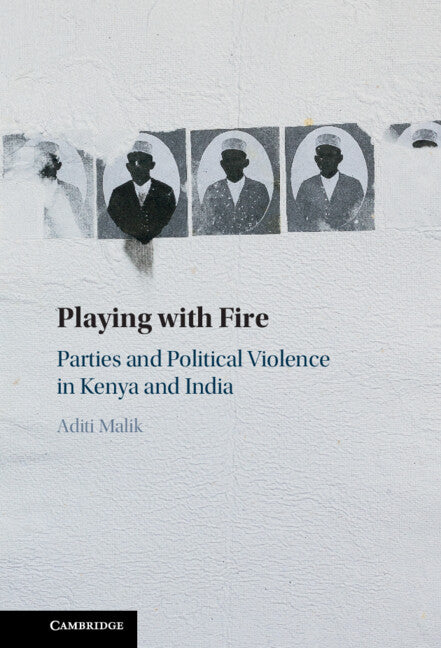
Playing with Fire
Parties and Political Violence in Kenya and India
Combines data from Kenya and India to show how party instability can impact elites' decisions to organize party violence.
Aditi Malik (Author)
9781009444231, Cambridge University Press
Hardback, published 27 June 2024
300 pages
22.9 x 15.2 x 1.9 cm, 0.617 kg
'Understanding party volatility is novel and useful for practitioners engaged in preventing and mitigating political violence … In this regard, Malik's book adds a new tool for preventing violence and opens the door for further research.' Dorina A. Bekoe, African Studies Review
Drawing on a rare cross-regional comparison of Kenya and India, Playing with Fire develops a novel explanation about ethnic party violence. Combining rich historical, qualitative, and quantitative data, the book demonstrates how levels of party instability can crucially inform the decisions of political elites to organize or support violence. Centrally, it shows that settings marked by unstable parties are more vulnerable to experiencing recurring and major episodes of party violence than those populated by durable parties. This is because transient parties enable politicians to disregard voters' future negative reactions to conflict. By contrast, stable party organizations compel politicians to take such costs into account, thereby dampening the potential for recurring and severe party violence. By centering political parties as key actors in the production of conflict, and bringing together evidence from both Africa and South Asia, Playing with Fire contributes new insights to the study of political violence.
List of Figures
List of Tables
List of Abbreviations
Acknowledgements
1. Parties and political violence
2. A theory of party instability and political violence
3. The development of divergent parties and party systems in Kenya and India
4. Party instability and political violence in Kenya
5. Party fragility and subnational patterns of violence in Kenya's rift valley and coast regions
6. Party stabilization, declining riot violence, and new modalities of political conflict in India
7. Party politics and subnational trajectories of riot violence in India's Hyderabad and Meerut cities
8. Party instability and political violence: comparative insights from Ghana and Turkey
9. Conclusion
Appendix A. National and subnational correlations between replacement volatility and alternative measures of party instability
Appendix B. Elite interviews
Appendix C. The development of civil society in Kenya and India
References
Datasets.
Subject Areas: Comparative politics [JPB]