Freshly Printed - allow 10 days lead
Couldn't load pickup availability
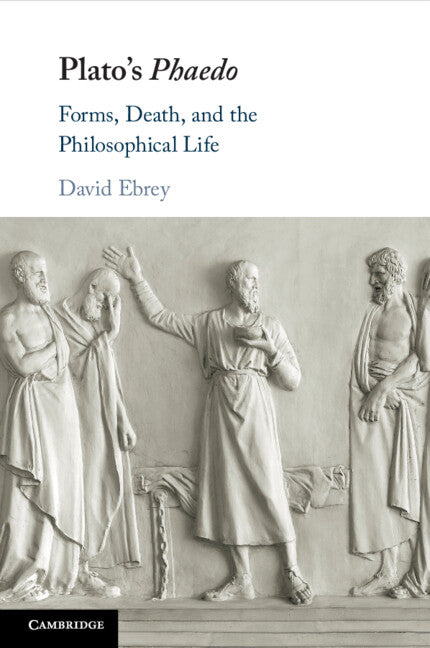
Plato's Phaedo
Forms, Death, and the Philosophical Life
A comprehensive book on Plato's Phaedo that reinterprets many famous Platonic ideas, in part by situating them in their context.
David Ebrey (Author)
9781108790994, Cambridge University Press
Paperback / softback, published 12 September 2024
362 pages
22.9 x 15.2 x 1.9 cm, 0.523 kg
'This book makes several important contributions to the scholarship on Plato's Phaedo.… [It] book will be read by scholars as a commentary on the entire dialogue, since no passage is left unanalyzed. In this spirit, I enthusiastically recommend the book to anyone interested in the Phaedo.' Douglas R. Campbell, Journal of the History of Philosophy
Plato's Phaedo is a literary gem that develops many of his most famous ideas. David Ebrey's careful reinterpretation argues that the many debates about the dialogue cannot be resolved so long as we consider its passages in relative isolation from one another, separated from their intellectual background. His book shows how Plato responds to his literary, religious, scientific, and philosophical context, and argues that we can only understand the dialogue's central ideas and arguments in light of its overall structure. This approach yields new interpretations of the dialogue's key ideas, including the nature and existence of 'Platonic' forms, the existence of the soul after death, the method of hypothesis, and the contemplative ethical ideal. Moreover, this comprehensive approach shows how the characters play an integral role in the Phaedo's development and how its literary structure complements Socrates' views while making its own distinctive contribution to the dialogue's drama and ideas.
1. The Characters
2. The Phaedo as an Alternative to Tragedy and Socrates as a Poet: 57a–61c
3. Defense of the Desire to be Dead: 61c–69e
4. Cebes' Challenge and the Cyclical Argument: 69e–72d
5. The Recollecting Argument: 72e–77d
6. The Kinship Argument: 77d–80d
7. The Return to the Defense: 80d–84b
8. Misology and the Soul as a Harmonia: 84c–86e, 88c–95a
9. Socrates' Autobiography: 95e–102a
10. Cebes' Objection and the Final Argument: 86e–88b, 102b–107b
11. The Cosmos and the Afterlife: 107c–115a
12. The Death Scene: 115a–118a.
Subject Areas: Philosophy of science [PDA], Philosophy of religion [HRAB], Ethics & moral philosophy [HPQ], Philosophy: metaphysics & ontology [HPJ], Western philosophy: Ancient, to c 500 [HPCA]