Freshly Printed - allow 7 days lead
Couldn't load pickup availability
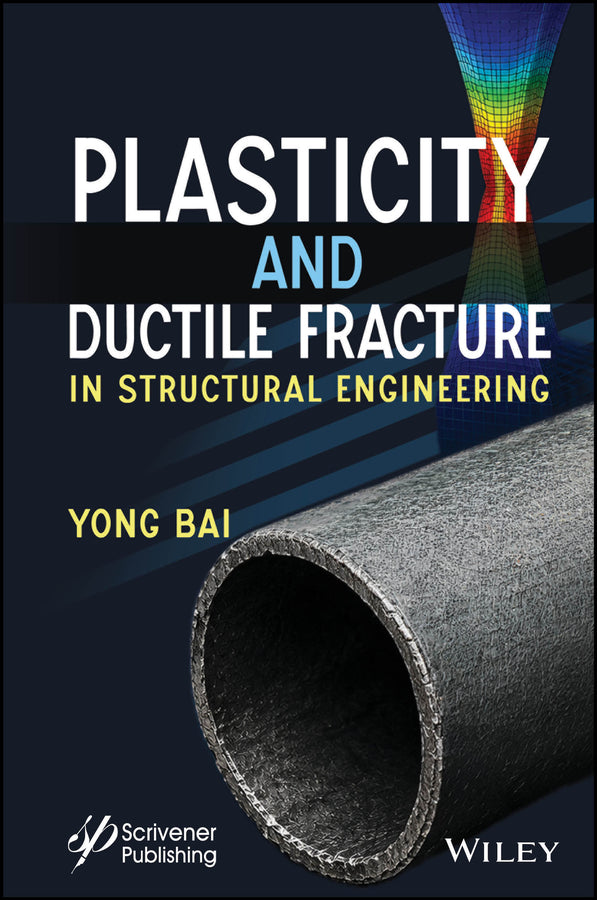
Plasticity and Ductile Fracture in Structural Engineering
Yong Bai (Author)
9781394434442, Wiley
Hardback, published 14 July 2026
464 pages
25 x 15 x 1.5 cm, 0.666 kg
Master the critical intersection of plasticity and ductile fracture with this comprehensive guide, which combines decades of global expertise and advanced numerical methods to ensure the structural safety and performance of metal designs. Plasticity and ductile fracture are two of the most critical subjects in the structural and mechanical behavior of materials, particularly for engineers involved in the design and safety assessment of metal structures. This book offers a unified and comprehensive treatment of both topics by integrating theoretical foundations, constitutive modeling, and practical case studies using advanced numerical methods. Starting with classical theories of plasticity, including stress tensors, yield criteria, hardening models, and constitutive equations, the text builds toward modern applications, including finite element formulations and real-world structural performance analysis. The text draws from the author’s extensive experience across China, Japan, Norway, and the U.S., making it a rich resource for graduate students, academic researchers, and practicing engineers in the structural, offshore, and mechanical engineering disciplines.
Preface xiii 1 Stress and Strain 1 2 Yielding Conditions 35 3 Constitutive Equations 65 4 Cyclic Loading and Shakedown 83 5 Some Application Problems 97 6 Plasticity in Finite Element Analysis 133 7 Plasticity in Total Force Model 173 8 Metal Forming Processing Plasticity 207 9 Mechanical Behavior of Thin Cylindrical Shells Under Combined Axial Compression and Bending 261 10 Characterization of Ductile Fracture Criterion for API X80 Pipeline Steel Based on a Phenomenological Approach 281 11 Fracture Response of Steel Pipelines Under Combined Tension and Torsion 317 12 Fracture Response of Steel Pipelines Under Combined Tension and Bending 339 13 Mechanical Behavior of Pipes with Crack under Combined Tension and Internal Pressure 373 14 The Hoop Stress Failure Analysis of Defective X80 Steel Pipes 399 15 Fracture Study of X80 Steel Based on Phase Field Method 427 References 438
Acknowledgement xv
1.2 Tension and Compression 13
1.3 Stress Tensor and Deviatoric Stress Tensor 17
1.4 Stress Space, π Plane, and Lode Parameters 25
1.5 Deviatoric Strain and Equivalent Strain 30
2.1 Introduction 35
2.2 Yield Locus 37
2.3 Yield Surface 38
2.4 Yield Criterion 43
2.5 Common Yielding Conditions 49
2.6 Hardening Rule 54
2.7 Loading and Unloading of Hardening Materials 57
2.8 Plastic Deformation 58
2.9 The Normality Rule 62
3.1 Introduction 65
3.2 The Total Strain Theory 66
3.3 The Flow Rules 69
3.4 Drucker's Stability Postulate 70
3.5 The Loading Criterion 72
3.6 Incremental Stress–Strain Relationships 73
4.1 Introduction 83
4.2 Cycling Loading 84
4.3 Shakedown Theorem 88
5.1 Torsion in Thin-Walled Tubes 97
5.2 Combined Tension and Torsion 102
5.3 Combined Tension, Torsion, and Bending 104
5.4 Bending in Thin-Walled Tubes 105
5.5 Combined Tension and Torsion in a Thin-Walled Tube 109
5.6 Bending in Rectangular Cross-Section 112
5.7 Internal Pressure in Thick-Walled Tubes 116
5.8 Identification Problems 122
6.1 Introduction 133
6.2 Elastic Materials 135
6.3 Thermo-Elastic Materials 144
6.4 Hypoelastic Materials 147
6.5 Hyperelastic Materials 150
6.6 Viscoelastic Materials 154
6.7 Elastic–Plastic Materials 156
6.8 Hypoelastic–Plastic Materials 160
6.9 Hyperelastic–Plastic Materials 164
6.10 Viscoplastic Materials 165
6.11 Plastic Materials 168
7.1 Introduction 173
7.2 Elastic Beam-Column with Large Displacements 175
7.3 The Plastic Node Method 177
7.4 Transformation Matrix 187
7.5 Stress-Based Plasticity Constitutive Equations 189
7.6 Deformation Matrix 204
8.1 Introduction 207
8.2 Classification 208
8.3 Forming Processes 209
8.4 Sheet Metal Formability 216
8.5 Anisotropy of Sheet Metal 228
8.6 Metal Forming in the Carcass Layer of Flexible Pipes 236
8.7 Metal Forming Effect on Residual Stress of the Carcass Layer in Flexible Pipes 242
9.1 Introduction 261
9.2 Experiments 263
9.3 Numerical Studies 268
9.4 Validation 273
9.5 Buckling Behavior of Thin Tubes Under Combined Loads 275
9.6 Conclusions 278
10.1 Introduction 281
10.2 Overview of Damage Model 284
10.3 Experimental Programs 289
10.4 Calibration Procedure 295
10.5 Comparison with Notched Tensile Specimen Test 303
10.6 Validation through CT Test 307
10.7 Conclusions 312
11.1 Introduction 317
11.2 Theoretical Equations 320
11.3 Finite Element Procedure 322
11.4 Results 325
11.5 Parametric Studies 329
11.6 Conclusions 334
12.1 Introduction 339
12.2 Finite Element Procedure 342
12.3 Results 346
12.4 Parametric Studies 351
12.5 Theoretical Models 356
12.6 Conclusions 368
13.1 Introduction 373
13.2 Finite Element Procedure 376
13.3 Results 380
13.4 Parametric Studies 382
13.5 Theoretical Solutions 384
13.6 Analyzing a 21-Inch X80 Steel Pipe 388
13.7 Conclusions 394
14.1 Introduction 399
14.2 Damage Mechanics Models 402
14.3 The Pipe Model 403
14.4 Parametric Studies 414
14.5 Conclusions 422
Bibliography 423
15.1 Introduction 427
15.2 Experiments 429
15.3 Finite Element Model 432
15.4 Conclusions 437
Index 441
Subject Areas: Mechanical engineering & materials [TG]