Freshly Printed - allow 7 days lead
Couldn't load pickup availability
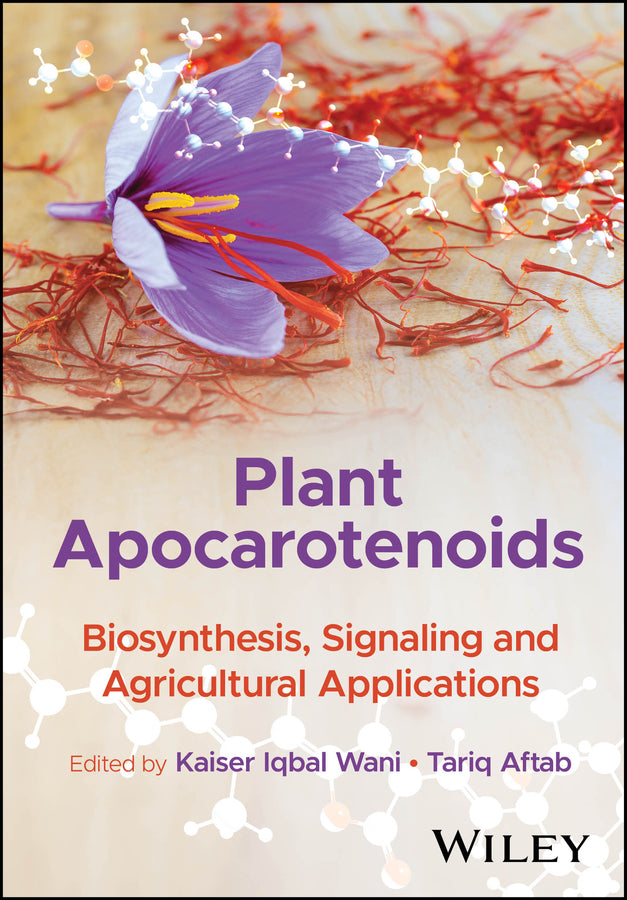
Plant Apocarotenoids
Biosynthesis, Signaling and Agricultural Applications
Kaiser Iqbal Wani (Edited by), Tariq Aftab (Edited by)
9781394332601, Wiley
Hardback, published 16 April 2026
336 pages
24.4 x 17 x 1.9 cm, 0.765 kg
Apocarotenoids are emerging as central players in plant biology, offering profound insights into growth regulation, stress responses, and developmental processes. Derived from carotenoids through oxidative cleavage, these compounds serve as key signaling molecules with far-reaching implications for plant physiology and crop improvement. Recent advancements in molecular biology, genetic engineering, and synthetic biology have accelerated research in this domain, making apocarotenoids a critical area of study for plant scientists, agricultural biotechnologists, and crop physiologists. Yet, despite their importance, comprehensive resources that integrate biosynthesis, signaling, and applied agricultural aspects have remained limited. Plant Apocarotenoids: Biosynthesis, Signaling and Agricultural Applications provides an in-depth exploration of both fundamental and translational aspects of these bioactive molecules. Organized into five sections, the volume begins with the fundamentals of apocarotenoid biosynthesis and signaling mechanisms before delving into specific compounds such as strigolactones, zaxinone, β-cyclocitral, and β-ionone. Special emphasis is placed on saffron apocarotenoids, reflecting their unique biochemical pathways and relevance to biotechnology. Later sections examine apocarotenoids in plant defense, symbiotic interactions, and stress adaptation, while concluding chapters address their engineering for agricultural applications such as crop resilience, biofortification, and global food security. An authoritative resource that bridges basic science and applied outcomes, Plant Apocarotenoids: Biosynthesis, Signaling and Agricultural Applications: Equipping readers with the knowledge necessary to drive future innovations in sustainable agriculture. Plant Apocarotenoids: Biosynthesis, Signaling and Agricultural Applications is an essential reference for graduate students, researchers, and professionals in plant science, biochemistry, crop physiology, genetics, and agricultural biotechnology. It is particularly suited for advanced courses in Plant Biochemistry, Plant Biotechnology, and Crop Improvement within MSc and PhD programs in agricultural and biological sciences.
About the Editors xi Section I Introduction and Fundamentals 1 1 General Overview of Apocarotenoids 3 1.1 Introduction 3 2 Apocarotenoid Biosynthesis, Signaling, and Regulatory Mechanisms in Plants 15 2.1 Introduction 15 3 Carotenoid-derived Diapocarotenoids: From Pigments to Plant Growth Regulators 39 3.1 Introduction 39 4 Apocarotenoid Metabolism and Redox Signaling in Plants 53 4.1 Introduction 53 Section II Key Apocarotenoids and Their Roles 63 5 Strigolactones: Discovery, Biological Activity, Biosynthesis, and Applications 65 5.1 Introduction 65 6 Strigolactone Perception and Response Under Nitrogen and Phosphorus Deficiency 91 6.1 Introduction 91 7 Zaxinone, A Potential Plant Hormone: Biosynthesis, Signaling, and Applications 105 7.1 Introduction 105 8 Zaxinone Mimics: Potential Agricultural Applications for Global Food Security 115 8.1 Introduction 115 9 β-Cyclocitral: Signaling During Stress Acclimatization in Plants 127 9.1 Introduction 127 10 β-Ionone: A Key Apocarotenoid in Plants and Wine 141 10.1 Introduction 141 Section III Saffron Apocarotenoids: Special Focus 159 11 Saffron Apocarotenoids 161 11.1 Occurrence and Structure 161 12 Saffron Apocarotenoids: Insights into Evolution, Gene Regulation, and Genetic Engineering Approaches for Crop Improvement 173 12.1 Introduction 173 13 Cell Biofactories for the Sustainable Production of Saffron Apocarotenoids 189 13.1 Introduction 189 14 Engineering Crocin Production in Heterologous Host Plants 203 14.1 Introduction 203 Section IV Physiological Roles and Stress Responses 217 15 Apocarotenoids in Plant Biology: Defense Signaling and Lignin Interactions 219 15.1 Introduction 219 16 Role of Carotenoid Cleavage Dioxygenase-encoding Genes in Mitigating Stress in Plants 237 16.1 Introduction 237 17 Impact of AM Symbiosis on Apocarotenoid Production in Plants 257 17.1 Introduction 257 18 Metabolic Engineering of Apocarotenoids in Plants 277 18.1 Engineering Plants for the Production of Exotic Apocarotenoids 277 References 297
List of Contributors xiii
Preface xix
Anu Pandita and Deepu Pandita
1.2 Apocarotenoids Sources 4
1.3 Classification of Apocarotenoids 5
1.4 Structural Diversity of Apocarotenoids 6
1.5 Significance of Apocarotenoids 6
1.6 Conclusion 11
Sunil Kumar Verma, Devendra Singh, and Anshu Mishra
2.2 The Significance of Apocarotenoids and Their Functions 16
2.3 The Structural Diversity of Plant Apocarotenoids and Their Metabolic Basis 22
2.4 Molecular Regulation of Apocarotenoid Biosynthesis 24
2.5 Genetic Perspectives on Apocarotenoid Natural Variations 26
2.6 Conclusion and Prospects 28
Chao Guo, Weiqiang Li, Yuchen Miao, and Kun-Peng Jia
3.2 Nomenclature and Identification of Carotenoid-derived DIAPOs in Plants 40
3.3 Biosynthesis of Carotenoid-derived DIAPOs in Plants 42
3.4 Anchorene Regulates Root Development Through Modulating Auxin Homeostasis 46
3.5 Conclusion and Perspectives 47
Muhammad Aamir Manzoor, Irfan Ali Sabir, Iftikhar Hussain Shah, Muhammad Usman, Muhammad Azam, Ghulam Murtaza, Alam Sher, Muhammad Waheed Riaz, Zishan Ahmad, and Cheng Song
4.2 Redox Signaling in Plants 54
4.3 Interplay Between Apocarotenoid Metabolism and Redox Signaling 57
4.4 Conclusion and Future Perspectives 59
Peng Zhong, Jianhua Jia, Jiali Liu, and Xiaohui Yan
5.2 Discovery of SLs 66
5.3 Biological Activities of SLs 68
5.4 Biosynthesis of SLs 77
5.5 Conclusion and Future Perspectives 79
Ishrat Mehmood, Abdullah, Kaiser Iqbal Wani, Muhammad Aamir Manzoor, and Tariq Aftab
6.2 Biosynthesis and Signaling Pathways of SLs in Plants 92
6.3 SL-mediated Root Architecture Modulation Under N Deficiency 94
6.4 P-Starvation-induced SL Signaling and Root System Remodeling 95
6.5 Interplay of N and P Deficiencies in SL Regulation 96
6.6 SLs as Mediators of Crop Resilience and Soil Microbiome Dynamics 97
6.7 Emerging Applications and Future Directions in SL Research 98
6.8 Conclusion 100
Ishrat Mehmood, Kaiser Iqbal Wani, Abdullah, Muhammad Aamir Manzoor, and Tariq Aftab
7.2 Identification and Characterization of Zaxinone: A Novel Plant Growth Regulator 106
7.3 Zaxinone Biosynthesis: From Molecules to Plant Growth 107
7.4 Zaxinone: Decoding Nature's Hidden Messenger in Plant Health and Hormonal Harmony 109
7.5 Harnessing Zaxinone: Applications in Plant Growth, Stress Adaptation, and Symbiosis 110
7.6 Conclusion 111
Shamshad Ahmad Khan, Nauf Al Araimi, and Priyanka Verma
8.2 Apocarotenoids and Zaxinone Identification 116
8.3 Zaxinone Mimics 117
8.4 Role of MiZax in Rice 120
8.5 MiZax in Other Crops 123
8.6 MiZax and Striga Infestation 124
8.7 Prospects of Zaxinone and Its Mimics in Crop Improvement 124
Vinay Kumar Dhiman, Sudarshna, Vivek Kumar Dhiman, and Devendra Singh
9.2 β-Cyclocitral: Formation and Derivatives 128
9.3 β-Cyclocitral and Salicylic Acid Interplay 130
9.4 Could It Be a New Agricultural Tool? 131
9.5 β-Cyclocitral Signaling in Plants Under Abiotic Stress 131
9.6 JA-induced β-Cyclocitral and Protection Against Bacterial Blight in Rice 132
9.7 Role in Regulation of Root Architecture 132
9.8 β-Cyclocitral and Nonvascular Plants: Allelochemical Response 133
9.9 β-Cyclocitral and Herbivory 133
9.10 β-Cyclocitral Role in Metabolite Formation 134
9.11 Conclusion 134
Alice Vilela and Berta Gonçalves
10.2 Role in Plants 142
10.3 β-Ionone Signaling and Mycorrhization 144
10.4 Key Enzymes Involved in β-Ionone Synthesis 145
10.5 Heterologous Production of β-Ionone in Microbial Cell Factories 145
10.6 Industrial Applications of β-Ionone 150
10.7 β-Ionone in Wine 151
10.8 Final Remarks 152
Braulio Edgar Herrera Cabrera, Rafael Salgado Garciglia, Luis Germán López Valdez, Alejandra Hernández Garcia, Adriana Delgado Alvarado, Francisco Javier Verduzco Miramón, and Hebert Jair Barrales-Cureño
11.2 Biosynthetic Pathways of Major Saffron Apocarotenoids 164
11.3 Impact of Abiotic Stress on Saffron Apocarotenoid Signals 166
11.4 Crocin and Crocetin Biosyntheses 166
11.5 Chemical Compositions 168
11.6 Key Enzymes Involved 169
11.7 Micro-RNAs Involved in Apocarotenoid Biosynthesis in Saffron 169
Aamir Hussain Pala, Adnan Shakeel, Jewel Jameeta Noor, Aabida Gul, Uzma Jan, Mehnaz Shakeel, and Nasheeman Ashraf
12.2 Biosynthesis and Regulation of Saffron Apocarotenoids 174
12.3 Evolution of the Carotenoid Biosynthesis Pathway Genes 177
12.4 Structure, Function, and Potential Uses of Crocin and Picrocrocin 179
12.5 Genomic Approaches to Enhance Apocarotenoids in Saffron 183
12.6 Conclusion 184
Tingan Zhou and Rodrigo Ledesma-Amaro
13.2 Saffron Apocarotenoids 190
13.3 Biosynthetic Pathway of Saffron Apocarotenoids 192
13.4 Microbial Cell Factories 194
13.5 Plant Cell Factories 196
Anu Pandita and Deepu Pandita
14.2 Biofortified Plants for Saffron Apocarotenoid Production 206
14.3 Conclusion 213
Nayaab Shahir Pandit, Mohsin Shafi, Ishrat Mehmmod, and Kaiser Iqbal Wani
15.2 Lignin: A Structural and Defensive Polymer 220
15.3 Biosynthesis of Apocarotenoids: From Carotenoids to Signaling Molecules 220
15.4 Key Apocarotenoids and Their Diverse Functions 221
15.5 Apocarotenoid Signaling in Plant Defense Mechanisms 222
15.6 Apocarotenoid Interactions: Crosstalk with Hormones and Microbes 223
15.7 Lignin: Biosynthesis, Structure, and Regulation 224
15.8 Analytical Approaches for Studying Apocarotenoids and Lignin 228
15.9 Agricultural and Biotechnological Applications 229
15.10 Illustrative Examples: From Model Systems to Crops 230
15.11 Future Directions and Perspectives 231
15.12 Conclusion 231
Najwa Shabir and Nasheeman Ashraf
16.2 The CCD Family 238
16.3 Discovery and Early Functional Studies 239
16.4 Structural Features and Catalytic Architecture of CCDs 240
16.5 Classification and Functional Roles of CCDs in Plant Stress Responses 241
16.6 Recent Discoveries of CCD Variants and Their Lineage-specific Functional Adaptations 245
16.7 Regulation of CCD Genes Under Stress Conditions 246
16.8 Expanding Functional Horizons of CCDs 247
Ishrat Mehmood, Abdullah, Kaiser Iqbal Wani, Muhammad Aamir Manzoor, Tariq Aftab, and Nayaab Shahir Pandit
17.2 Unveiling the Symbiotic Relationship: AM Fungi and Plant Health 259
17.3 Apocarotenoids: Multifunctional Metabolites in Plant Physiology 259
17.4 Molecular Mechanisms Driving AM Fungi-induced Apocarotenoid Biosynthesis in Plants 262
17.5 Functional Roles of Apocarotenoids in Stress Adaptation 265
17.6 Ecological and Agricultural Implications of AM-induced Apocarotenoid Production 266
17.7 Challenges and Considerations 268
17.8 Conclusion 268
Maria Lobato-Gómez and Antonio Granell
18.2 Carotenoids 278
18.3 Apocarotenoids 280
18.4 Metabolic Engineering of Plant Apocarotenoids 281
Index 305
Subject Areas: Science: general issues [PD]