Special Order - allow 2+ weeks lead
Couldn't load pickup availability
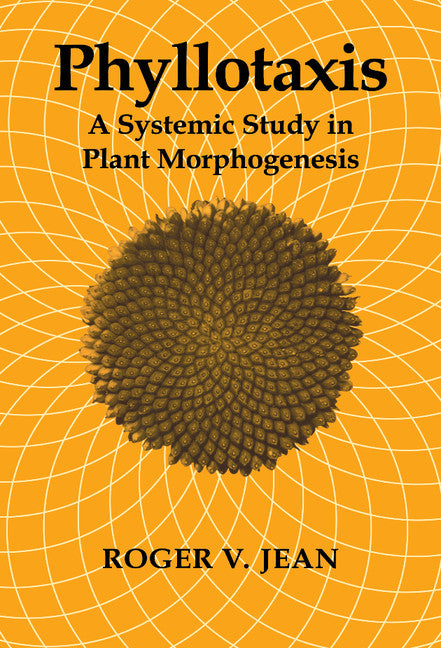
Phyllotaxis
A Systemic Study in Plant Morphogenesis
The many facets of phyllotaxis are dealt with in an integrated manner for the first time.
Roger V. Jean (Author)
9780521404822, Cambridge University Press
Hardback, published 28 January 1994
402 pages, 105 b/w illus. 10 tables
22.9 x 15.2 x 2.2 cm, 0.71 kg
"...especially well done, with a careful description of the mathematical basis needed to describe phyllotaxic patterns and a large number of examples...an important book for the mathematical biologist or anyone whose research interests involve geometrical aspects of plant structure. It is an excellent primer for description and methods of generation of phyllotaxic patterns...specialists will want to buy the book..." Thomas Herbert, Plant Science Bulletin
Phyllotaxis, the study of the patterns exhibited by leaves and other organs of plants, raises some of the deepest questions of plant morphogenesis. What principles of biological organisation produce these dynamical geometric systems? The constant occurrence of the Fibonacci sequence in such systems is a phenomenon that has fascinated botanists and mathematicians for centuries. In this book, first published in 1994, the many facets of phyllotaxis are dealt with in an integrated manner for the first time. The author describes a unified concept of phyllotaxis based on experimental, anatomical, cellular, physiological and paleontological observations. The book provides a framework for formal analyses of botanical data and emphasises the relevance of the phyllotactic paradigm in the study of other structures, such as crystals and proteins. It is of interest to cystallographers and physicists as well as to botanists and mathematicians.
Prologue
Part I. Pattern Recognition: Introduction
1. The centric representation
2. The fundamental theorem and its applications
3. Hierarchal control in phyllotaxis
4. Allometry-type model in phyllotaxis
5. Practical pattern recognition
Epilogue
Part II. Pattern Generation: A Key to the Puzzles: Introduction
6. An interpretative model
7. Testing the interpretative model
8. The interpretative model and whorled patterns
9. Convergences among models
Epilogue
Part III. Origins of Phyllotactic Patterns: Introduction
10. Exotic phyllotaxis
11. Morphogenetical parallelism and autoevolutionism
12. The challenge redefined
Epilogue
Part IV. Complements: Introduction
Appendices
Bibliography
Indexes.
Subject Areas: Mathematical modelling [PBWH]