Freshly Printed - allow 7 days lead
Couldn't load pickup availability
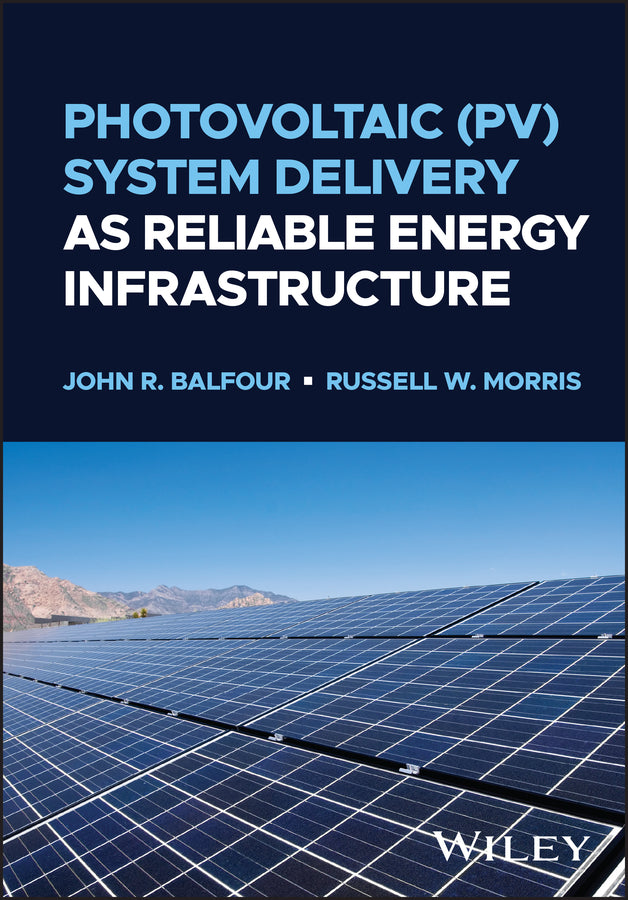
Photovoltaic (PV) System Delivery as Reliable Energy Infrastructure
At a time when deployment of solar needs to triple its recent record rates in order to meet the grid decarbonization targets of 2035, a book about treating the delivery of solar power plants with the mindset of energy infrastructure could not be more timely. "Photovoltaic (PV) System Delivery As Reliable Energy Infrastructure", by J.R. Balfour and R.W. Morris, published by Wiley this year, is breaking new ground in an area where published material is thin. The book, at more than 500 pages over 11 chapters, is nothing if not thorough. The authors cover every part of the delivery process, but the main focus are the underlying principles of Systems Engineering, and the way those affect Reliability, Maintanability, and Availability of the power plants.
Tassos Golnas,Technology Manager, Solar Energy Technologies Office (SETO).
John R. Balfour (Author), Russell W. Morris (Author)
9781119571193, Wiley
Hardback, published 2 May 2024
576 pages
24.4 x 17 x 3.8 cm, 1.134 kg
A practical guide to improving photovoltaic power plant lifecycle performance and output Photovoltaic (PV) System Delivery as Reliable Energy Infrastructure introduces a Preemptive Analytical Maintenance (PAM) for photovoltaic systems engineering, and the Repowering™ planning approach, as a structured integrated system delivery process. A team of veteran photovoltaics professionals delivers a robust discussion of the lessons learned from mature industries—including PV, aerospace, utilities, rail, marine, and automotive—as applied to the photovoltaic industry. The book offers real-world “technical and fiscal” examples of the impact of photovoltaics to all stakeholders during the concept, specification, operations, maintenance, and Repowering™ phases. In each chapter, readers will learn to develop RAMS specifications, reliability data collection, and tasks while becoming familiar with the inherent benefits of how these affect the cost of design and development, maintenance, spares, and systems operation. The authors also explain when and how to consider and implement Repowering™, plant upgrades and the considerations from concept through retirement and disposal of the plant. Readers will also find: Perfect for all new through to experienced photovoltaic design and specification engineers, photovoltaic plant owners, operators, PV asset managers and all interested stakeholders. Photovoltaic (PV) System Delivery as Reliable Energy Infrastructure will also earn a place in the libraries of utilities, engineering, procurements, construction professionals and students.
Preface xix Acknowledgments xxi Abbreviations xxiii 1 Assessing PV Industry Challenges 1 1.1 Introduction 1 1.2 Terminology 2 1.3 Preventive Analytic Maintenance 3 1.4 Current State of the Industry 5 1.5 Defining Failure and Success 6 1.6 Application of PAM 17 1.7 Cost Control Considerations 18 1.8 Project Versus System Delivery Process 21 1.9 PAM Concept 24 1.10 Challenges Today with the Bidding Process 25 Bibliography 35 Notes 36 2 PV System Delivery Process 39 2.1 Introduction 39 2.2 PAM PV System Delivery Process 42 2.3 PV Plant Commissioning 64 2.4 Universal Real-Time Data (URTD) and Data Sharing 71 2.5 PV Plant Lifecycle 76 2.6 Standard Test Conditions 77 2.7 Capacity and Capability 78 2.8 Addressing the Gaps 82 2.9 Masking and Its Impact 85 2.10 System Design Assumptions Drive Plant Fiscal Performance 87 2.11 Conclusion 89 Bibliography 90 Notes 90 3 Current PV Component Technologies 93 Key Chapter Points 93 Key Impacts 93 3.1 Component Selection 93 3.2 Present State of Technology 97 3.3 Manufacturing Risk 100 3.4 Primary Technologies Discussion 121 3.5 Inverters 134 3.6 Equipment Removal, Disposal, and Recycling 142 Bibliography 147 Notes 147 4 SE/Repowering TM Planning Process 149 Key Chapter Points 149 Key Chapter Impacts 149 4.1 Introduction 149 4.2 What Is the SE/Repowering TM Process? 152 4.3 There Is a Continuous and Contentious Complaint about Lifecycle Performance 156 4.4 Cannibalization 162 4.5 Impacts of SE/Repowering TM 163 4.6 Types of SE/Repowering TM 166 4.7 Preemptive Analytical Maintenance SE/Repowering TM System Planning 175 4.8 RAMS for SE/Repowering TM 176 4.9 SE/Repowering TM Considerations 184 4.10 Technology Fatigue 196 4.11 Data Collection 197 Bibliography 202 Notes 202 5 System Engineering 205 5.1 Introduction 205 5.2 Why Systems Engineering 206 5.3 SE Process 210 5.4 Project Phases Overview 218 5.5 Systems Engineering Tools 220 5.6 System Versus Project Delivery Method 227 5.7 Conclusion 264 Bibliography 265 Notes 267 6 Reliability 271 6.1 Introduction 271 6.2 Why Reliability 272 6.3 Success/Failure 274 6.4 Overview 280 6.5 Reliability 282 6.6 Stakeholder Needs 284 6.7 Reliability Predictions, Analysis, and Assessments 287 6.8 Reliability Program Plan 293 6.9 Reliability Mathematics 295 6.10 Reliability Block Diagrams (RBD) 307 6.11 Fault Trees 311 6.12 Failure Modes and Effects Analysis (FMEA) 311 6.13 Failure Reporting and Corrective System (FRACAS) and the PV SCADA 324 6.14 Root Cause Analysis 325 6.15 Data Analysis 326 6.16 Reliability Predictions 334 6.17 Derating 337 6.18 Reliability Testing 338 6.19 Summary 341 Bibliography 342 Notes 345 7 Maintainability 347 7.1 Introduction 347 7.2 Responsibility for Maintainability 350 7.3 Types of Maintenance 350 7.4 Maintenance Cost 355 7.4.1 Run to Failure 356 7.5 Typical Maintenance Flow 357 7.6 Additional Maintenance Metrics 364 7.7 Available Maintenance Time 364 7.8 Maintenance-Driven Availability 365 7.9 Preventive Maintenance (PM) 371 7.10 Customer-Generated Maintenance 371 7.11 Energy Storage 373 7.12 Spares 374 7.13 Testability 379 7.14 Maintenance and Testability Specifications 384 7.15 Conclusion 386 Bibliography 386 Notes 387 8 Availability 389 8.1 Introduction 389 8.2 Why Measure Component Availability 391 8.3 Information Categories for Plant Availability (Unavailability) 395 8.4 Types of Availability 395 8.5 Confusion With Availability Metrics 403 8.6 Grid Availability 404 8.7 Specifications 404 8.8 Conclusion 406 Bibliography 406 Notes 407 9 Energy Storage System (ESS) 409 Key Chapter Points 409 Key Chapter Impacts 409 9.1 Introduction Energy Storage Systems (ESSs) 410 9.2 Applications of Energy Storage 412 9.3 Batteries 414 9.4 Components of an Energy Storage System 423 9.5 Battery Management System (BMS) 426 9.6 Battery Thermal Management 427 9.7 ESS Cost 429 9.8 Reliability 432 9.9 ESS Maintenance and Operational Considerations 433 9.10 Considerations 437 9.11 Electric Vehicles as Grid Storage 439 9.12 Summary 441 Bibliography 441 Notes 442 10 Data Collection 443 Key Chapter Points 443 Key Impacts 443 10.1 Introduction 443 10.2 Reducing Risk Begins with Data 446 10.3 Shared RAMS Data 450 10.4 Stakeholders 451 10.5 Anonymized Plant Data 452 10.6 Stakeholder Business Case for Sharing Reliability Data 452 10.7 The Level Necessary to Control Costs and Improve PV Systems 455 10.8 Monitoring for Better Data, Security, and Plant Cost Control 455 10.9 Data Analysis 457 10.10 Data Presentation 459 10.11 Process 461 10.12 Implementation 463 10.13 The Monitoring Plan 465 10.14 Warranty Issues 469 10.15 Synthetic Data 470 10.16 Conclusion 471 10.A Appendix 471 Bibliography 472 Notes 473 11 Operations and Maintenance (O&M) 475 11.1 Introduction 475 11.2 Safety 477 11.3 Reliability 480 11.4 Availability 482 11.5 Maintainability 483 11.6 Testability 484 11.7 Project Development 486 11.8 O&M Plan 486 11.9 Conclusion 497 11.A Appendix A: Photovoltaic Fires Calculation Methodology 498 11.B Appendix B: Operations Scope Example (Source: Courtesy of Higher Powered LLC) 500 11.C Appendix C: Maintenance Scope Example 503 Bibliography 514 Notes 515 Glossary 517 Index 527
Subject Areas: Electronics & communications engineering [TJ]