Freshly Printed - allow 7 days lead
Couldn't load pickup availability
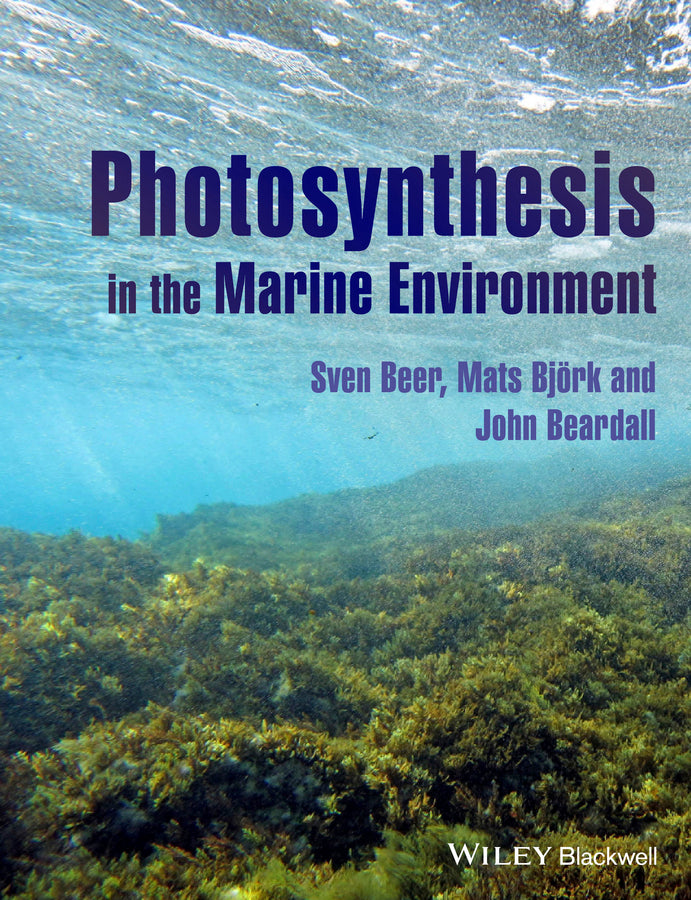
Photosynthesis in the Marine Environment
Sven Beer (Author), Mats Björk (Author), John Beardall (Author)
9781119979579, Wiley
Paperback / softback, published 13 May 2014
224 pages
24.6 x 19.1 x 1.2 cm, 0.494 kg
"Marine photosynthesis provides for at least half of the primary production worldwide..." Photosynthesis in the Marine Environment constitutes a comprehensive explanation of photosynthetic processes as related to the special environment in which marine plants live. The first part of the book introduces the different photosynthesising organisms of the various marine habitats: the phytoplankton (both cyanobacteria and eukaryotes) in open waters, and macroalgae, marine angiosperms and photosymbiont-containing invertebrates in those benthic environments where there is enough light for photosynthesis to support growth, and describes how these organisms evolved. The special properties of seawater for sustaining primary production are then considered, and the two main differences between terrestrial and marine environments in supporting photosynthesis and plant growth are examined, namely irradiance and inorganic carbon. The second part of the book outlines the general mechanisms of photosynthesis, and then points towards the differences in light-capturing and carbon acquisition between terrestrial and marine plants. This is followed by discussing the need for a CO2 concentrating mechanism in most of the latter, and a description of how such mechanisms function in different marine plants. Part three deals with the various ways in which photosynthesis can be measured for marine plants, with an emphasis on novel in situ measurements, including discussions of the extent to which such measurements can serve as a proxy for plant growth and productivity. The final chapters of the book are devoted to ecological aspects of marine plant photosynthesis and growth, including predictions for the future.
About the authors ix Part I Plants and the Oceans 1 Introduction 1 Chapter 1 The evolution of photosynthetic organisms in the oceans 5 Chapter 2 The different groups of marine plants 15 2.1 Cyanobacteria 16 Chapter 3 Seawater as a medium for photosynthesis and plant growth 39 3.1 Light 40 Part II Mechanisms of Photosynthesis, and Carbon Acquisition in Marine Plants 57 Introduction to Part II 57 Chapter 4 Harvesting of light in marine plants: The photosynthetic pigments 61 4.1 Chlorophylls 61 Chapter 5 Light reactions 67 5.1 Photochemistry: excitation, de-excitation, energy transfer and primary electron transfer 67 Chapter 6 Photosynthetic CO2-fixation and -reduction 81 6.1 The Calvin cycle 81 Chapter 7 Acquisition of carbon in marine plants 95 7.1 Cyanobacteria and microalgae 96 Part III Quantitative Measurements, and Ecological Aspects, of Marine Photosynthesis 127 Introduction to Part III 127 Chapter 8 Quantitative measurements 129 8.1 Gas exchange 131 Chapter 9 Photosynthetic responses, acclimations and adaptations to light 157 9.1 Responses of high- and low-light plants to irradiance 157 Chapter 10 Photosynthetic acclimations and adaptations to stress in the intertidal 175 10.1 Adaptations of macrophytes to desiccation 175 Chapter 11 How some marine plants modify the environment for other organisms 183 11.1 Epiphytes and other 'thieves' 183 Chapter 12 Future perspectives on marine photosynthesis 191 12.1 'Harvesting' marine plant photosynthesis 191 References 199
Preface xi
About the companion website xiii
2.2 Eukaryotic microalgae 17
2.3 Photosymbionts 23
2.4 Macroalgae 27
2.5 Seagrasses 34
3.2 Inorganic carbon 45
3.3 Other abiotic factors 52
Summary notes of Part I 55
4.2 Carotenoids 63
4.3 Phycobilins 64
5.2 Electron transport 74
5.3 ATP formation 76
5.4 Alternative pathways of electron flow 77
6.2 CO2-concentrating mechanisms 89
7.2 Photosymbionts 101
7.3 Macroalgae 104
7.4 Seagrasses 118
7.5 Calcification and photosynthesis 122
Summary notes of Part II 124
8.2 How to measure gas exchange 133
8.3 Pulse amplitude modulated (PAM) fluorometry 137
8.4 How to measure PAM fluorescence 142
8.5 What method to use: Strengths and limitations 146
9.2 Light responses of cyanobacteria and microalgae 163
9.3 Light effects on photosymbionts 164
9.4 Adaptations of carbon acquisition mechanisms to light 169
9.5 Acclimations of seagrasses to high and low irradiances 169
10.2 Other stresses in the intertidal 181
11.2 Ulva can generate its own empires 185
11.3 Seagrasses can alter environments for macroalgae and vice versa 187
11.4 Cyanobacteria and eukaryotic microalgae 189
12.2 Predictions for the future 192
12.3 Scaling of photosynthesis towards community and ecosystem production 194
Summary notes of Part III 197
Index 203
Subject Areas: Biology, life sciences [PS]