Freshly Printed - allow 7 days lead
Couldn't load pickup availability
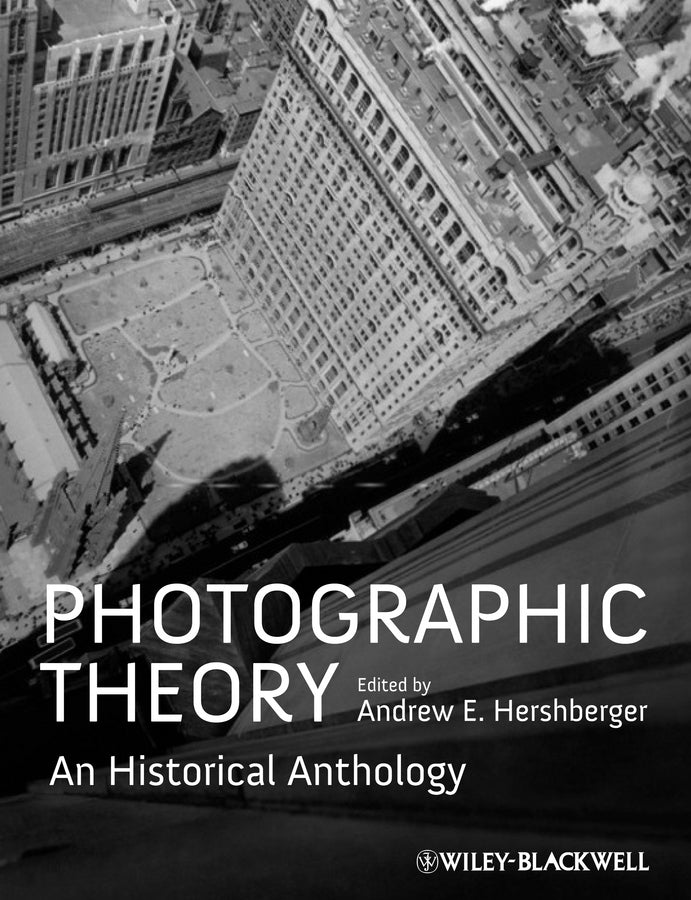
Photographic Theory
An Historical Anthology
“A canonical volume long overdue, smartly constructed, comprehensive and up-to-date, Hershberger's introductory commentaries are thoughtful, and insightful. Readers uninitiated and scholarly alike will find much to appreciate. Highly recommended!” – Fredrik Marsh, Guggenheim Fellow
“Hershberger brings the theoretical lineage of photography together in a delightful chronology from early notions of the image to today’s digital revolution. It constructs a historical framework for the novice, and provides titillating insights for the cognoscenti.” - Robert Ladislas Derr, The Ohio State University
Andrew E. Hershberger (Author)
9781405198462, Wiley
Hardback, published 6 December 2013
480 pages
25.4 x 19.8 x 2.8 cm, 0.993 kg
"There can be no question that those of us who teach the history of photography – and our students – have been put most deeply in Hershberger’s debt." (History of Photography Online, 1 June 2015) "This chronologically (and, to a lesser extent, thematically) organized selection of key contributions to photographic theory display both the highly exciting diversity of theoretical questions raised by the emergence, development, triumph, and eventual metamorphosis of photography and the amazing possibility to organize the sometimes savage heterogenity of this material along unobtrusive and simple art-historical lines." - Leonardo Online (1 February 2014)
Hershberger is the winner of a 2015 Insight Award from the Society for Photographic Education for his work on this book and for his overall contributions to the field! Photographic Theory: An Historical Anthology presents a compendium of readings spanning ancient times to the digital age that are related to the history, nature, and current status of debates in photographic theory.
Introduction 1 1 Before Photography to Invention: c. 380 B.C.E.–1839 9 Camera/Vision 11 1.1 Excerpts from the Allegory of the Cave. In The Republic 12 1.2 The Function of the Eye, As Explained by the Camera Obscura 17 1.3 Description of the Camera Lucida 19 Art/History 23 1.4 Excerpts on Linear Perspective. In On Painting 24 1.5 Account of the late Mr. [Robert] Barker 29 1.6 Description of the Process of Painting and Effects of Light Invented by Daguerre, and Applied by Him to the Pictures of the Diorama 31 2 Invention to Pictorialism: 1839–c. 1880 35 What is Photography? 37 2.1 Some Account of the Art of Photogenic Drawing 38 2.2 The Pencil of Nature. A New Discovery 44 2.3 Report [on the Daguerreotype to the Chamber of Deputies] 48 Art/History 55 2.4 Upon Photography in an Artistic View, and in Its Relations to the Arts 56 2.5 La Photographie 59 2.6 Photography 61 Camera/Vision 67 2.7 The Stereoscope and the Stereograph 68 2.8 Combination Printing. In Pictorial Effect in Photography 72 2.9 Annals of My Glass House 76 3 Pictorialism to/and/vs. Modernism: c. 1880–c. 1920 81 Camera/Vision 83 3.1 Focussing. In Naturalistic Photography for Students of the Art 84 3.2 The Death of Naturalistic Photography 88 3.3 The Hand Camera — Its Present Importance 91 Interdisciplinary Approaches 95 3.4 Photo-Chemical Investigations and a New Method of Determination of the Sensitiveness of Photographic Plates 96 3.5 Logic as Semiotic: The Theory of Signs 100 3.6 Intuition and Art. In Æsthetic: As Science of Expression and General Linguistic 105 3.7 The Cinematographical Mechanism of Thought and the Mechanistic Illusion…. In Creative Evolution 108 What Should Photographs Look Like? 113 3.8 On the Straight Print 114 3.9 What is a “Straight Print”? 118 3.10 Photography and Artistic-Photography 121 4 Modernism to Postmodernism: c. 1920–c. 1960 123 Camera/Vision 125 4.1 Photography and the New God 126 4.2 Light: A Medium of Plastic Expression 130 4.3 Seeing Photographically 132 4.4 The Camera’s Glass Eye 136 What Should Photographs Look Like? 139 4.5 Aims 140 4.6 A Personal Credo 142 4.7 Our Illustrations 147 4.8 Photography at the Crossroads 150 Art/History 155 4.9 Excerpts from Perspective as Symbolic Form 156 4.10 The Age of the World Picture 161 4.11 Excerpts from Museum Without Walls 164 Interdisciplinary Approaches 169 4.12 Photography and Typography 170 4.13 The Making of a Film. In Film as Art 174 4.14 The Ontology of the Photographic Image. In What Is Cinema? 176 What is Photography? 181 4.15 Mechanism and Expression, the Essence and Value of Photography 182 4.16 Introduction to The Decisive Moment 188 4.17 Photography 192 5 Modernism and Postmodernism to Digital Imaging: c. 1960–c. 1990 199 Art/History 201 5.1 Equivalence: The Perennial Trend 202 5.2 Perspective. In Languages of Art 207 5.3 Can There Ever Again Be a History of Photography? 211 5.4 Introduction to Before Photography: Painting and the Invention of Photography 214 5.5 New Metaphorics: Spirit and Symbol in Contemporary Landscape Photography 219 Camera/Vision 225 5.6 Introduction to The Photographer’s Eye 226 5.7 Post-Visualization 232 5.8 Introduction to New Topographics 235 Interdisciplinary Approaches 239 5.9 Excerpts from The World Viewed 240 5.10 Notes on the Index: Seventies Art in America 246 5.11 Photography and Fetish 251 5.12 Film, Photography, and Fetish: The Analyses of Christian Metz 256 What is Photography? 263 5.13 On the Nature of Photography 264 5.14 Photography, Vision, and Representation 269 5.15 The Directorial Mode: Notes Toward a Definition 276 5.16 Selections from Transparent Pictures: On the Nature of Photographic Realism 284 5.17 The Photograph as Post-Industrial Object: An Essay on the Ontological Standing of Photographs 290 Identity/Politics 295 5.18 The Traffic in Photographs 296 5.19 Of Mother Nature and Marlboro Men: An Inquiry into the Cultural Meanings of Landscape Photography 302 5.20 Excerpts from Right of Inspection 310 5.21 Fetal Images: The Power of Visual Culture in the Politics of Reproduction 315 6 Postmodernism and Digital Imaging (Return to Pictorialism?): c. 1990–c. 2010 319 What is Digital Photography? 321 6.1 The Transcendental Machine? A Comparison of Digital Photography and Nineteenth-Century Modes of Photographic Representation 322 6.2 Photojournalism in the Age of Computers 329 6.3 Phantasm: Digital Imaging and the Death of Photography. In Metamorphoses 334 6.4 Escaping Reality: Digital Imagery and the Resources of Photography 338 6.5 Fixing the Art of Digital Photography: Electronic Shadows 344 6.6 Digital Ontologies: The Ideality of Form in/and Code Storage — or — Can Graphesis Challenge Mathesis? 350 Identity/Politics 355 6.7 Do Not Doubt the Dangerousness of the 12-Inch-Tall Politician 356 6.8 The Politics of Focus: Feminism and Photography Theory 359 6.9 Re-Picturing Photography: A Language in the Making 365 6.10 A Painful Labour: Responsibility and Photography 370 Camera/Vision 377 6.11 Clement Greenberg and Walker Evans: Transparency and Transcendence 378 6.12 The Shadows on the Wall. In The Reconfigured Eye: Visual Truth in the Post-Photographic Era 382 6.13 Of Fish, Birds, Cats, Mice, Spiders, Flies, Pigs, and Chimpanzees: How Chance Casts the Historic Action Photograph into Doubt 384 Art/History 389 6.14 The Invisible Dragon: On Beauty I 390 6.15 The Idiom in Photography as the Truth in Painting 394 6.16 “Impressed by Nature’s Hand”: Photography and Authorship 399 Photography and Memory 407 6.17 Surviving Images: Holocaust Photographs and the Work of Postmemory 408 6.18 Visualizing Memory: Photographs and the Art of Biography 412 6.19 Remembering September 11: Photography as Cultural Diplomacy 415 6.20 Through a Glass, Darkly: Photography and Cultural Memory 421 Interdisciplinary Approaches 425 6.21 Curiosity and Conjecture: Mathematics, Photography, and the Imagination 426 6.22 Image as Trace: Speculations about an Undead Paradigm 429 6.23 The Photographic Argument of Philosophy 436 Works Cited and Further Reading 440 Credits, Sources, and Acknowledgments 449 Acknowledgments 454 Index 456
Plato, c. 380 B.C.E.
Leonardo da Vinci, c. 1520
William H. Wollaston, 1807
Leon Battista Alberti, 1540
Anonymous, 1806
Louis-Jacques-Mandé Daguerre, 1839
William Henry Fox Talbot, 1839 [March]
Nathaniel Parker Willis and Timothy O. Porter, eds., 1839 [April]
François Arago, 1839 [July]
Sir William J. Newton, 1853
Antoine Joseph Wiertz, 1855
Eastlake, Lady (Elizabeth) 1857
Oliver Wendell Holmes, 1859
Henry Peach Robinson, 1869
Julia Margaret Cameron, 1874
Peter Henry Emerson, 1890
Peter Henry Emerson, 1890
Alfred Stieglitz, 1896
Ferdinand Hurter and Vero C. Driffield, 1890
Charles Sanders Peirce, c. 1900
Benedetto Croce, 1902
Henri Bergson, 1907
Robert Demachy, 1907
Frederick H. Evans, 1907
Marius de Zayas, 1913
Paul Strand, 1922
László Moholy-Nagy, 1923
Edward Weston, 1943
Clement Greenberg, 1946
Albert Renger-Patzsch, 1927
Ansel Adams, 1943
Frank R. Fraprie, 1943
Berenice Abbott, 1951
Erwin Panofsky, 1927
Martin Heidegger, 1938/52
André Malraux, 1947
Jan Tschichold, 1928
Rudolph Arnheim, 1932
André Bazin, 1945
Franz Roh, 1929
Henri Cartier-Bresson, 1952
Siegfried Kracauer, 1960
Minor White, 1963
Nelson Goodman, 1968
Peter C. Bunnell, 1975
Peter Galassi, 1981
Gretchen Garner, 1988
John Szarkowski, 1966
Jerry Uelsmann, 1967
William Jenkins, 1975
Stanley Cavell, 1971
Rosalind Krauss, 1977
Christian Metz, 1985
Ben Singer, 1988
Rudolf Arnheim, 1974
Joel Snyder and Neil Walsh Allen, 1975
A. D. Coleman, 1976
Kendall L.Walton, 1984
Vilém Flusser, 1986
Allan Sekula, 1981
Deborah Bright, 1985
Jacques Derrida, 1985
Rosalind Pollack Petchesky, 1987
Diana Emery Hulick, 1990
Fred Ritchin, 1990
Geoffrey Batchen, 1994
Barbara E. Savedoff, 1997
Ellen Handy, 1998
Johanna Drucker, 2001
David Wojnarowicz, 1991
Lindsay Smith, 1992
Aphrodite Désirée Navab, 2001
Sharon Sliwinski, 2004
Mike Weaver, 1991
William J. Mitchell, 1992
Robin Kelsey, 2009
Dave Hickey, 1991
Rosemary Hawker, 2002
Douglas R. Nickel, 2009
Marianne Hirsch, 2001
Deborah Willis, 2003
Liam Kennedy, 2003
Alan Trachtenberg, 2008
David Travis, 2003
Peter Geimer, 2007
Alexander Sekatskiy, 2010
Subject Areas: Photography & photographs [AJ]