Freshly Printed - allow 7 days lead
Couldn't load pickup availability
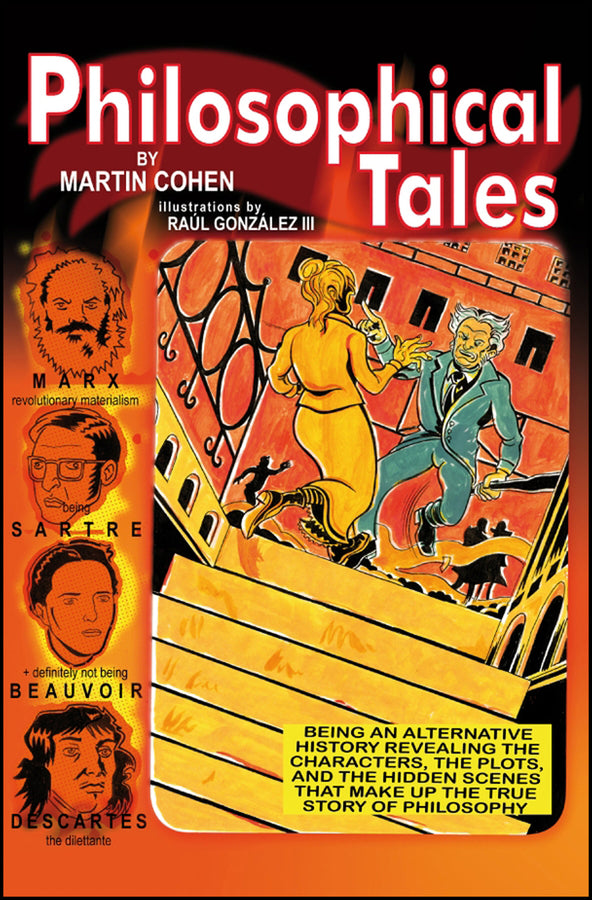
Philosophical Tales
Being an Alternative History Revealing the Characters, the Plots, and the Hidden Scenes That Make Up the True Story of Philosophy
"A lover of philosophical ideas and practiced debunker of intellectual sham, Martin Cohen knocks some thirty important philosophers from Socrates to Derrida off their pedestals, and presents in a series of philosophical tales various aspects of their thought, life and personality which few of us ever suspected."
—Zenon Stavrinides, University of Bradford
Martin Cohen (Author), Raul Gonzalez, III (Illustrated by)
9781405140362, Wiley
Hardback, published 4 April 2008
304 pages
23.6 x 16 x 2.8 cm, 0.567 kg
"We need more stories in philosophy, and Martin Cohen aims to fill this lacuna with Philosophical Tales. [This book] is intended for a general audience interested in a satirical introduction to overlooked aspects of Western philosophy and the lives of the great philosophers. Philosophical Tales does tell a number of interesting stories, and any instructor of philosophy will find it handy to have these stories available to enliven a class. Instructors will also find it valuable to use these philosophical tales to raise a compelling question: is a philosophy only as good as the philosopher who proposes it?" (Teaching Philosophy,, December 2009) "Great philosophers only become well known after their deaths. Indeed, to speak of contemporary celebrity philosophers is oxymoronic. Still, one can't help wondering who amongst living philosophers will merit future Philosophical Tales. (The Philosopher, Autumn 2008)
Philosophical Tales “A lover of philosophical ideas and practiced debunker of intellectual sham, Martin Cohen knocks some thirty important philosophers from Socrates to Derrida off their pedestals, and presents in a series of philosophical tales various aspects of their thought, life and personality which few of us ever suspected.”
Zenon Stavrinides, University of Bradford
Forward!. How to Use this Book. Philosophical Illustrations. The Tales. I The Ancients. 1 Socrates the Sorcerer (469–399 bce). 2 The Different Forms of Plato (ca. 427–347 bce). 3 Aristotle the Aristocrat (384–ca. 322 bce). II More Ancients. 4 Lao Tzu Changes into Nothing (6th–5th c. bce). 5 Pythagoras Counts Up to Ten (ca. 570–495 bce). 6 Heraclitus Chooses the Dark Side of the River (ca. 5th c. bce). 7 Hypatia Holds Up Half of the Sky (ca. 370–415 ce). III Medieval Philosophy. 8 Augustine the Hippocrite (354–430 ce). 9 St. Thomas Aquinas Disputes the Existence of God (1225–1274). IV Modern Philosophy. 10 Descartes the Dilettante (1596–1650). 11 Hobbes Squares the Circle (1588–1679). 12 Spinoza Grinds Himself Away… (1632–1677). V Enlightened Philosophy. 13 John Locke Invents the Slave Trade (1632–1704). 14 The Many Faces of David Hume (1711–1776). 15 Rousseau the Rogue (1712–1778). 16 Immanuel Kant, the Chinaman of Königsburg (1724–1804). VI The Idealists. 17 Gottfried Leibniz, the Thinking Machine (1646–1716). 18 Bishop Berkeley’s Bermuda College (1685–1753). 19 Headmaster Hegel’s Dangerous History Lesson (1770–1831). 20 Arthur Schopenhauer and the Little Old Lady (1788–1860). VII The Romantics. 21 The Seduction of Søren Kierkegaard (1813–1855). 22 Mill’s Poetical Turn (1806–1873). 23 Henry Thoreau and Life in the Shed (1817–1862). 24 Marx’s Revolutionary Materialism (1818–1883). VIII Recent Philosophy. 25 Russell Denotes Something (1872–1970). 26 The Ripping Yarn of Ludwig Wittgenstein (1889–1951). 27 Heidegger’s Tale (and the Nazis) (1889–1976). 28 Benjamin Lee Whorf and the Color Pinker (ca. 1900–1950). 29 Being Sartre and Not Definitely Not Being Beauvoir (1905–1980 and not 1908–1986). 30 Deconstructing Derrida (1930–2004). Scholarly Appendix: Women in Philosophy, and Why There Aren’t Many. Key Sources and Further Reading. Acknowledgments. Index
Subject Areas: Philosophy [HP]