Freshly Printed - allow 7 days lead
Couldn't load pickup availability
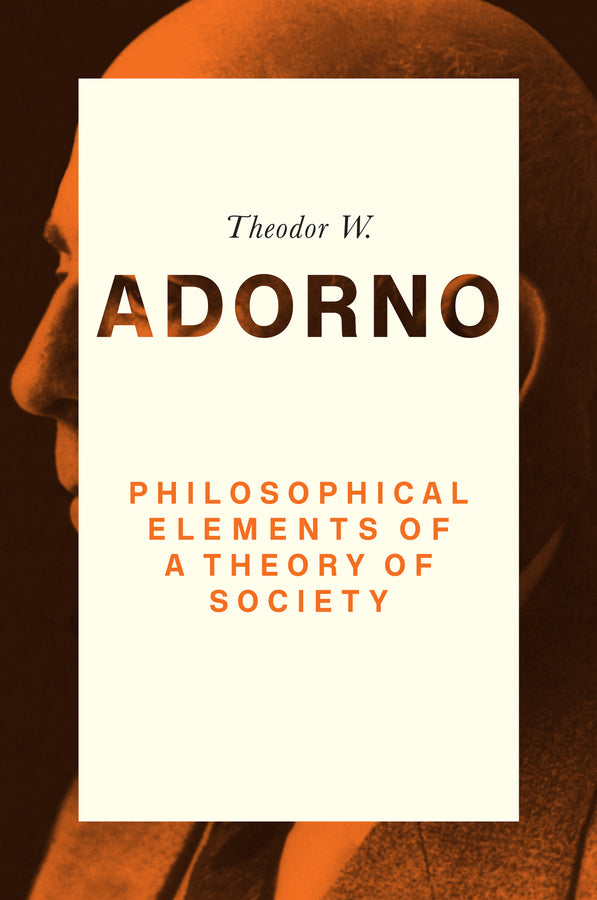
Philosophical Elements of a Theory of Society
Theodor W. Adorno (Author)
9780745679471, Polity Press
Hardback, published 18 January 2019
192 pages
23.1 x 15.5 x 2 cm, 0.408 kg
"a joy to read"
Marx & Philosophy Review of Books
"Against the alleged waning of Adorno’s radical commitments in his last years, these lectures of 1964 on the relationship between social theory and empirical research testify to his abiding Marxist loyalties. Exhorting his students to pierce the “technological veil” of their “administered world,” he insists on the power of class, reified consciousness, and the impoverishment of experience in the irrational totality of late capitalism."
Martin Jay, Berkeley
As an exile in America during the War, Theodor Adorno grew acquainted with the fundamentals of empirical social research, something which would shape the work he undertook in the early 1950s as co-director of the Frankfurt Institute for Social Research. Yet he also became increasingly aware of the ‘fetishism of method’ in sociology, and saw the serious limitations of theoretical work based solely on empirical findings.
In this lecture course given in 1964, Adorno develops a critique of both sociology and philosophy, emphasizing that theoretical work requires a specific mediation between the two disciplines. Adorno advocates a philosophical approach to social theory that challenges the drive towards uniformity and a lack of ambiguity, highlighting instead the fruitfulness of experience, in all its messy complexity, for critical social analysis. At the same time, he shows how philosophy must also realise that it requires sociology if it is to avoid falling for the old idealistic illusion that the totality of real conditions can be grasped through thought alone.
Masterfully bringing together philosophical and empirical approaches to an understanding of society, these lectures from one of the most important social thinkers of the 20th century will be of great interest to students and scholars in philosophy, sociology and the social sciences generally.
positivism – Weber’s relationship to theory – Weber’s concept of ‘understanding’ – Weber’s concept of ‘rationality’ – Bureaucracy and domination – Dialectics
theoretical aspects of atheoretical thinking
Darmstadt community studies – Theory formation presupposes a consideration of discontinuity
The status of facts within the complexion of society as a whole
Registering facts and productive imagination – The concept of tendency – Capitalist calculus – The exchange relationship – Tendency and prophecy
The new as the core of theory – The non-identical in theory – Theory and dynamics of society –Tendency and totality – Social reality and theory
Distrust towards theory formation – Theory as a unified system of society
Liberalism, Marxism, German Idealism – System as tendency – Modifications of ‘market society’ as results of class struggles – Monopolizing tendency of capital
State interventionism as a crisis outlet – Integration of the proletariat
‘Work Climate’ study – The system-immanence of the proletariat – Class consciousness and integration – Ideology and experience: The phenomenon of personalization – Insight into society in theoretical thought – System-immanent consciousness – Politics as an aspect of ideology – The meaning of changes in reality and consciousness
concretism
‘Levelled middle-class society’ – Exchange value as a source of pleasure – The meaning of concretism for labour organizations – The transformation of Marxian theory into state religion – Abstractism – Accusation of the bourgeoisification of the proletariat – Everyday class struggle
The consequences of mechanization – The dominance of conditions – Wage satisfaction – Subjectivism in sociological research – Communication research
The semblance of freedom in the exchange principle – Subjective experiences of the semblance of levelling – Supply and demand of labour
Social theory between dogmatic ossification and naïve faith in facts – Semblance of integration and increasing socialization – Disintegration
Rationalization and the reality principle – The function of the system
Antagonism of power and powerlessness: Disintegration through growing integration – Integration and powerlessness – False identity of the general and the particular
ideology critique and language critique – The mythologization of antagonisms in socialist countries – The dialectic and rupture of theory and experience – Loss of experience – Theory as system and non-system
The irrationality and rationality of society
Weber’s theory of science
Rationality and irrationality – Changes in the concept of reason – The whole, in its rationality, is irrational – Dialectical theory – Critique of undialectical thought – Critique of unified sociology and the fetishization of science – The historical change in the function of science
Openness as a key concept – Functional change in the concept of science: Leibniz, Fichte, Hegel, Kant – The equation of science with truth – The danger of intuitionism
The relationship between method and matter – Announcement of the next topic: Critique of Parsons’s methodology
The postulation of method and the structure of the matter – Parsons’s unified conceptual system – The relationship between psychology and sociology: Karen Horney, Erich Fromm – Freud: Sociology as applied psychology
The concept of role – Critique of the psychological reduction of social processes: Marx, Durkheim – Subject and socialization in Weber’s ‘understanding’ sociology – The antagonistic relationship between the individual and society – The necessity of a critical reflection on method
Spontaneity of thought – Formal and transcendental logic in Kant
The character of reason – Method II
Dialectical philosophy and self-determination – Didactics
The complexity of capitalism and the Marxian method – Marx’s toying with dialectics – The disastrous consequence of the primacy of method – Two meanings of the concept of method
The employee mentality – Theory and system
Spinoza and Leibniz – The empiricist critique of rationalism – System frenzy and the disintegrated cosmos – The problem of the concept of system in Kant’s idealism – Nietzsche and Kierkegaard
Rejection of system – On dogmatic attitudes – Systems regress to modes of representation – Systematic thinking and the administered world
Equation of theory and system in Parsons – Focus on the essence
Unregulated experience – Empiricism as a corrective – The relationship between knowledge and democracy
Experimental situations – Realism and power relations
Objectivity and subjectivity
Bureaucracy and domination
Sociological concept formation – Personalized epiphenomena and fascism – The independence of bureaucracy in Russia – Armament and overall social structure – The position of ideology today: De-ideologization
The consumer world – The ‘consciousness industry’: The change in ideology and its contemporary production – The technological veil – Language critique and reified consciousness – Critique
Subject Areas: Sociology & anthropology [JH]