Freshly Printed - allow 10 days lead
Couldn't load pickup availability
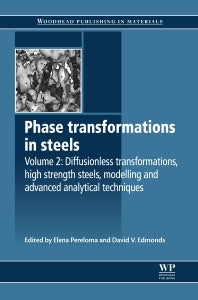
Phase Transformations in Steels
Diffusionless Transformations, High Strength Steels, Modelling and Advanced Analytical Techniques
Elena Pereloma (Edited by), David V Edmonds (Edited by)
9781845699710, Elsevier Science
Hardback, published 11 May 2012
680 pages
23.3 x 15.6 x 3.6 cm, 1.16 kg
"The two volumes represent a thorough study on this subject...gives a better understanding on microstructural and mechanical behavior of steels, predict their lifetime evolution and act to prevent material degradation and significant environmental impacts."--International Journal of Environmental Studies, Vol 70, Issue 2-13 A new and comprehensive book on phase transformations is both timely and welcome… The various chapters bring nicely up-to-date the vast knowledge of steel transformations in the literature., Professor Ted Massalski, Carnegie Mellon University, USA (from the Foreword)
The processing-microstructure-property relationships in steels continue to present challenges to researchers because of the complexity of phase transformation reactions and the wide spectrum of microstructures and properties achievable. This major two-volume work summarises the current state of research on phase transformations in steels and its implications for the emergence of new steels with enhanced engineering properties.Volume 2 reviews current research on diffusionless transformations and phase transformations in high strength steels, as well as advances in modelling and analytical techniques which underpin this research. Chapters in part one discuss the crystallography and kinetics of martensite transformations, the morphology, substructure and tempering of martensite as well as shape memory in ferrous alloys. Part two summarises research on phase transformations in high strength low alloy (HSLA) steels, transformation induced plasticity (TRIP)-assisted multiphase steels, quenched and partitioned steels, advanced nanostructured bainitic steels, high manganese twinning induced plasticity (TWIP) and maraging steels. The final two parts of the book review advances in modelling and the use of advanced analytical techniques to improve our understanding of phase transformations in steels.With its distinguished editors and distinguished international team of contributors, the two volumes of Phase transformations in steels is a standard reference for all those researching the properties of steel and developing new steels in such areas as automotive engineering, oil and gas and energy production.
Contributor contact details Foreword Introduction Part I: Diffusionless transformations Chapter 1: Crystallography of martensite transformations in steels Abstract: 1.1 Introduction 1.2 Martensite transformations in steels 1.3 Phenomenological theory of martensite crystallography (PTMC) 1.4 The post phenomenological theory of martensite crystallography (PTMC) period 1.5 Strain energy – the Eshelby/Christian model and the infinitesimal deformation (ID) approach 1.6 Interfacial dislocation models 1.7 Future trends 1.8 Conclusions Chapter 2: Morphology and substructure of martensite in steels Abstract: 2.1 Morphology and crystallographic features of martensite in ferrous alloys 2.2 Morphology and substructure of lath martensite 2.3 Morphology and substructure of lenticular martensite 2.4 Morphology and substructure of thin plate martensite 2.5 Conclusions Chapter 3: Kinetics of martensite transformations in steels Abstract: 3.1 Introduction 3.2 Mechanism and kinetics of martensitic transformation 3.3 Mechanically induced transformations 3.4 Transformation plasticity constitutive relations and applications 3.5 Conclusions Chapter 4: Shape memory in ferrous alloys Abstract: 4.1 Introduction 4.2 Fe-Pt alloys 4.3 Fe-Ni and Fe-Ni-C alloys 4.4 Fe-Ni-Co-based alloys 4.5 Austenitic stainless steels with low stacking fault energy (SFE) 4.6 Fe-Mn-based alloys 4.7 Summary 4.8 Acknowledgements Chapter 5: Tempering of martensite in carbon steels Abstract: 5.1 Introduction 5.2 Martensitic microstructures prior to tempering heat treatments 5.3 Classification of aging and tempering stages: general considerations 5.4 Changes in martensitic fine structure due to aging 5.5 The stages of tempering 5.6 Conclusions Part II: Phase transformations in high strength steels Chapter 6: Phase transformations in microalloyed high strength low alloy (HSLA) steels Abstract: 6.1 Introduction to microalloyed high strength low alloy (HSLA) steels 6.2 Brief historical review of the development of microalloyed steels 6.3 Solubility of microalloying elements in austenite and ferrite 6.4 Precipitation 6.5 Effects of microalloying on transformation kinetics 6.6 Phase transformations during high strength low alloy (HSLA) steels processing 6.7 Controlled processed ferrite/bainite and acicular ferrite steels 6.8 Conclusions and future trends 6.9 Acknowledgements Chapter 7: Phase transformations in transformation induced plasticity (TRIP)-assisted multiphase steels Abstract: 7.1 Introduction 7.2 Historical perspectives on the emergence of transformation induced plasticity (TRIP)-assisted multiphase steels 7.3 Influence of parameters of the thermomechanical process on the formation of multiphase microstructures containing retained austenite 7.4 Conclusion and future trends Chapter 8: Phase transformations in quenched and partitioned steels Abstract: 8.1 Introduction to the quenching and partitioning concept 8.2 Microstructure development fundamentals and alloy designs 8.3 Mechanical behavior, potential applications, and implementation status 8.4 Conclusions Chapter 9: Phase transformations in advanced bainitic steels Abstract: 9.1 Introduction 9.2 Design of third generation of advanced high strength steels 9.3 Carbide-free bainitic steels: a material ready for the nanocentury 9.4 Conclusions and future trends 9.5 Acknowledgement Chapter 10: Phase transformations in high manganese twinning-induced plasticity (TWIP) steels Abstract: 10.1 Introduction 10.2 Fe-Mn-X alloys 10.3 Strain-induced twinning 10.4 Twinning-induced plasticity (TWIP) industrialization 10.5 Conclusions 10.6 Acknowledgements Chapter 11: Phase transformations in maraging steels Abstract: 11.1 State of the art of ultra high strength steels 11.2 Types of maraging steels 11.3 Microstructure and precipitates in maraging steels 11.4 Reverted austenite and mechanical properties 11.5 Evolution of precipitates and the overall process 11.6 Precipitation kinetic theory in Fe-12Ni-6Mn maraging type alloy 11.7 Research trends Part III: Modelling phase transformations Chapter 12: First principles in modelling phase transformations in steels Abstract: 12.1 Introduction 12.2 Ab initio description of phase stability of pure iron 12.3 Ab initio phase stability of iron carbides 12.4 Substitutional alloying elements 12.5 Ab initio description of diffusivity in bcc Fe 12.6 Future trends Chapter 13: Phase field modelling of phase transformations in steels Abstract: 13.1 Introduction 13.2 Phase field methodology 13.3 Austenite formation 13.4 Austenite decomposition 13.5 Future trends Chapter 14: Molecular dynamics modeling of martensitic transformations in steels Abstract: 14.1 Introduction 14.2 Interatomic interaction potentials 14.3 Martensitic transformations in iron: case studies 14.4 Transformations in ferrous nanosystems 14.5 Conclusions and future trends 14.6 Acknowledgement Chapter 15: Neural networks modeling of phase transformations in steels Abstract: 15.1 Introduction 15.2 Essence of the method 15.3 On the quest of critical temperatures 15.4 Determining microstructural parameters 15.5 Development of continuous cooling transformation (CCT) diagrams 15.6 Conclusions and future trends Part IV: Advanced analytical techniques for studying phase transformations in steels Chapter 16: Application of modern transmission electron microscopy (TEM) techniques to the study of phase transformations in steels Abstract: 16.1 Introduction 16.2 Transmission electron microscopy (TEM) sample preparation 16.3 Conventional transmission electron microscopy (CTEM) of steels 16.4 Modern transmission electron microscopy (TEM) of steels 16.5 In-situ transmission electron microscopy (TEM) 16.6 Future trends: emerging transmission electron microscopy (TEM) techniques 16.8 Conclusions Chapter 17: Atom probe tomography for studying phase transformations in steels Abstract: 17.1 Introduction 17.2 Outline of the technique 17.3 Specimen requirements 17.4 Recent developments 17.5 Interpretation of data 17.6 Characterizing and understanding phase transformations in various steels 17.7 Future trends 17.8 Conclusion 17.9 Acknowledgments Chapter 18: Electron backscatter diffraction (EBSD) techniques for studying phase transformations in steels Abstract: 18.1 Introduction 18.2 Fundamentals of the electron backscatter diffraction (EBSD) technique 18.3 The current standard of 2D electron backscatter diffraction (EBSD) applications 18.4 3D electron backscatter diffraction (3D-EBSD) 18.5 Conclusions and future development of the technique Chapter 19: Application of synchrotron and neutron scattering techniques for tracking phase transformations in steels Abstract: 19.1 Introduction 19.2 X-ray and neutron scattering techniques 19.3 Measurements of phase transformation in steels 19.4 Conclusions and future trends 19.5 Acknowledgements Index
Subject Areas: Metals technology / metallurgy [TDM]