Freshly Printed - allow 7 days lead
Couldn't load pickup availability
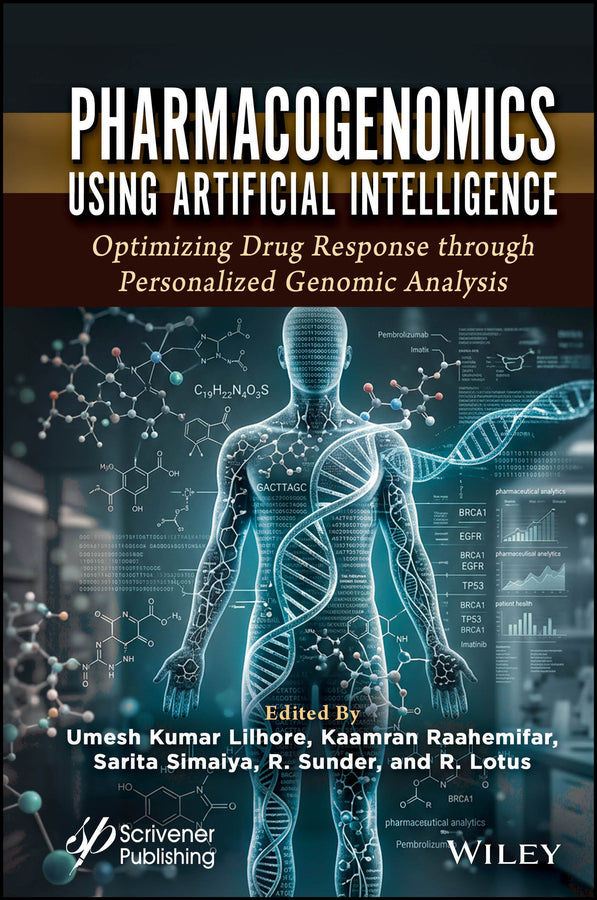
Pharmacogenomics Using Artificial Intelligence
Optimizing Drug Response through Personalized Genomic Analysis
Umesh Kumar Lilhore (Edited by), Kaamran Raahemifar (Edited by), Sarita Simaiya (Edited by), R. Sunder (Edited by), R. Lotus (Edited by)
9781394404438, Wiley
Hardback, published 2 July 2026
352 pages
22.9 x 15.2 x 2.2 cm, 0.604 kg
Bridging the critical gap between complex genomic data and actual clinical practice, this essential volume delivers the cutting-edge AI methodologies, expert bioinformatics insights, and practical case studies needed to unlock truly personalized medicine. The intersection of artificial intelligence and pharmacogenomics represents a transformative change in the life sciences industry. Pharmacogenomics, the study of how genetic variations influence an individual’s response to drugs, has long held the promise of enabling personalized treatments that are tailored to the genetic profile of individual patients, improving therapeutic outcomes and minimizing adverse drug reactions. However, the complexity of genomic data, massive scale of information, and challenge of interpreting the intricate relationships between genetic variations and drug responses have impeded the widespread implementation of personalized treatments in clinical practice. This volume explores how AI technologies are transforming personalized medicine by optimizing drug responses based on individual genetic profiles. The book will provide a comprehensive look at the role of AI in advancing pharmacogenomic research and its application in clinical practice, enabling healthcare professionals to predict the most effective and safest drugs for individual patients. The book will be structured around the application of cutting-edge AI techniques in analyzing genomic data. Each chapter will highlight different aspects of AI-driven pharmacogenomics, from drug development and genetic variant identification to clinical implementation and ethical considerations. Experts from diverse fields, including bioinformatics, pharmacology, and data science, will contribute insights into how AI can be harnessed to analyze large genomic datasets, predict patient-specific drug responses, and overcome existing challenges in precision medicine. This volume will not only provide theoretical knowledge but also offer practical examples, case studies, and methodologies that researchers, clinicians, and healthcare professionals can utilize to enhance pharmacogenomic research and personalize patient care.
Preface xv 1 Foundations of Pharmacogenomics: Understanding the Genetic Basis of Drug Response 1 1.1 Introduction 2 2 From Data to Therapy: Artificial Intelligence Applications in Pharmacogenomics 23 2.1 Introduction 24 3 Machine Learning Approaches for Genomic Data Analysis in Pharmacogenomics 49 3.1 Introduction 50Contents vii 4 Deep Learning and Neural Networks: Unlocking Complex Patterns in Genomic Medicine 75 4.1 Introduction 76 5 AI-Driven Drug Discovery: Accelerating Therapeutic Innovation through Genomics 101 5.1 Introduction 102 6 Personalized Medicine Through Pharmacogenomics and AI: A Precision Therapeutics Approach 125 6.1 Introduction 126 7 Real-World Use Cases of AI in Pharmacogenomic Decision Support Systems 149 7.1 Introduction 150 8 AI Algorithms for Predicting Drug Response in Diverse Populations: Bridging Pharmacogenomics and Precision Medicine 173 8.1 Introduction 174x Contents 9 Artificial Intelligence for Genetic Variant Detection and Interpretation 197 9.1 Introduction 198 10 Cardiovascular Pharmacogenomics: Genetic Predictors of Drug Response and Toxicity 219 10.1 Introduction 220 11 Wearable Devices and Real-Time Pharmacogenomic Monitoring 239 11.1 Introduction 240 12 Challenges and Limitations of Applying Artificial Intelligence in Pharmacogenomic Pipelines: Technical, Clinical, and Operational Perspectives 259 12.1 Introduction 260 13 Ethical Frameworks for Integrating AI in Pharmacogenomics: A Focus on Equity and Justice 285 13.1 Introduction 286 14 The Future of AI in Pharmacogenomics: Trends, Innovations, and Global Perspectives 307 14.1 Introduction 308 References 325
Dhanesh Kumar, Thangiah Sathishkumar, Sarangam Kodati, Venkata Praveen Kumar Vuppala, Rasmi A. and Rajakumar Perumal
1.2 Genetics of Drug Response Mechanisms 5
1.3 Clinically Actionable Examples 7
1.4 Implementation Frameworks and Clinical Integration 14
1.5 New Technologies and Emerging Trends 19
1.6 Conclusion 20
Yuvaraj Velusamy, L. Gandhimathi, Shaziya Islam, P. Jyothi, Saranya P. and S. Suresh
2.2 Data Foundations in AI-Driven Pharmacogenomics 28
2.3 AI Methodologies in PGx 32
2.4 Translating Data to Therapy: Key AI-Driven PGx Applications 36
2.5 Challenges and Limitations 39
2.6 Future Perspectives 42
2.7 Conclusion 45
Ashwin M., Sreenivas Mekala, V. Arun, Ashish, S. Mathumohan and K. Kaliraj
3.2 Related Works 51
3.3 Methodology 58
3.4 Results and Discussions 65
3.5 Conclusion 71
M. Sudharsan, K. Maithili, T. Ravi, Margaret Mary T., M. Rajesh Khanna and P. Eswaran
4.2 Related Works 78
4.3 Methodology 81
4.4 Results and Discussions 89
4.5 Conclusion 96
4.6 Future Directions of the Study 96
K. Prakash, Phani Kumar Solleti, Tarak Hussain, Chilukala Mahender Reddy, Margaret Mary T. and P. Arumugam
5.2 Related Works 104
5.3 Methodology 107
5.4 Results and Discussions 113
5.5 Conclusion 119
5.6 Future Directions 120
Dafik, Anto Lourdu Xavier Raj Arockia Selvarathinam, Priya K. V., Sreeram Indraneel, C. Ambhika and Ruth Ramya Kalangi
6.2 Related Works 128
6.3 Methodology 133
6.4 Results and Discussions 139
6.5 Discussion 143
6.6 Conclusion 145
6.7 Future Directions 146
Kayal Padmanandam, IsaiVani Mariyappan, Anitha D., Sachin Chandravadan Karad, Pooja P. Raj and Umesh Kumar Lihore
7.2 Background and Rationale 153
7.3 Methodology 155
7.5 Discussion 165
7.6 Challenges and Barriers to Implementation 167
7.7 Future Directions 168
7.8 Conclusion 169
Fathimathul Rajeena P.P., Rahoof P. P. and Sunder R.
8.2 Background 177
8.3 Methodology 180
8.4 Results and Findings 184
8.5 Conclusion 193
Lokendra Singh Songare, Narendra B. Mustare, Kamepalli Sujatha, Albin Kurian, Aparajita Mukherjee and Umesh Kumar Lilhore
9.2 Related Works 200
9.3 Methodology 204
9.4 Results and Findings 208
9.5 Conclusion 215
9.6 Future Directions 216
Sunder R., Shanimol Shajan, S. Anupkant, Donamol Joseph, D. Vetrithangam and Rasmi A.
10.2 Related Works 222
10.3 Methodology 225Contents xi
10.4 Results and Findings 227
10.5 Conclusion 236
10.6 Future Directions 236
P. Kavitha, Sruthy Sukumaran, Kavya Clare P. Shaji, S. Chinnapparaj, Veeraiyah Thangasamy and Sunder R.
11.2 Related Works 242
11.3 Methodology 246
11.4 Results and Findings 248
11.5 General Discussion 253
11.6 Conclusions 254
11.7 Future Directions 255
Yagyesh Godiyal, Maharani Abu Bakar, S. Madhusudhanan, Kochumol Abraham, Aparajita Mukherjee and Sunder R.
12.2 Thematic Analysis of Challenges 262
12.3 Identification of Repeated Patterns, Bottlenecks 269
12.4 Strategies to Minimize these Challenges 272
12.5 Real-World AI Applications in Pharmacogenomics 277
12.6 Conclusion 280
12.7 Future Research Directions 280
Ika Hesti Agustin, R. Kannamma, Nallametti Nagarjuna, Sheela S., D. Vetrithangam and Thilagavathi K.
13.2 Related Works 288
13.3 Research Design 292
13.4 Results and Findings 295
13.5 Conclusion and Future Work 303
Sanaj M.S., Minnuja Shelly, Asha S., Nor Asilah Wati Abdul Hamid, S. Mathumohan and Sudhir Ramadass
14.2 Foundations of AI in Pharmacogenomics 311
14.3 Present Developments in Pharmacogenomics Using AI 313
14.4 Innovations and Emerging Technologies 317
14.5 Global Perspectives and Trends 320
14.6 Challenges and Limitations 322
14.7 Future Directions 323
14.8 Conclusion 324
Index 329
Subject Areas: Chemistry [PN]