Freshly Printed - allow 7 days lead
Couldn't load pickup availability
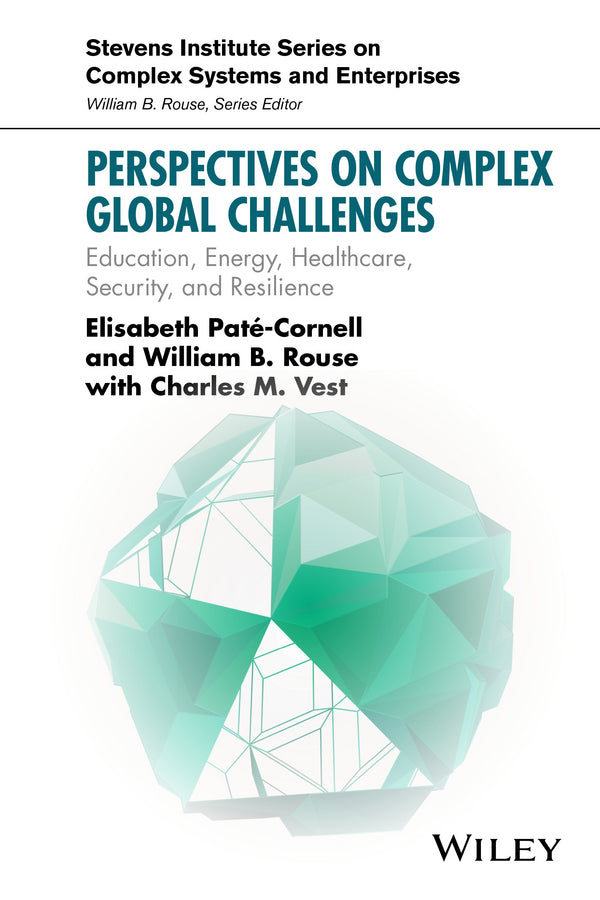
Perspectives on Complex Global Challenges
Education, Energy, Healthcare, Security, and Resilience
Elisabeth Pate-Cornell (Author), William B. Rouse (Author), Charles M. Vest (With)
9781118984093, Wiley
Paperback / softback, published 2 September 2016
240 pages
23.4 x 15.8 x 1.3 cm, 0.345 kg
Examines current and prospective challenges surrounding global challenges of education, energy, healthcare, security, and resilience This book discusses issues in large-scale systems in the United States and around the world. The authors examine the challenges of education, energy, healthcare, national security, and urban resilience. The book covers challenges in education including America's use of educational funds, standardized testing, and the use of classroom technology. On the topic of energy, this book examines debates on climate, the current and future developments of the nuclear power industry, the benefits and cost decline of natural gases, and the promise of renewable energy. The authors also discuss national security, focusing on the issues of nuclear weapons, terrorism and cyber security. Urban resilience is addressed in the context of natural threats such as hurricanes and floods. Perspectives on Complex Global Challenges: Education, Energy Healthcare, Security, and Resilience serves as a reference for government officials, personnel in security, business executives and system engineers.
Contributors xiii Introduction and Overview 1 Can America Still Compete? 17 Section I Education 21 1 Introduction 23 Overview of Contributions 28 References 30 2 K-12 Education Reform in the United States 33 Great Teachers 35 High Expectations 36 Tension in the System 36 Intelligent use of Technology in the Classroom 37 Make Education Relevant for the Student 38 3 Secure America’s Economic Future by Investing in Young Children 41 Reference 43 Recommended Readings 43 4 The Future of Teaching in the United States 45 References 48 5 The Conundrum of Controlling College Costs 49 References 52 6 Military Education 53 Section II Energy 59 7 Introduction 61 Energy Demand 62 The Electric Grid 64 Nuclear Power 65 Renewable Energy 66 Role of Consumers 67 Overview of Contributions 69 References 71 8 The Future of the US Electric Grid 73 System Organization 73 Bulk Power 74 Distribution 76 Cybersecurity 78 Concluding Observations 78 9 The Revolution in Natural Gas 81 10 The Future of Nuclear Power in the United States 85 11 Renewable Energy: Balancing Risk and Reward 89 Section III Healthcare 93 12 Introduction 95 Driving Forces 96 Complexity of Decision Making 98 Value and Healthcare Delivery 98 Overview of Contributions 100 References 102 13 How to Move Toward Value-Based Healthcare? 105 Recommended Readings 107 14 Delivering on the Promise to Reduce the Cost of Healthcare with Electronic Health Records 109 Recommended Readings 112 15 Big Data in Health and Healthcare: Hopes and Fears for the Future 113 16 Medical Education: One Size Does not Fit All 117 Section IV Security 121 17 Introduction 123 Emergence of Non-State Powers and Terrorist Groups 123 Resizing the US Nuclear Arsenal 124 Cybersecurity 125 Intelligence 126 Biological Weapons 126 US Defense Budget 127 Overview of Contributions 128 References 132 18 Vigilance in an Evolving Terrorism Landscape 133 19 The Market’s Role in Improving Cybersecurity 139 References 144 20 On Nuclear Weapons 145 21 The Nuclear Security Challenge: It is International 147 22 Nuclear Weapon Reductions Must be Part of Strategic Analysis 151 23 Maintaining us Leadership in Science Technology and Innovation for National Security 155 Section V Resilience 159 24 Introduction 161 Framework for Urban Resilience 162 Potential Approaches 163 Overview of Contributions 164 References 167 25 Urban Resilience: How Cities need to Adapt to Unanticipated and Sudden Change 169 References 171 26 Buying Down Risks and Investing in Resilience 173 References 177 27 Resilience from the Perspective of a Chief Urban Designer 179 28 Engineering for Resilience: Ten Commandments of the Dutch Approach 183 System of Systems 186 Public Expertise 187 Crowded House 188 Co-Governance 188 Clear Direction 189 Executive Leadership 190 International Bat Strategy 191 Implementation Democracy 191 Shared Service 193 Checks and Balances 193 References 194 Conclusions 195 Index 197
Elisabeth Paté-Cornell, William B. Rouse, and Charles M. Vest
Norman R. Augustine
Craig R. Barrett
Deborah J. Stipek
Linda Darling-Hammond
Lawrence S. Bacow
William J. Perry
Richard Schmalensee
John Deutch
Richard A. Meserve
Richard H. Truly and Michal C. Moore
Denis A. Cortese and Robert K. Smoldt
William W. Stead
Elizabeth A. McGlynn
Lloyd B. Minor and Michael M.E. Johns
Michael E. Leiter
Herbert Lin
George P. Shultz
Siegfried S. Hecker
Henry A. Kissinger and Brent Scowcroft
Jacques S. Gansler
Michael Batty
Richard Reed
Alexandros Washburn
Theo Toonen
Subject Areas: Electronics & communications engineering [TJ]