Freshly Printed - allow 10 days lead
Couldn't load pickup availability
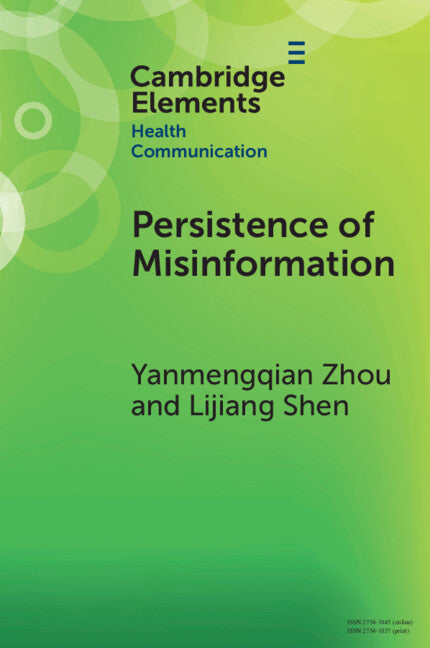
Persistence of Misinformation
Biased Cognitive Processing and Polarization
Reviews and analyses the underlying mechanisms why health-related misinformation persists despite fact-checking efforts.
Yanmengqian Zhou (Author), Lijiang Shen (Author)
9781009397377, Cambridge University Press
Paperback / softback, published 6 February 2025
66 pages
22.8 x 15.1 x 0.4 cm, 0.11 kg
Misinformation can be broadly defined as information that is inaccurate or false according to the best available evidence, or information whose validity cannot be verified. It is created and spread with or without clear intent to cause harm. There is well-documented evidence that misinformation persists despite fact-checking and the presentation of corrective information, often traveling faster and deeper than facts in the online environment. Drawing on the frameworks of social judgment theory, cognitive dissonance theory, and motivated information processing, the authors conceptualize corrective information as a generic type of counter-attitudinal message and misinformation as attitude-congruent messages. They then examine the persistence of misinformation through the lens of biased responses to attitude-inconsistent versus -consistent information. Psychological inoculation is proposed as a strategy to mitigate misinformation.
1. Introduction
2. The Processing of Misinformation vs. Corrective Information
3. Inoculation as a Mitigation Strategy
4. Conclusion.
Subject Areas: Linguistics [CF]