Freshly Printed - allow 10 days lead
Couldn't load pickup availability
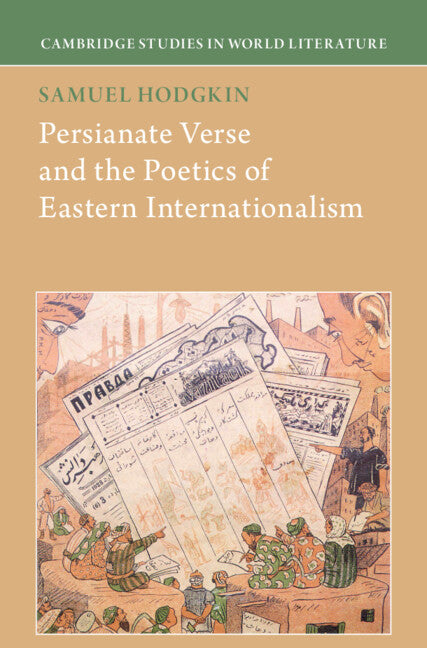
Persianate Verse and the Poetics of Eastern Internationalism
This book shows how Persianate poetics and communist internationalism brought together 20th-century writers from across Eurasia.
Samuel Hodgkin (Author)
9781009411639, Cambridge University Press
Hardback, published 21 December 2023
312 pages
23.5 x 15.5 x 2.3 cm, 0.58 kg
'… delightful… Throughout the book, genres, poems, authors, and modes of reading are in constant and often dizzying movement across eras and between languages … Hodgkin's analysis relies on minute examination of words and images, all interpreted against a detailed knowledge of Persian and Soviet literary culture. Yet one of the enduring legacies of the Soviet partition of the literary commons is that, all too often, these writers are now encountered not through the medium of their words but through the media of the streets, parks, theaters, statues, and even cities named in honor of the writers' continued roles as national figureheads. In this respect, Hodgkin's devotion to close reading can read as an homage to the sociality of adab, a quixotic defense of a world in which writers mattered because words mattered.' Gabriel McGuire, Iranian Studies
At the height of literary nationalisms in the twentieth century, leftist internationalists from Turkey, Iran, Afghanistan, India, and the Soviet East bonded over their shared love of the classical Persian verses of Hafiz and Khayyam. At writers' congresses and in communist literary journals, they affirmed their friendship and solidarity with lyric ghazals and ruba'iyat. Persianate poetry became the cultural commons for a distinctively Eastern internationalism, shaping national literatures in the Soviet Union, the Middle East, and South Asia. By the early Cold War, the literary entanglement between Persianate culture and communism had established models for cultural decolonization that would ultimately outlast the Soviet imperial project. In the archive of literature produced under communism in Persian, Tajik, Dari, Turkish, Uzbek, Azerbaijani, Armenian, and Russian, this book finds a vital alternative to Western globalized world literature.
Introduction. Persianate/Eastern/International: Geographies, forms, periodizations
1. Tribunes: the newspaper poetry of Eastern revolution, 1905–1925
2. Canons: Classical Persianate voices in national and international literary institutions, 1921–1948
3. Occasions: context collapse in the multinational system of socialist realism, 1934–1938
4. Translations: sentimental internationalism and its Eastern love languages, 1941–1972
5. Recognitions: persianate internationalism at the ends of Soviet empire, 1958–2023
Conclusion. Old verses for a Persianate internationalist future.
Subject Areas: Literary studies: general [DSB]