Freshly Printed - allow 10 days lead
Couldn't load pickup availability
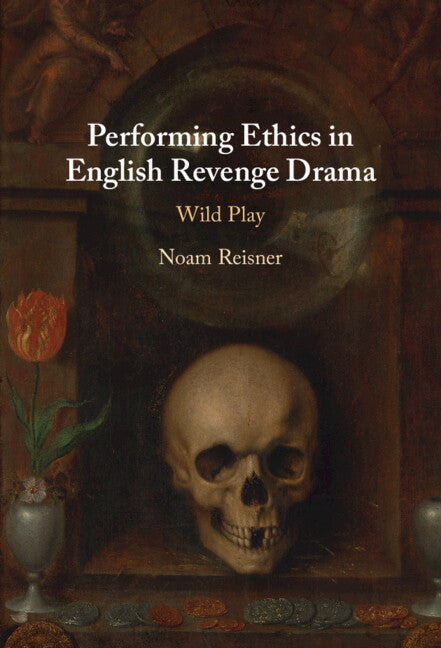
Performing Ethics in English Revenge Drama
Wild Play
An investigation of how Renaissance English revenge drama carried out important ethical work through audience participation and metatheatre.
Noam Reisner (Author)
9781009462440, Cambridge University Press
Hardback, published 27 June 2024
292 pages
23.6 x 16.2 x 2.2 cm, 0.58 kg
'Performing Ethics in English Revenge Drama offers fresh, historically and philosophically grounded insights into early modern revenge tragedy, opening up new ways of understanding works by Marlowe, Marston, Chettle, Middleton, and others. Reisner makes a compelling case for how these playwrights used Kyd's precedent to interrogate the gap between abstract moral thought and the possibilities of ethical action.' Gretchen E. Minton, Professor of English, Montana State University
Adapting Francis Bacon's notion of revenge as a 'kind of wild justice', Noam Reisner shows how English Renaissance revenge drama takes the form of 'wild play'. These plays drew on complicated modes of audience participation and devices of metatheatricality, allowing audiences to test how abstract moral or ethical concepts play out in a performative arena of human action. Reisner demonstrates that their overwhelming popularity is best understood in terms of these 'mimetic ethical exercises' which they generated for their audiences. This study surveys a range of revenge plays from the period's commercial theatre, beginning with Kyd's The Spanish Tragedy and tracking the development of similar plays responding to Kyd's original design in late Elizabethan and early Jacobean drama. In the process it also provides a stage history of Kydian revenge drama with fresh readings of select plays by Marlowe, Shakespeare, Marston, Middleton and other early Jacobean playwrights.
Introduction: the mimetic ethical exercise
1. Plot holes and empty spaces: the ethics of Thomas Kyd's revenge paradigm
2. Dramatic hyperboles: Marlowe's and Shakespeare's early engagement with Kyd
3. Wild child's play: antitheatrical moral censure and Marston's revenge satire
4. Marking the ground of revenge: Hamlet's impasse and the question of spectator guilt
5. Ghosting Shakespeare's Hamlet: Hamlet's violent afterlives in the plays of Chettle and Middleton
6. Passive aggressors: Chapman's and Tourneur's moralistic revenge
Epilogue
Bibliography
Index.
Subject Areas: Literary studies: general [DSB]