Freshly Printed - allow 7 days lead
Couldn't load pickup availability
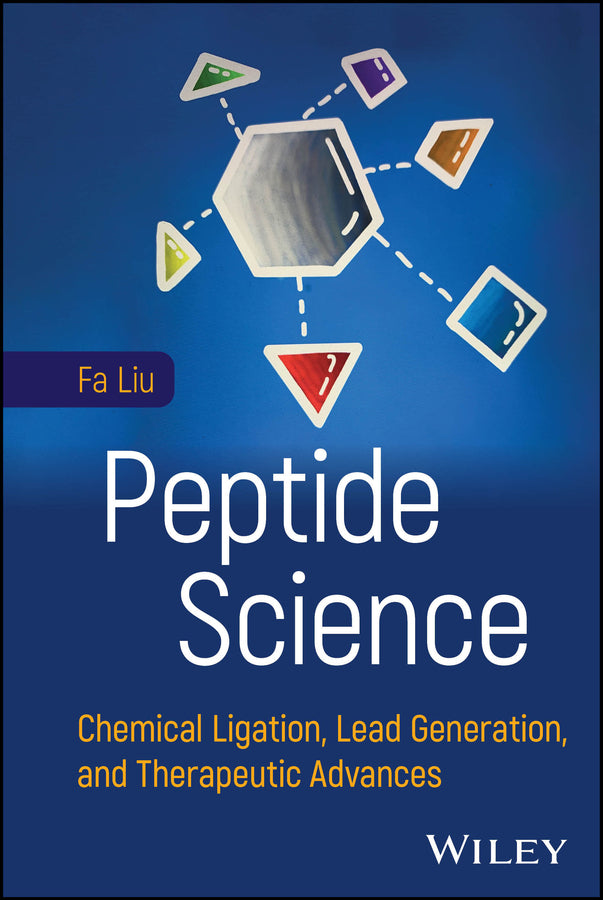
Peptide Science
Chemical Ligation, Lead Generation, and Therapeutic Advances
Fa Liu (Edited by)
9781119824671, Wiley
Hardback, published 15 July 2025
544 pages
28 x 19 x 3.3 cm, 1.021 kg
Understand the nature and applications of peptides with this clear and comprehensive guide Peptides are signaling molecules comprised of amino acids which play an important role in modulating certain physiological processes. They have a wide range of applications, particularly with respect to biological studies and therapeutical potentials. The explosive growth of peptide science in recent years and the variety of achievements in peptide drug discovery and related areas have made it an important area of study for new researchers and industry professionals. Peptide Science offers a clear, systematic overview of this burgeoning field and its major applications. Covering the chemistry, the pertinent technologies, and major existing therapies, it provides the tools required to integrate peptide research with virtually any area of research and development. Fully cognizant of the latest technological advances, it’s a must-own for anyone looking to understand a vital field of chemistry. Peptide Science readers will also find: Peptide Science is ideal for industry professionals and researchers in organic chemistry, peptide science/chemistry, protein chemistry, biochemistry, and pharmaceutical sciences.
List of contributors xiii Preface xvii Section I New Developments in Peptide Chemistry 1 1 Chemical Peptide Ligations 3 1.1 Introduction 3 1.2 Ligation Driven by Trans-esterification 4 1.3 Ligation Driven by Imine Capture 8 1.4 Ligation Initiated by Hydroxylamine 10 1.5 Ligation in Protein Synthesis 12 1.6 Ligations in Drug Development 17 1.7 Summary and Outlook 21 2 Protein and Peptide Ligation Using Peptide Ligases 29 2.1 Introduction 29 2.2 Peptide Ligases Mechanism of Action 32 2.3 Sortase 33 2.4 Peptide Asparaginyl Ligases 38 2.5 Subtilisin-derived Peptide Ligases 41 2.6 Trypsiligase 44 2.7 Conclusion 46 3 Modern Methods for Late-stage Peptide Modification 55 3.1 Introduction 55 3.2 Methionine 57 3.3 Aspartate and Glutamate 59 3.4 Arginine 61 3.5 Tryptophan 62 3.6 Functionalization of sp2 C-H Bonds: Tyr, Phe, and His 66 3.7 Functionalization of sp3 C-H Bonds 71 3.8 Other X-H Functionalizations 73 3.9 Conclusion 74 Section II Peptide Drug Hit Identification 87 4 Generating Phage Libraries Bearing Unnatural Pharmacophores 89 4.1 Introduction 89 4.2 Biotin Capture Assay to Detect Chemical Modification of Phage Libraries 93 4.3 N-terminal Oxidation and Functionalization to Incorporate Unnatural Fragments 106 4.4 Macrocyclization of Phage-displayed Peptides Bearing Cysteines 110 4.5 Macrocyclization and Installation of Warheads in Phage-displayed Libraries 114 4.6 Outlook 120 5 Computational Peptide Design for Diverse Structures and Functions 127 5.1 The Various Types of Peptides 128 5.2 In Silico Peptide Design: From Physics-based Methods to DL 129 5.3 Physics-based Methods 130 5.4 DL Methods for Peptide Design 136 5.5 Optimizing for Membrane Permeability and Stability 140 5.6 Remaining Challenges 141 5.7 Conclusion 143 Section III Peptide Drug Lead Generation and Optimization 151 6 Peptide Discovery: Lead Generation 153 6.1 Introduction 153 6.2 Approved Drugs Discovered Through Phage Display 174 6.3 Approved Drugs Discovered Through mRNA Display 177 6.4 A Successful Example 185 6.5 Conclusion 188 7 A Survey and Guide to the Development of Fatty Acid-derivatized Peptide Therapeutics 203 7.1 Introduction 203 7.2 Basics of Fatty Acid Derivatization of Peptides 204 7.3 Evolution of GLP-1-based Incretins into Stable, Long-acting Therapeutics 205 7.4 Diverse Mechanisms of Fatty Acid Derivatization to Extend Insulin Half-life 210 7.5 Development of a Stable, Fatty Acid-derivatized Amylin Analog 214 7.6 Stabilization and Fatty Acid Derivatization of Peptide YY (PYY) 217 7.7 Guidance for Advancing Fatty Acid-derivatized Peptides 222 7.8 Concluding Remarks 242 Section IV Peptide Drug Case Studies 269 8 Insulin in Its Second Century: History, Evolution, and Aspirations 271 8.1 Introduction 271 8.2 The Evolution of Insulin Therapy 272 8.3 Structure 278 8.4 Synthesis 280 8.5 Aspirational Aims 286 8.6 Concluding Thoughts 290 9 Incretins and Development of Incretin-based Therapeutics 305 9.1 Introduction 305 9.2 Development of Novel GLP-1 and GIP-based Therapeutics 309 9.3 Development of Multi-receptor Agonists Targeting Incretin and Other Hormonal Receptors 315 9.4 Summary and Perspective 329 10 Peptide-based Therapeutics for Inflammatory and Autoimmune Diseases 339 10.1 Introduction 339 10.2 Literature Search and Methods 341 10.3 Representative Anti-inflammatory Peptides in Clinical Trials 342 10.4 Summary and Discussion 351 11 Radioligand as a Unique Rising Modality for Cancer Diagnosis and Treatment 359 11.1 Radioligand Introduction 359 11.2 Radionuclides and Chelators Developed for Medical Imaging and Cancer Treatment 361 11.3 Notable Radioligands Developed for Cancer Diagnosis and Treatment 364 11.4 Emerging Targets 371 11.5 Emerging Binder Modalities as Radioligand Vector 379 11.6 Perspectives: Promises and Challenges 384 12 Peptide-small Molecule Drug Conjugates for Cancer, Metabolic Diseases, and Beyond 401 12.1 Introduction 401 12.2 Peptide-drug Conjugates for Cancer 402 12.3 Peptide-drug Conjugates for Metabolic Diseases 409 12.4 Peptide-drug Conjugates for Other Diseases 415 12.5 Challenges in Peptide-drug Conjugate Design 415 12.6 Summary 416 13 Emerging Landscape of Therapeutic Oligonucleotide Delivery by Cell-penetrating Peptide 425 13.1 Introduction 425 13.2 Cell-penetrating Peptides 426 13.3 Applications of CPPs for the Delivery of Therapeutic Oligonucleotides 433 13.4 Future Perspectives and Summary 447 Section V Peptide CMC and Regulatory 469 14 Peptides Chemistry, Manufacturing, and Controls 471 14.1 Introduction 471 14.2 CMC Information and Format for DS 472 14.3 CMC Information and Format for DP 477 14.4 Synthetic Peptide CMC Development 483 14.5 Conclusions 504 Index 509
Yihui Cao and Xuechen Li
Anna Koijen and Leendert J. van den Bos
Yuxuan Ding and Zachary T. Ball
Christin Kossmann, Arunika Ekanayake and Ratmir Derda
Stephen Rettie, David Juergens and Gaurav Bhardwaj
Yvonne Angell, Wendy Hartsock, Hans Melo and Timothy M. Reichart
Michael T. Jacobsen, Christian Poulsen, Katharina L. Kopp, Jørgen Olsen and Nick Cox
John P. Mayer, Kishore Thalluri, Ethan Mickelson, Michael H.B. Stowell and Richard D. DiMarchi
Nan Zheng, Xiao-xuan Su, Shengping Zhang and Weijun Shen
Sunay V. Chankeshwara, Werngard Czechtizky and Wu Su
Ming-Jin Jheng, Xiaozhu Wang, Pengyun Li and Fa Liu
Rongjun He, Sumeet Singh and Adam Mezo
Xiang Li, Xiulong Shen, Ashweta Sahni and Ziqing Qian
Jack Xu
Subject Areas: Chemistry [PN]