Freshly Printed - allow 7 days lead
Couldn't load pickup availability
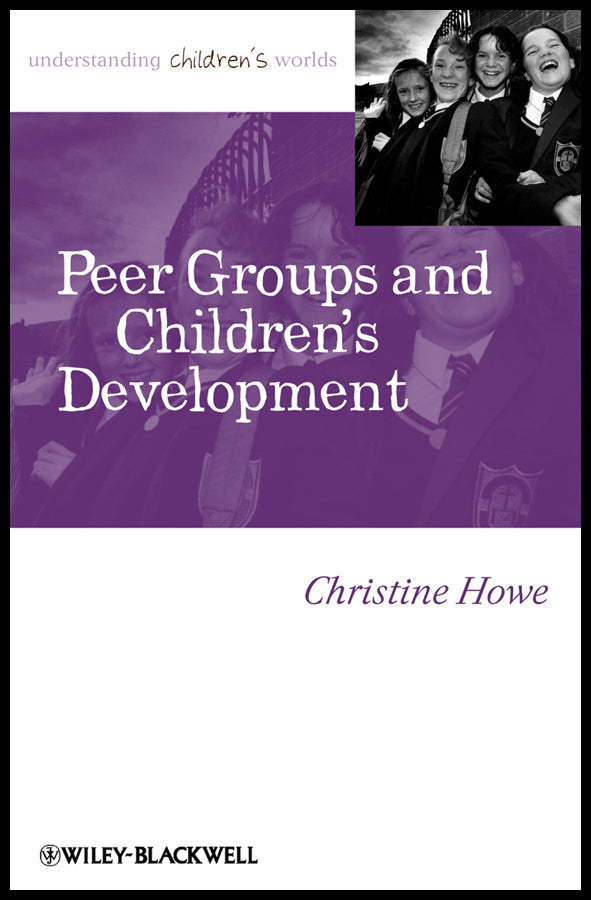
Peer Groups and Children's Development
"This is the book that we were all expecting from Christine Howe: truly interdisciplinary and at the crossroads of psychology and education. It is well-informed – a bridge between the many insights of researchers and educationalists from all over the world. But it also faces difficult issues, and puts them under the scrutiny of experimental and observational evidence without being afraid to go against some established beliefs. Compulsory reading for all those interested in the consequences of children's peer group experience in the classroom." "Christine Howe's thoroughly researched book offers a thoughtful analysis of the wide literature on children’s experiences of the peer group and its profound influence on their social, emotional and educational development. Practitioners and researchers will be enthralled and inspired by this sensitive and informed account of the social-cultural contexts in which children learn and grow." "This important book offers an engaging and accessible introduction to the contemporary literature concerning the developmental significance of children's peer groups. It is a distinctive work, not least because it emphasises the role of peers in children's well-being, when so much other work has chosen to focus on their negative impact." “This is an excellent and timely book; scholarly and intellectually coherent, yet accessible to practitioners.”
—Professor Anne-Nelly Perret-Clermont, Institute of Psychology and Education, University of Neuchâtel
—Helen Cowie, Research Professor, University of Surrey, UK
—Professor Karen Littleton, The Open University, UK
—Peter Blatchford, University of London
Christine Howe (Author)
9781405179454, Wiley
Hardback, published 22 January 2010
248 pages
23.9 x 16 x 2.1 cm, 0.499 kg
""Both undergraduate and graduate students and researchers in education, child
psychology, developmental psychology, and social psychology would find the book, or
particular chapters, useful as they explore the nature of peer groups in educational settings.
Researchers in psychology will become better aware of the many facets of school and
classroom life that should be considered when studying children in the classroom context". (PsycCritiques, 8 December 2010)
"
"The experiences of schoolchildren with their peer groups and the implications for social, personal and intellectual development are considered here, as Howe reviews and integrates literature relating to classroom and out-of-class settings. The text is intended to address psychologists' and educationalists' research concerns, as well as the practical concerns of teachers, parents, counsellors and policymakers." (Times Higher Education, November 2010)
Peer Groups and Children's Development considers the experiences of school-aged children with their peer groups and its implications for their social, personal and intellectual development
Series Editor’s Preface. Acknowledgments. 1. Peer Groups in a Cultural Context. Introduction. Cultural Dependency. Theoretical Framework. Peer Groups and Children’s Development. 2. Peer Groups and Classroom Structure. Introduction. The Peer Group Structure of Classes. The Structure of Classroom Subgroups. Summary and Conclusions. 3. Performance and Cooperation in Classrooms. Introduction. Whole-Class Interaction and the Performance Mode. Subgroup Interaction and the Cooperative Mode. Summary and Conclusions. 4. Cooperative Interaction and Curriculum Mastery. Introduction. Piagetian Perspectives on Cooperative Interaction. Assistance and Cooperative Interaction. The Social Impact of Classroom Interaction. 5. Friendship, Status, and Centrality. Introduction. Children’s Friendships. Peer Status in Formal Groups. Status in Friendship Groups. 6. Individual Differences in Informal Experiences. Introduction. Varying Experiences of Status. Friendship and Status Compared. Continuity and Change. 7. Social and Personal Adjustment. Introduction. Peer Groups and Antisocial Behavior. Peer Groups and Personal Adjustment. Summary and Conclusions. 8. School Performance Revisited. Introduction. Peer Groups and Educational Failure. Diverse Consequences of Friendship. Classroom Practice and Developmental Outcomes. 9. Implications for Practice and Future Research. Summary and Introduction. Remedial Work with Individuals. Qualified Endorsement of the Cooperative Approach. Future Research and Theoretical Development. References. Index.
Subject Areas: Psychology [JM]