Freshly Printed - allow 10 days lead
Couldn't load pickup availability
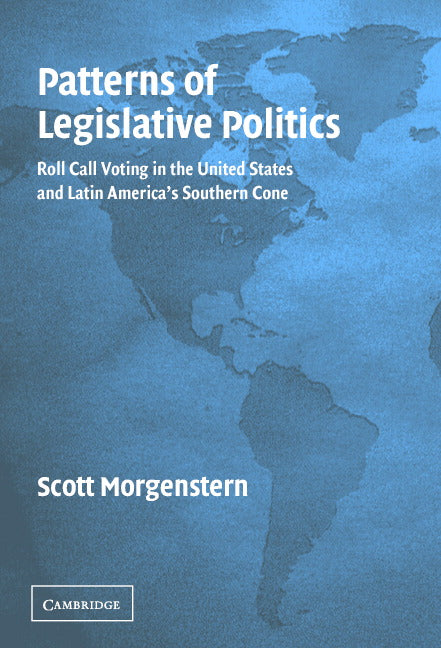
Patterns of Legislative Politics
Roll-Call Voting in Latin America and the United States
This book uses roll call data to explore legislative politics in Argentina, Brazil, Chile and Uruguay.
Scott Morgenstern (Author)
9780521820561, Cambridge University Press
Hardback, published 3 November 2003
240 pages
23.5 x 15.9 x 2.3 cm, 0.48 kg
"Morgenstern argues persuasively...writes clearly and details both the case for his conclusions and the limits to his claims. A pathbreaking study. Highly recommended." C.H. Blake, James Madison University, CHOICE
Using the United States as a basis of comparison, this book makes extensive use of roll call data to explore patterns of legislative politics in Argentina, Brazil, Chile and Uruguay. It distinguishes among parties, factions, coalitions and delegations based on the extent to which they are unified in their voting and/or willing to form policy coalitions with other legislative 'agents'. It discusses the voting unity and ballot systems that allow voters to identify an agent, and describes the degree to which those agents have been flexible with regards to the formation of policy coalitions. It also shows that the US parties have exhibited higher levels of unity but less flexibility in recent years, and thus contrast the prevailing pattern in Latin America. The book focuses its explanation for the patterns on the role of candidate nominations, other aspects of the electoral system and the legislators' ideological alignments.
Introduction: party, faction, and coalitions, names and abbreviations
1. Pattern of legislative politics: identifiability and flexibility
2. Representation and the agent system
3. Identifying agents
4. Influences on agent unity: discipline and cohesion
5. Explaining voting unity
6. Policy coalitions and agent flexibility
7. Conclusion.
Subject Areas: Political parties [JPL], Politics & government [JP]