Special Order - allow 2+ weeks lead
Couldn't load pickup availability
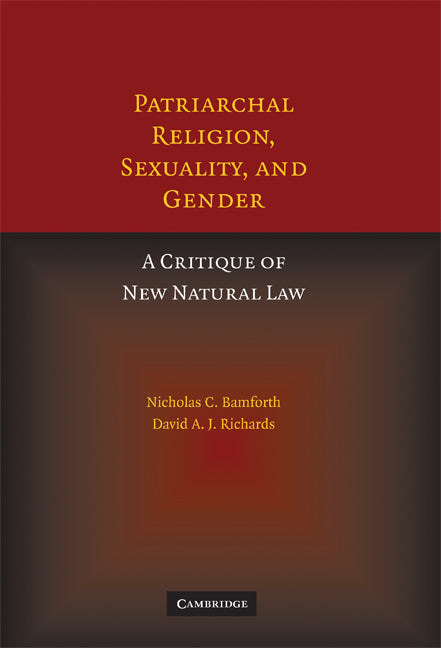
Patriarchal Religion, Sexuality, and Gender
A Critique of New Natural Law
This book examines the patriarchal nature of fundamental Christianity and offers a critique of the new natural lawyers' school of thought.
Nicholas Bamforth (Author), David A. J. Richards (Author)
9780521868631, Cambridge University Press
Hardback, published 6 December 2007
416 pages
24 x 16.1 x 2 cm, 0.726 kg
'Nicholas Bamforth and David A. J. Richards make a full frontal attack on the philosophical consistency, social relevance, and political desirability of new natural law … will be welcomed … this text presents challenging philosophical insights as well as informative commentary on the role of doctrinal religion in the construction of seemingly secular law. … constructive mode … meticulously argued, well-written, and thoroughly annotated … provides a detailed map of the philosophical, personal, and political affiliations between Grisez, Finnis, George and, most importantly, it closely traces their arguments to 'illiberal prescriptions' concerning sexuality and gender. … This is the gap in the philosophical investigation of new natural law that the text wishes to fill.' Politics and Religion
Legal theorists are familiar with John Finnis's book Natural Law and Natural Rights, but usually overlook his interventions in US constitutional debates and his membership of a group of conservative Catholic thinkers, the 'new natural lawyers', led by theologian Germain Grisez. In fact, Finnis has repeatedly advocated conservative positions concerning lesbian and gay rights, contraception and abortion, and his substantive moral theory (as he himself acknowledges) derives from Grisez. Bamforth and Richards provide a detailed explanation of the work of the new natural lawyers within and outside the Catholic Church - the first truly comprehensive explanation available to legal theorists - and criticize Grisez's and Finnis's arguments concerning sexuality and gender. New natural law is, they argue, a theology rather than a secular theory, and one which is unappealing in a modern constitutional democracy. This book will be of interest to legal and political theorists, ethicists, theologians and scholars of religious history.
1. New natural law in context
2. The architecture and reach of new natural law
3. Criteria for evaluating new natural law
4. Internal consistency: is new natural law secular?
5. Internal consistency: is new natural law Thomistic?
6. Substantive appeal: what's wrong with homophobia and sexism?
7. Substantive appeal: new natural law, sexism, and homophobia
8. Substantive appeal: moral absolutes and the inconsistent fundamentalism of new natural law
9. New natural law and patriarchal religion
10. Conclusions: Christian alternatives to new natural law.
Subject Areas: Jurisprudence & philosophy of law [LAB], Social & political philosophy [HPS]