Freshly Printed - allow 10 days lead
Couldn't load pickup availability
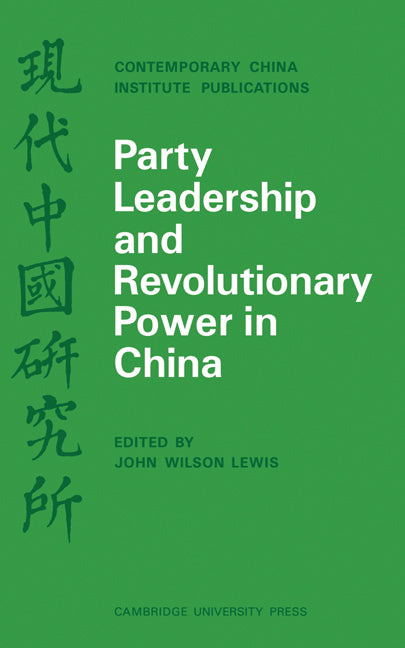
Party Leadership and Revolutionary Power in China
Essays by twelve leading scholars give readers insight into the workings of politics in Communist China.
John Wilson Lewis (Edited by)
9780521096140, Cambridge University Press
Paperback / softback, published 2 July 1970
432 pages
20.3 x 12.7 x 0.2 cm, 0.47 kg
Originally published in 1970, this volume consists of essays by twelve leading scholars from the United States and Britain, all of whom concentrated their studies on the problems of China. Their papers were originally written for a conference on the Chinese Communist Party, held at Ditchley Park, England, in July 1968. During the discussions, a number of themes emerged as the factors governing the evolution of the Party. These related to problems of leadership, power and the revolutionary struggle within the Party and their effect on Chinese society. The authors subsequently revised their papers, highlighting these problems within the realm of their own subject, ranging from the power elite and the Central Committee to the village leadership and the role of the Army. The editor, in his introduction, throws further light on the leadership and power struggle, on Mao's role and on the effects of the Great Cultural Revolution.
Preface Stuart R. Schram
Introduction John Wilson Lewis
Acknowledgements
Part I. The Changing Role of the Communist Party in the Revolutionary Struggle: 1. The influence of the past: how the early years helped to shape the future of the Chinese Communist Party C. Martin Wilbur
2. Transfer of legitimacy in the Chinese Communist Party: origins of the Maoist myth William F. Dorrill
3. The roles of the monolithic party under the totalitarian leader Leonard Schapiro and John Wilson Lewis
Part II. The Power Elite in Theory and Practice: 4. The reign of virtue: some broad perspectives on leader and Party in the Cultural Revolution Benjamin I. Schwartz
5. The Party in Chinese Communist ideology Stuart R. Schram
6. Factionalism in the Central Committee Philip Bridgham
Part III. The Communist Party and Chinese Society After the Take-Over: 7. Keeping the revolution going: problems of village leadership after land reform Thomas P. Bernstein
8. Party policies towards the intellectuals: the unique blooming and contending of 1961–2 Merle Goldman
9. Getting ahead and along in Communist China: the ladder of success on the eve of the Cultural Revolution Michel Oksenberg
Part IV. The New View of Power in the Cultural Revolution Donald W. Klein
11. Army-Party relations in the light of the Cultural Revolution John Gittings
Contributors
Index.
Subject Areas: General & world history [HBG]