Freshly Printed - allow 8 days lead
Couldn't load pickup availability
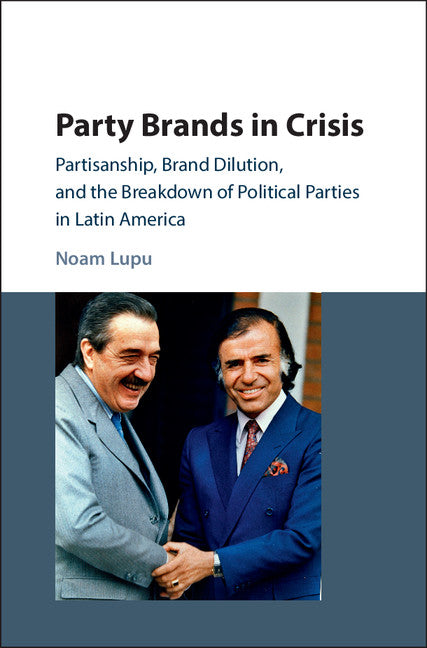
Party Brands in Crisis
Partisanship, Brand Dilution, and the Breakdown of Political Parties in Latin America
Party Brands in Crisis offers a new way of thinking about how the behavior of political parties affects voters' attachments.
Noam Lupu (Author)
9781107073609, Cambridge University Press
Hardback, published 15 January 2016
264 pages, 23 b/w illus.
23.5 x 15.8 x 2.3 cm, 0.56 kg
'Lupu provides here a very significant contribution to the literature on political parties, and especially to our understanding of Latin American politics. He develops a novel and insightful theory about party brands and their erosion based on ideological convergence and negative performance. He tests the implications of his theory making an impressive use of multiple methodologies to explain party breakdown in Latin America. Moreover, the implications of his study go beyond the region as suggested by his exploration of the relationship between polarization and party brands. In sum, this book is most likely to generate a new research agenda for the study of political parties, which will have a long-lasting effect on the discipline.' M. Victoria Murillo, Columbia University, New York
Why have so many established political parties across Latin America collapsed in recent years? Party Brands in Crisis offers an explanation that highlights the effect of elite actions on voter behavior. During the 1980s and 1990s, political elites across the region implemented policies inconsistent with the traditional positions of their party, provoked internal party conflicts, and formed strange-bedfellow alliances with traditional rivals. These actions diluted party brands and eroded voter attachment. Without the assured support of a partisan base, parties became more susceptible to short-term retrospective voting, and voters without party attachments deserted incumbent parties when they performed poorly. Party Brands in Crisis offers the first general explanation of party breakdown in Latin America, reinforcing the interaction between elite behavior and mass attitudes.
1. Why do parties break down?
2. Brand dilution and party breakdown
3. Explaining party breakdown across Latin America
4. Argentina - Peronism survives, radicals collapse
5. Venezuela - AD and COPEI break down
6. Party brands and mass partisanship - experimental evidence
7. Party brands and mass partisanship in comparative perspective
8. Parties, partisanship, and democracy: conclusions.
Subject Areas: Regional government [JPR], Political parties [JPL], Comparative politics [JPB]