Freshly Printed - allow 10 days lead
Couldn't load pickup availability
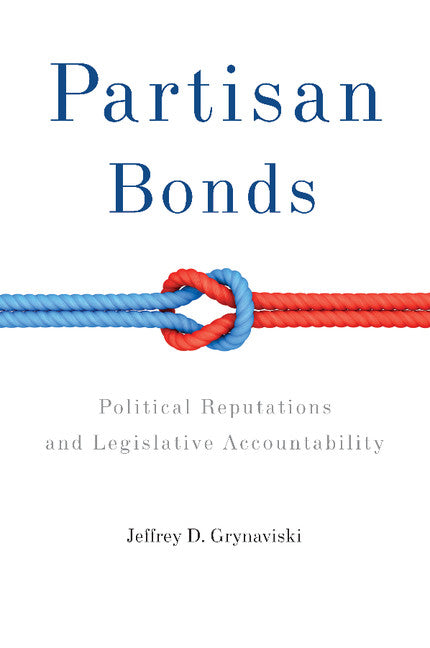
Partisan Bonds
Political Reputations and Legislative Accountability
Argues that voters rely on partisan cues because party brand names provide credible information about how politicians are likely to act in office.
Jeffrey D. Grynaviski (Author)
9780521757508, Cambridge University Press
Paperback / softback, published 22 August 2013
262 pages, 23 b/w illus. 18 tables
22.9 x 15.2 x 1.5 cm, 0.41 kg
“Partisan Bondsis political science at its best. Grynaviski analyzes a plethora of data (election results, congressional voting scores, public opinion surveys, etc.) using multiple tools of political science (formal theory, the historical record, and multivariate analysis) to answer an important question (how parties facilitate elections) with varied data (election results, congressional voting scores, public opinion surveys, etc.). His argument that party leaders invest in party reputations to develop party labels that provide credible cues to the voters is an important corrective to the conventional wisdom. Partisan Bondsis a must-read for anyone interested – and everyone ought to be interested – in how American democracy works.”
– Sean Theriault, University of Texas at Austin
Political scientists have long painted American voters' dependence on partisan cues at the ballot box as a discouraging consequence of their overall ignorance about politics. Taking on this conventional wisdom, Jeffrey D. Grynaviski advances the provocative theory that voters instead rely on these cues because party brand names provide credible information about how politicians are likely to act in office, despite the weakness of formal party organization in the United States. Among the important empirical implications of his theory, which he carefully supports with rigorous data analysis, are that voter uncertainty about a party's issue positions varies with the level of party unity it exhibits in government, that party preferences in the electorate are strongest among the most certain voters, and that party brand names have meaningful consequences for the electoral strategies of party leaders and individual candidates for office.
1. Introduction
2. Theory
3. Voter learning about parties
4. Party unity and the strength of party preferences
5. Reconciling candidate and party brand names
6. Brand names and party strategy
7. Conclusion.
Subject Areas: Political economy [KCP], Politics & government [JP]