Freshly Printed - allow 6 days lead
Couldn't load pickup availability
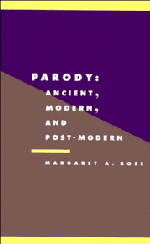
Parody
Ancient, Modern and Post-modern
The definitive work on parody (both literary and artistic), of key interest to theorists.
Margaret A. Rose (Author)
9780521429245, Cambridge University Press
Paperback, published 9 September 1993
328 pages
21.8 x 14.1 x 2.1 cm, 0.475 kg
'A very important book. Margaret Rose's work reaches into many of the central issues for the discussion of modern literature and art. This is one of those books which moves beyond the sometimes narrow theoretical debates of the 70s and 80s to become a general text.' Malcolm Bradbury
In this definitive work Margaret Rose presents an analysis and history of theories and uses of parody from ancient to contemporary times and offers a new approach to the analysis and classification of modern, late-modern, and post-modern theories of the subject. The author's Parody/Meta-Fiction (1979) was influential in broadening awareness of parody as a 'double-coded' device which could be used for more than mere ridicule. In the present study she both expands and revises the introductory section of her 1979 text and adds substantial new sections on modern and post-modern theories and uses of parody and pastiche which also discuss the work of theorists and writers including the Russian formalists, Mikhail Bakhtin, Hans Robert Jauss, Wolfgang Iser, Julia Kristeva, Roland Barthes, Michel Foucault, Jacques Derrida, Ihab Hassan, Jean Baudrillard, Fredric Jameson, A. S. Byatt, Martin Amis, Charles Jencks, Umberto Eco, David Lodge, Malcolm Bradbury and others.
Introduction
Part I. Defining Parody from the Ancients Onwards: 1. Ways of defining parody
2. Distinguishing parody from related forms
Part II. Modern Parody: 3. Modern and late-modern theories and uses of parody
Part III. Post-Modern Parody: 4. Contemporary late-modern and post-modern theories and uses of parody
Part IV. Conclusions: 5. General conclusion
6. From the ancient to the modern and the post-modern: a summary
Bibliography
Index.
Subject Areas: Literary theory [DSA]