Freshly Printed - allow 8 days lead
Couldn't load pickup availability
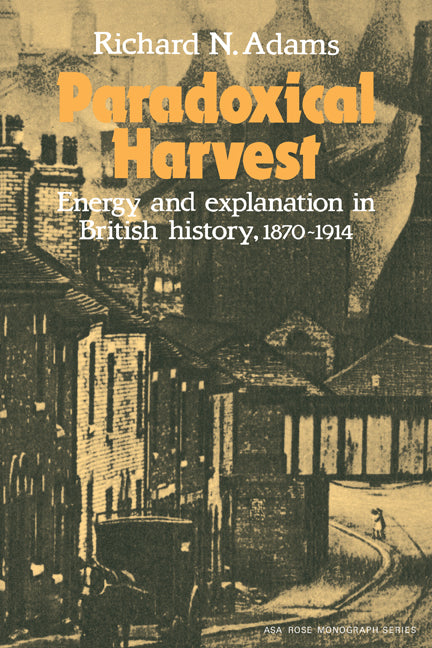
Paradoxical Harvest
Energy and explanation in British History, 1870–1914
This book is a study of the relationship between the use of energy in society and the general pattern of development in Great Britain during the 1870–1914 era.
Richard N. Adams (Author)
9780521288668, Cambridge University Press
Paperback, published 30 September 1982
156 pages
22.9 x 15.2 x 0.9 cm, 0.24 kg
This book is a study of the relationship between the use of energy in society and the general pattern of development in Great Britain during the 1870–1914 era. Professor Adams argues that Britain's apparent 'decline' in this period was not in fact a decline but a levelling off in capacity to do work, a result of the country's collective decision to invest more heavily abroad than at home. This pattern accords with Lotka's general energetic principle of natural selection. Specifically, Britain found it necessary to invest abroad, thereby creating an industrial environment for its own products and giving the impetus to other industrial nations - especially the United States and Germany - to seriously threaten Britain's primary position in industry and trade. The book should be of interest to those concerned with development, economic growth, energy and society, cultural development, and in general to specialists in anthropology, sociology, European and British history, economics and economic history.
List of figures and tables
Preface
1. A historical overview, 1870–1914
2. Concepts and theory
3. The levelling off of energy consumption
4. The world structure expands
5. Triggering flows: trade, investment and invisibles
6. Triggering flows: skills
7. The case of grain agriculture
8. Advantages at home
9. The regulatory weakness of government
10. The relation of human energy to non-human energy
11. Conclusion
Appendix: obtaining human energy sectors
References
Index.
Subject Areas: Early modern history: c 1450/1500 to c 1700 [HBLH], British & Irish history [HBJD1]