Special Order - allow 2+ weeks lead
Couldn't load pickup availability
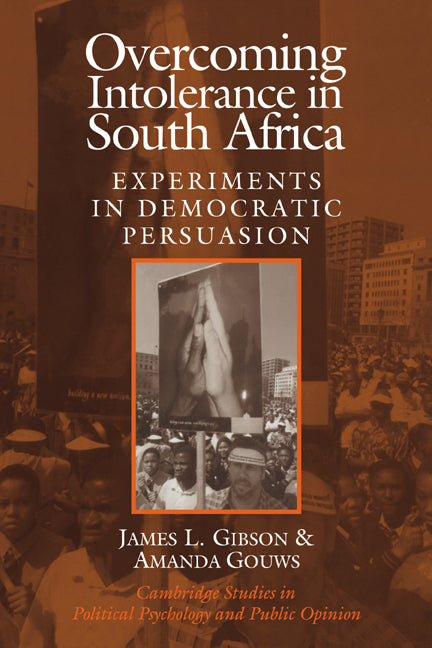
Overcoming Intolerance in South Africa
Experiments in Democratic Persuasion
This book investigates the degree to which political tolerance effects democratic reform in South Africa.
James L. Gibson (Author), Amanda Gouws (Author)
9780521813907, Cambridge University Press
Hardback, published 23 September 2002
280 pages
23.6 x 15.9 x 2.5 cm, 0.539 kg
'The authors are serious political scientists who produced a carefully designed and evaluated survey instrument and conducted their research with numerous checks and balances so as not to misinterpret their findings or manipulate their respondents. This is a very important book.' Mail & Guardian
Overcoming Intolerance in South Africa investigates the degree to which the political culture of South Africa - the beliefs, values, and attitudes toward politics held by ordinary people - impedes or promotes the consolidation of democratic reform. One set of values is of particular concern in this study - political tolerance. The authors contend that political tolerance is a crucial element of democratic political cultures in general, but that in the South African case, tolerance is perhaps more important than any other democratic value. Since South Africa is one of the most polyglot countries in the world, the only viable strategy for survival is tolerance toward the political views of others. The overwhelming emphasis throughout this book is on finding ways to enhance the willingness of South Africans to 'put up with' their political enemies, to allow open and widespread political competition, and to coexist in their diversity.
List of tables and figures
Preface
Part I. Introduction: 1. Political tolerance in the New South Africa
2. The South African context
Part II. South African Intolerance as It Is: 3. The nature of political intolerance in South Africa
4. Social identities, threat perceptions and political intolerance
5. Making tolerance judgements: the effect of context, local and national
Part III. South African Intolerance as It Might Be: 6. The persuasibility of tolerance and intolerance
7. The law and legal institutions as agents of persuasion
8. Becoming tolerant? Short-term changes in South African political culture
9. Conclusions: experimenting with tolerance in the New South Africa
Appendix: research design and methodology
References
Index.
Subject Areas: Political structures: democracy [JPHV], Politics & government [JP], Psychology [JM], Regional studies [GTB]