Freshly Printed - allow 10 days lead
Couldn't load pickup availability
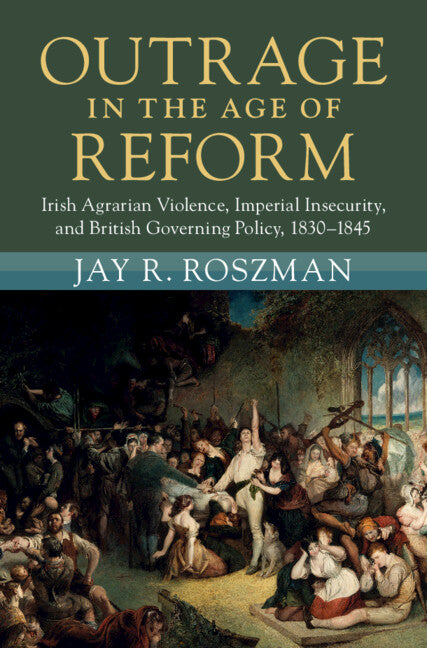
Outrage in the Age of Reform
Irish Agrarian Violence, Imperial Insecurity, and British Governing Policy, 1830–1845
Reveals how fear of Irish agrarian violence fundamentally shaped British political culture during the pivotal period of 19th-century reform.
Jay R. Roszman (Author)
9781009186780, Cambridge University Press
Hardback, published 22 September 2022
330 pages
23.5 x 15.8 x 2.2 cm, 0.63 kg
'Outrage in the Age of Reform is a landmark contribution to both Irish and British historiography. It will be of obvious value to scholars of nineteenth-century Britain and Ireland, but it also speaks to broader audiences interested in the dynamics of insurgency, counterinsurgency, and state formation, particularly within colonial settings. The book's ability to fuse political, social, and imperial history into a cohesive and compelling narrative makes it a prime candidate for inclusion in undergraduate and postgraduate syllabi on nineteenth-century Irish as well as British history.' Constantin Torve, Agricultural History Review
In the 1830s, as Britain navigated political reform to stave off instability and social unrest, Ireland became increasingly influential in determining British politics. This book is the first to chart the importance that Irish agrarian violence – known as 'outrages' – played in shaping how the 'decade of reform' unfolded. It argues that while Whig politicians attempted to incorporate Ireland fully into the political union to address longstanding grievances, Conservative politicians and media outlets focused on Irish outrages to stymie political change. Jay R. Roszman brings to light the ways that a wing of the Conservative party, including many Anglo-Irish, put Irish violence into a wider imperial framework, stressing how outrages threatened the Union and with it the wider empire. Using underutilised sources, the book also reassesses how Irish people interpreted 'everyday' agrarian violence in pre-Famine society, suggesting that many people perpetuated outrages to assert popularly conceived notions of justice against the imposition of British sovereignty.
Introduction
1. Governing Ireland in the age of reform
2. 'Outrage' in Ireland: Agrarian violence and Irish claims to counter-sovereignty
3. 'Justice to Ireland': Whigs and Ireland, 1835–1840
4. Protestant mobilisation and the spectre of colonial violence
5. Ireland and the Tory imagination
Conclusion.
Subject Areas: Social & cultural history [HBTB], Modern history to 20th century: c 1700 to c 1900 [HBLL], British & Irish history [HBJD1]