Freshly Printed - allow 10 days lead
Couldn't load pickup availability
Organizational Stress and Well-Being
Global thought leaders in the fields of workplace stress and well-being highlight how theory and research can improve employee health and well-being.
Laurent M. Lapierre (Edited by), Sir Cary Cooper (Edited by)
9781009268301, Cambridge University Press
Paperback / softback, published 22 August 2024
510 pages
22.8 x 15.1 x 2.6 cm, 0.73 kg
'… the impact of the COVID-19 pandemic combined with the challenges of the global socioeconomic environment on the workforce enhances this volume's value as both a resource for research and as an intimate guide on emerging issues, theoretical and practical, that human resource managers and organizational leaders will face. … Recommended.' S. R. Kahn, Choice
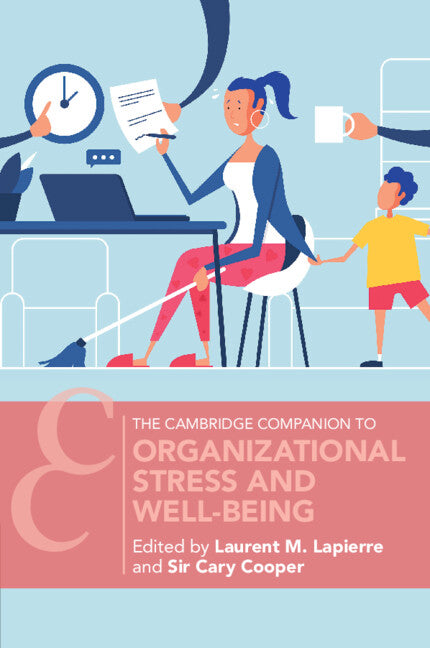
In this Cambridge Companion, global thought leaders in the fields of workplace stress and well-being highlight how theory and research can improve employee health and well-being. The volume explains how and why the topics of workplace stress and well-being have evolved and continue to be highly relevant, and why line managers have great influence over employees' quality of working life. It includes the latest research findings on stress and well-being and their impact on organizations, as well as up-to-date findings on the effectiveness of workplace interventions focused on these issues. It also explores important and emerging issues relating to organizational stress and well-being, including the ongoing effects of the global coronavirus pandemic. This is an ideal reference for students and researchers in the areas of human resources management, occupational health psychology and organisational behavior.
Part I. Historical Evolution and Continued Relevance of the Study of Organisational Stress and Well-being: 1. From occupational fatigue to occupational health Paul E. Spector
2. Impacts of stress and well-being on organisations and societies: a global perspective Peter Y. Chen, Yiqiong Li and Haibo Wu
3. Theories of organisational stress and well-being: a comparative perspective Johannes Siegrist and Heinrich-Heine
Part II. Line Managers: 4. Is it stressful at the top? The demands of leadership in times of stability and crisis Dorian Hartlaub, Ilke Inceoglu, Alina Hernandez Bark, Ronit Kark and Bar-Ilan
5. The role of line managers in promoting and protecting employee well-being Amanda J. Hancock, Nora Elena Daher Moreno and Kara A. Arnold
Part III. Major Issues Relating to Stress and Well-being: 6. Work-nonwork balance and employee well-being Wendy J. Casper, Julie Holliday Wayne, Frederick Rice and Hoda Vaziri
7. Understanding the decision-making process for presenteeism behavior: an integration and conceptual model Zara Whysall, Maria Karanika-Murray and Huijun Chen
8. Burnout: a critical overview Wilmar Schaufeli
9. Work engagement and organizational well-being Marisa Salanova
10. How and why gender relates to workplace stress and well-being Hope Dodd, Rose LeFevre-Levy and Kristen M. Shockley
11. The measurement of well-being at work Kevin Daniels, Emma Russell, George Michaelides, Emike Nasamu and Sara Connolly
Part IV. Workplace Interventions Addressing Stress and Well-being: 12. Occupational stress and well-being: workplace interventions involving managers/supervisors Leslie B. Hammer, Shalene J. Allen and Jordyn J. Leslie
13. Effective employee-targeted stress and well-being interventions Kimberly E. O'Brien and Terry A. Beehr
Part V. Emerging Issues: 14. Mitigating the adverse effects of technostress Monideepa Tarafdar, Henri Pirkkalainen and Markus Salo
15. What can management do about employee mental health? Laurent M. Lapierre, E. Kevin Kelloway and Daniel Quintal-Curcic.
Subject Areas: Personnel & human resources management [KJMV2]