Freshly Printed - allow 7 days lead
Couldn't load pickup availability
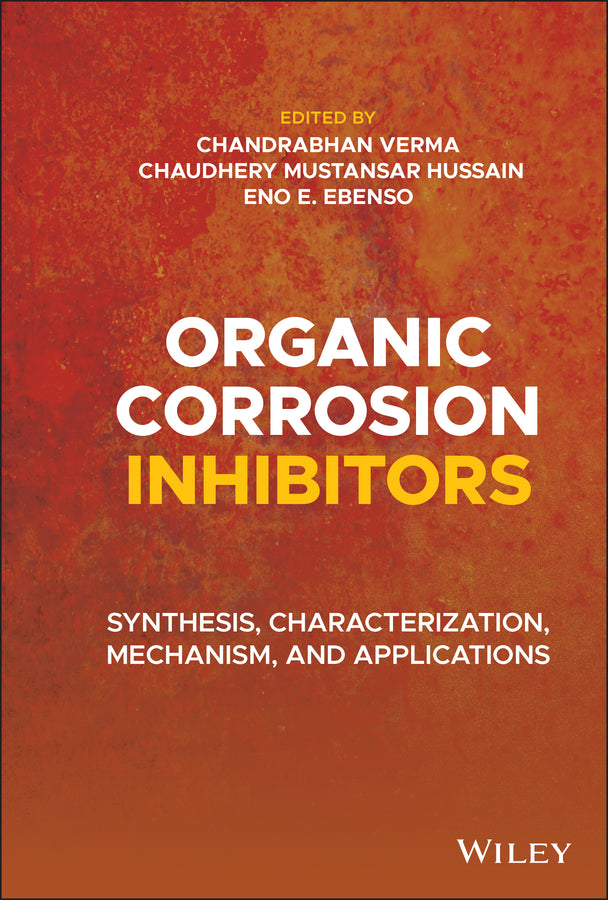
Organic Corrosion Inhibitors
Synthesis, Characterization, Mechanism, and Applications
Chandrabhan Verma (Edited by), Chaudhery Mustansar Hussain (Edited by), Eno E. Ebenso (Edited by)
9781119794486, Wiley
Hardback, published 10 December 2021
528 pages
1 x 1 x 1 cm, 0.454 kg
Provides comprehensive coverage of organic corrosion inhibitors used in modern industrial platforms, including current developments in the design of promising classes of organic corrosion inhibitors Corrosion is the cause of significant economic and safety-related problems that span across industries and applications, including production and processing operations, transportation and public utilities infrastructure, and oil and gas exploration. The use of organic corrosion inhibitors is a simple and cost-effective method for protecting processes, machinery, and materials while remaining environmentally acceptable. Organic Corrosion Inhibitors: Synthesis, Characterization, Mechanism, and Applications provides up-to-date coverage of all aspects of organic corrosion inhibitors, including their fundamental characteristics, synthesis, characterization, inhibition mechanism, and industrial applications. Divided into five sections, the text first covers the basics of corrosion and prevention, experimental and computational testing, and the differences between organic and inorganic corrosion inhibitors. The next section describes various heterocyclic and non-heterocyclic corrosion inhibitors, followed by discussion of the corrosion inhibition characteristics of carbohydrates, amino acids, and other organic green corrosion inhibitors. The final two sections examine the corrosion inhibition properties of carbon nanotubes and graphene oxide, and review the application of natural and synthetic polymers as corrosion inhibitors. Featuring contributions by leading researchers and scientists from academia and industry, this authoritative volume: Offering an interdisciplinary approach to the subject, Organic Corrosion Inhibitors: Synthesis, Characterization, Mechanism, and Applications is essential reading for chemists, chemical engineers, researchers, industry professionals, and advanced students working in fields such as corrosion inhibitors, corrosion engineering, materials science, and applied chemistry.
Preface xv About the Editors xvii List of Contributors xix Part I Basics of Corrosion and Prevention 1 1 An Overview of Corrosion 3 1 Introduction 3 1.1 Basics about Corrosion 3 1.2 Economic and Social Aspect of Corrosion 4 1.3 The Corrosion Mechanism 5 1.4 Classification of Corrosion 8 1.5 Common Methods of Corrosion Control 11 1.6 Adsorption Type Corrosion Inhibitors 13 References 15 2 Methods of Corrosion Monitoring 19 2.1 Introduction 19 2.2 Methods and Discussion 21 2.3 Conclusion 33 References 33 3 Computational Methods of Corrosion Monitoring 39 3.1 Introduction 39 3.2 Quantum Chemical (QC) Calculations-Based DFT Method 40 3.3 Atomistic Simulations 45 Acknowledgments 51 Suggested Reading 51 References 51 4 Organýc and Inorganýc Corrosýon Inhýbýtors: A Comparýson 59 4.1 Introduction 59 4.2 Corrosion Inhibitors 61 References 69 Part II Heterocyclic and Non-Heterocyclic Corrosion Inhibitors 75 5 Amines as Corrosion Inhibitors: A Review 77 5.1 Introduction 77 5.2 Conclusion and Outlook 88 Important Websites 89 References 89 6 Imidazole and Its Derivatives as Corrosion Inhibitors 95 6.1 Introduction 95 6.2 Corrosion Mechanism 96 6.3 Corrosion Inhibitors 97 6.4 Corrosion Inhibitors: Imidazole and Its Derivatives 98 6.5 Computational Studies 110 6.6 Conclusions 113 References 113 7 Pyridine and Its Derivatives as Corrosion Inhibitors 123 7.1 Introduction 123 7.2 Summary and Outlook 130 References 140 8 Quinoline and Its Derivatives as Corrosion Inhibitors 149 8.1 Introduction 149 8.2 Quinoline and Its Derivatives as Corrosion Inhibitors 151 8.3 Conclusion and Outlook 160 References 161 9 Indole and Its Derivatives as Corrosion Inhibitors 167 9.1 Introduction 167 9.2 Synthesis of Indoles and Its Derivatives 168 9.3 A Brief Overview of Corrosion and Corrosion Inhibitors 171 9.4 Application of Indoles as Corrosion Inhibitors 172 9.5 Corrosion Inhibition Mechanism of Indoles 201 9.6 Theoretical Modeling of Indole-Based Chemical Inhibitors 202 9.7 Conclusions and Outlook 205 References 207 10 Environmentally Sustainable Corrosion Inhibitors in Oil and Gas Industry 221 10.1 Introduction 221 10.2 Corrosion in the Oil–Gas Industry 222 10.3 Review of Literature on Environmentally Sustainable Corrosion Inhibitors 223 10.4 Conclusions and Outlook 233 References 235 Part III Organic Green Corrosion Inhibitors 241 11 Carbohydrates and Their Derivatives as Corrosion Inhibitors 243 11.1 Introduction 243 11.2 Glucose- Based Inhibitors 244 11.3 Chitosan- Based Inhibitors 246 11.4 Inhibition Mechanism of Carbohydrate Inhibitor 251 11.5 Conclusions 252 References 252 12 Amino Acids and Their Derivatives as Corrosion Inhibitors 255 12.1 Introduction 255 12.2 Corrosion Inhibitors 257 12.3 Why There Is Quest to Explore Green Corrosion Inhibitors? 258 12.4 Amino Acids and Their Derived Compounds: A Better Alternate to the Conventional Toxic Corrosion Inhibitors 261 12.5 Overview of the Applicability of Amino Acid and Their Derivatives as Corrosion Inhibitors 264 12.6 Recent Trends and the Future Considerations 277 12.7 Conclusion 280 Acknowledgments 281 References 281 13 Chemical Medicines as Corrosion Inhibitors 287 13.1 Introduction 287 13.2 Greener Application and Techniques Toward Synthesis and Development of Corrosion Inhibitors 288 13.3 Types of Chemical Medicine-Based Corrosion Inhibitors 291 13.4 Application of Chemical Medicines in Corrosion Inhibition 292 Acknowledgments 306 References 306 14 Ionic Liquids as Corrosion Inhibitors 315 14.1 Introduction 315 14.2 Inhibition of Metal Corrosion 316 14.3 Ionic Liquids as Corrosion Inhibitors 317 14.4 Conclusion and Future Trends 335 Acknowledgment 336 Abbreviations 336 References 337 15 Oleochemicals as Corrosion Inhibitors 343 15.1 Introduction 343 15.2 Corrosion 344 15.3 Significance of Green Corrosion Inhibitors 345 15.4 Overview of Oleochemicals 345 15.5 Literatures on the Utilization of Oleochemicals as Corrosion Protection 349 15.6 Conclusions and Outlook 365 References 366 Part IV Organic Compounds-Based Nanomaterials as Corrosion Inhibitors 371 16 Carbon Nanotubes as Corrosion Inhibitors 373 16.1 Introduction 373 16.2 Characteristics, Preparation, and Applications of CNTs 374 16.3 CNTs as Corrosion Inhibitors 376 16.4 Conclusion 381 Conflict of Interest 381 Acknowledgment 381 Abbreviations 381 References 382 17 Graphene and Graphene Oxides Layers Application as Corrosion Inhibitors in Protective Coatings 387 17.1 Introduction 387 17.2 Preparation of Graphene and Graphene Oxides 388 17.3 Protective Film and Coating Applications of Graphene 390 17.4 The Organic Molecules Modified Graphene as Corrosion Inhibitor 398 17.5 The Effect of Dispersion of Graphene in Epoxy Coatings on Corrosion Resistance 399 17.6 Challenges of Graphene 404 17.7 Conclusions and Future Perspectives 404 References 406 Part V Organic Polymers as Corrosion Inhibitors 411 18 Natural Polymers as Corrosion Inhibitors 413 18.1 An Overview of Natural Polymers 413 18.2 Mucilage and Gums from Plants 415 18.3 The Future and Application of Natural Polymers in Corrosion Inhibition Studies 429 References 431 19 Synthetic Polymers as Corrosion Inhibitors 435 19.1 Introduction 435 19.2 General Mechanism of Polymers as Corrosion Inhibitors 437 19.3 Corrosion Inhibitors – Synthetic Polymers 437 19.4 Conclusion 445 Useful Links 447 References 447 20 Epoxy Resins and Their Nanocomposites as Anticorrosive Materials 451 20.1 Introduction 451 20.2 Characteristic Properties of Epoxy Resins 452 20.3 Main Commercial Epoxy Resins and Their Syntheses 453 20.4 Reaction Mechanism of Epoxy/Amine Systems 459 20.5 Applications of Epoxy Resins 461 20.6 Conclusion 471 Abbreviations 471 References 472 Index483
Marziya Rizvi
Sheerin Masroor
Hassane Lgaz, Abdelkarim Chaouiki, Mustafa R. Al-Hadeethi, Rachid Salghi, and Han-Seung Lee
Goncagül Serdaroğlu and Savaş Kaya
Chandrabhan Verma, M. A. Quraishi, Eno E. Ebenso,and Chaudhery Mustansar Hussain
Jeenat Aslam, Ruby Aslam, and Chandrabhan Verma
Chandrabhan Verma, M. A. Quraishi, and Chaudhery Mustansar Hussain
Chandrabhan Verma and M. A. Quraishi
Taiwo W. Quadri, Lukman O. Olasunkanmi, Ekemini D. Akpan, and Eno E. Ebenso
M. A. Quraishi and Dheeraj Singh Chauhan
Jiyaul Haque and M. A. Quraishi
Saman Zehra and Mohammad Mobin
Mustafa R. Al-Hadeethi, Hassane Lgaz, Abdelkarim Chaouiki, Rachid Salghi, and Han-Seung Lee
Ruby Aslam, Mohammad Mobin, and Jeenat Aslam
F. A. Ansari, Sudheer, Dheeraj Singh Chauhan, and M. A. Quraishi
Yeestdev Dewangan, Amit Kumar Dewangan, Shobha, and Dakeshwar Kumar Verma
Renhui Zhang, Lei Guo, Zhongyi He, and Xue Yang
Marziya Rizvi
Megha Basik and Mohammad Mobin
Omar Dagdag, Rajesh Haldhar, Eno E. Ebenso, Chandrabhan Verma,A. El Harfi, and M. El Gouri
Subject Areas: Mechanical engineering & materials [TG]