Freshly Printed - allow 7 days lead
Couldn't load pickup availability
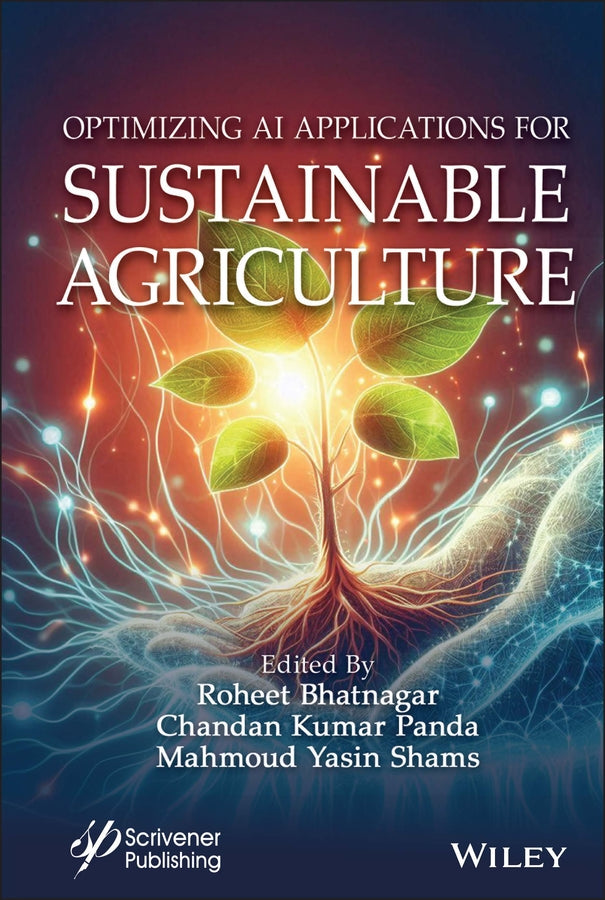
Optimizing AI Applications for Sustainable Agriculture
Roheet Bhatnagar (Edited by), Chandan Kumar Panda (Edited by), Mahmoud Yasin Shams (Edited by)
9781394287239, Wiley
Hardback, published 3 November 2025
576 pages
28 x 19 x 2.6 cm, 1.021 kg
Embrace the future of sustainable food production with this comprehensive guide that explores how artificial intelligence and emerging technologies are revolutionizing agriculture. In an era marked by climate change, resource depletion, and population growth, innovation is not a luxury—it is a necessity. Integrating AI into agricultural practices offers a promising solution. From precision farming and crop monitoring to predictive analytics and decision support systems, AI has the potential to revolutionize how we grow, manage, and distribute food. This book is a comprehensive guide that delves into the transformative potential of artificial intelligence and emerging technologies in the field of agriculture. An in-depth exploration of various AI technologies, such as machine learning, deep learning, natural language processing, and computer vision, will demonstrate the wide applications these tools have for agricultural practices. It covers emerging technologies like the Internet of Things, drones, precision farming, and agro-technology. The primary focus is on how these technologies can enhance sustainability in agriculture by improving crop yields, reducing water consumption, minimizing chemical use, and promoting eco-friendly farming practices. This essential guide will give readers a deep understanding of how cutting-edge technology can be harnessed to create a more sustainable future for agriculture. Readers will find the volume: Audience Researchers, computer and agricultural scientists, farmers, and policymakers looking to leverage the potential of artificial intelligence and machine learning for the benefit of farmers.
Preface xxi Part I: Artificial Intelligence-Assisted Sustainable Agriculture 1 1 AI and Emerging Technologies for Precision Agriculture: A Survey 3 1.1 Introduction 4 1.2 Precision Agriculture 5 1.3 Artificial Intelligence 9 1.3.1 Role of AI in Agriculture 11 1.4 Internet of Things (IoT) 11 1.4.1 Basics of IoT in Agriculture 13 1.4.2 Role of IoT 15 1.5 Blockchain Technology 15 1.6 Technologies Used in Smart Farming 17 1.6.1 Global Positioning System (GPS) 17 1.6.2 Sensor Technologies 17 1.6.3 Variable Rate Technology and Grid Soil Sampling 18 1.6.4 Geographic Information System (GIS) 19 1.6.5 Crop Management 19 1.6.6 Soil and Plant Sensors 20 1.6.7 Yield Monitor 20 1.7 Challenges 24 1.8 Future Research 26 1.9 Conclusion 29 References 29 2 AI-Enabled Framework for Sustainable Agriculture Practices 33 2.1 Introduction 34 2.2 Sustainable Agriculture Imperatives 35 2.2.1 Environmental Degradation 36 2.2.2 Biodiversity Loss 36 2.2.3 Climate Change Impacts 36 2.2.4 Resource Scarcity 37 2.2.5 Food Security and Economic Stability 37 2.2.6 Public Health Concerns 37 2.2.7 Social Equity and Rural Livelihoods 37 2.2.8 Global Food Shortage Concerns 38 2.2.9 Empowerment and Awareness 38 2.3 Social Relevance of Sustainable Practices in Agriculture 38 2.3.1 Livelihood Security 39 2.3.2 Community Health and Well-Being 39 2.3.3 Social Equity and Inclusion 39 2.3.4 Rural Empowerment and Resilience 40 2.4 Sustainable Agriculture Indicators 40 2.4.1 Food Grain Productivity 40 2.4.2 Population Density 41 2.4.3 Cropping Intensity 42 2.5 Sustainable Agriculture Practices Followed Till Date 42 2.5.1 Agroforestry 42 2.5.2 Integrated Pest Management (IPM) 44 2.5.3 Crop Rotation 44 2.5.4 Cover Cropping 44 2.5.5 Organic Farming 44 2.5.6 No-Till Farming 44 2.6 AI-Enabled Conceptual Framework 44 2.6.1 Perception from Environment Using IoT Sensors 45 2.6.1.1 Remote Sensing 45 2.6.1.2 IoT Sensors 46 2.6.2 Data Storage 46 2.6.3 Data Processing 47 2.6.4 Training and Testing by ML Models 47 2.7 Applications of Artificial Intelligence in Agriculture 48 2.8 Challenges and Barriers to Sustainable Agriculture 51 2.8.1 Theoretical Obstacles 51 2.8.2 Methodological Obstacles 52 2.8.3 Personal Obstacles 53 2.8.4 Practical Obstacles 54 2.9 Future Directions 55 2.10 Conclusion 57 References 58 3 The Impact of Artificial Intelligence on Agriculture: Revolutionizing Efficiency and Sustainability 61 Applications 62 3.1 Introduction 62 3.2 Precision Farming 64 3.2.1 Data Collection and Analytics 64 3.2.2 Disease Detection 65 3.2.3 Yield Production and Optimization 65 3.2.4 Precision Irrigation 66 3.3 Crop Monitoring 67 3.3.1 Remote Sensing and Satellite Imagery 67 3.3.2 Drones 67 3.3.3 Computer Vision and Image Analysis 68 3.3.4 Sensor Network and IoT 68 3.3.5 Weed Detection Management 68 3.4 AI in Aquaculture 69 3.4.1 Monitoring Water Quality 69 3.4.2 Feed Management 70 3.4.3 Breeding Technique 70 3.4.4 Autonomous Systems and Market Optimization 70 3.5 Predictive Analysis 71 3.5.1 Irrigation Optimization 71 3.5.2 Supply Chain Management 72 3.5.3 Weather and Climate Modeling 72 3.5.4 Equipment Maintenance 73 3.6 Robotics and Automation in AI Agriculture 73 3.6.1 Robotic Planting System 73 3.6.2 Automated Irrigation Systems 74 3.6.3 AI-Driven Crop Monitoring 75 3.6.4 Harvesting Robots 75 3.7 Livestock Monitoring 75 3.7.1 Video and Image Analysis 76 3.7.2 Health Monitoring 76 3.7.3 Behavior Analysis 77 3.7.4 Predictive Analysis 77 3.7.5 Environment Analysis 77 3.7.6 Disease Analysis and Prediction 78 3.8 AI for Climate Smart Agriculture 78 3.8.1 Climate Prediction and Weather Forecasting 79 3.8.2 Enhancing Resilience to Climate Variability 79 3.8.3 Water Management 80 3.8.4 Reducing Greenhouse Gas Emissions 80 3.8.5 Increasing Productivity and Sustainability 80 3.9 AI in Agroecology 81 3.9.1 Decision Support Systems 81 3.9.2 Biodiversity Conservation 82 3.9.3 Soil Health Management 82 3.10 Soil Analysis 83 3.10.1 Soil Classification 83 3.10.2 Soil Nutrient Management 83 3.10.3 Disease and Pest Detection 84 3.10.4 Soil Moisture Monitoring 84 3.10.5 Precision Agriculture 84 3.10.6 Soil Erosion Prediction 85 3.10.7 Soil Remediation 85 3.11 Conclusion 86 Bibliography 87 4 Integrating Artificial Intelligence into Sustainable Agriculture: Advancements, Challenges, and Applications 89 4.1 Introduction 90 4.2 Literature Review 92 4.3 Key Critical Challenges of Conventional Agriculture 97 4.3.1 Overview of Conventional Agriculture 97 4.3.2 The Distinction Between Agriculture in the Past and Now 99 4.4 AI Technologies and Sustainable Agriculture 103 4.5 Artificial Intelligence’s Practical Use in Farming 104 4.6 Challenges and Ethical Considerations 107 4.6.1 Challenges 107 4.6.1.1 Data Privacy and Security 107 4.6.1.2 Accessibility and Inclusivity 107 4.6.1.3 Algorithm Bias 107 4.6.1.4 Interoperability and Standardization 107 4.6.1.5 Job Displacement 108 4.6.2 Ethical Considerations 108 4.6.2.1 Transparency and Accountability 108 4.6.2.2 Environmental Impact 108 4.6.2.3 Informed Consent 108 4.6.2.4 Fair Distribution of Benefits 109 4.6.2.5 Long-Term Sustainability 109 4.7 Conclusions and Further Work 109 References 110 5 Artificial Intelligence for Sustainable and Smart Agriculture 117 5.1 Introduction 118 5.2 Literature Review 120 5.3 AI Techniques for Revolutionizing Traditional Farming 125 5.4 Role of the IoT in Smart Farms 128 5.4.1 Smart Farming Technologies 130 5.4.1.1 Precision Agriculture 130 5.4.1.2 Livestock Monitoring 130 5.4.1.3 Crop Monitoring 130 5.4.2 Climate Management and Weather Forecasting 130 5.4.3 Supply Chain Optimization 131 5.4.4 Analytics and Assistance for Decision-Making 131 5.4.5 The Advantages and Difficulties of IoT in Agriculture 131 5.4.5.1 Advantages 131 5.4.5.2 Difficulties 131 5.5 Environmental Concerns Related to Agriculture 132 5.5.1 Environmental Concerns Related to Sustainable Agriculture 132 5.5.2 Environmental Concerns Related to Smart Agriculture 132 5.6 Challenges and Considerations 135 5.7 Conclusions and Further Work 137 References 142 6 Data-Driven Approaches for Sustainable Agriculture and Food Security 145 6.1 Introduction 146 6.1.1 The Role of Data in Agriculture 146 6.1.2 Importance of Sustainability and Food Security 147 6.1.3 Overview of Data-Driven Technologies 148 6.2 Big Data in Agriculture 150 6.2.1 Definition and Characteristics of Big Data 150 6.2.2 Applications of Big Data in Agriculture 151 6.2.3 Challenges and Opportunities 152 6.2.3.1 Challenges 152 6.2.3.2 Opportunities 153 6.3 Internet of Things (IoT) in Agriculture 154 6.3.1 Understanding IoT and Its Components 154 6.3.2 IoT Applications in Farming 155 6.3.3 Benefits and Challenges of IoT Implementation 156 6.4 Artificial Intelligence and Machine Learning in Agriculture 157 6.4.1 Fundamentals of AI and Machine Learning 157 6.4.2 AI and ML Applications in Crop Monitoring and Management 158 6.4.3 Predictive Analytics for Yield Optimization 159 6.5 Remote Sensing and GIS in Agriculture 159 6.5.1 Remote Sensing Technologies Overview 159 6.5.2 GIS Mapping for Precision Agriculture 160 6.5.3 Monitoring Environmental Impact and Land Use 161 6.6 Data-Driven Approaches for Sustainable Crop Management 162 6.6.1 Precision Agriculture Techniques 162 6.6.2 Crop Disease Detection and Management 162 6.6.3 Water Management and Irrigation Systems 163 6.7 Data-Driven Livestock Management 163 6.7.1 Monitoring Animal Health and Welfare 163 6.7.2 Precision Livestock Farming 164 6.7.3 Sustainable Feed Management 164 6.8 Supply Chain Management and Food Security 165 6.8.1 Traceability and Transparency in the Food Supply Chain 165 6.8.2 Data-Driven Approaches for Food Distribution 165 6.8.3 Enhancing Food Security through Data Analytics 166 6.9 Policy Implications and Ethical Considerations 167 6.9.1 Regulatory Frameworks for Data-Driven Agriculture 167 6.9.2 Ethical Issues Surrounding Data Collection and Privacy 167 6.9.3 Balancing Innovation with Social Responsibility 168 6.10 Future Trends and Conclusion 168 6.10.1 Emerging Technologies and Trends 168 6.10.2 Potential Impact on Sustainable Agriculture and Food Security 169 6.11 Conclusion 170 References 170 Part II: Recent Developments in Crop Disease Detection and Prevention 175 7 Advances in Plant Disease Detection and Classification Systems 177 7.1 Introduction 178 7.2 Literature Review 179 7.3 Methodologies and Techniques 185 7.3.1 CNN Architectures 185 7.3.2 Activation Functions 186 7.3.3 Loss Functions 187 7.3.4 Learning Rate Schedulers 187 7.3.5 Early Stopping 188 7.3.6 Checkpoints and Callbacks 188 7.3.7 Data Preprocessing 189 7.3.8 Data Augmentation 189 7.3.9 Transfer Learning 190 7.3.10 Ensemble Learning 191 7.4 Challenges and Limitations 191 7.4.1 Dataset Scarcity 192 7.4.2 Image Variability 192 7.4.3 Label Inconsistency 193 7.4.4 Model Interpretability 193 7.5 Proposed Model 194 7.5.1 Model Architecture 195 7.5.2 Training Mechanism 196 7.6 Future Scope 198 7.6.1 Development of Comprehensive Datasets 199 7.6.2 Exploration of Novel Architectures 199 7.6.3 Integration of Advanced Technologies 200 7.6.4 Crowdsourcing New Data 201 7.6.5 Adaptation and Interaction 201 7.6.6 Integrated Remediation Strategies 202 7.7 Conclusion 203 References 204 8 Ensemble-Based Crop Disease Biomarker Multi-Domain Feature Analysis (ECDBMFA) 207 8.1 Introduction 208 8.2 Literature Survey 208 8.3 Design of ECDBMFA 210 8.4 Result Evaluation and Comparative Analysis with Existing Techniques 217 8.5 Conclusion 226 References 226 9 Artificial Intelligence and Machine Learning in Crop Yield Prediction and Pest Control 231 Introduction 232 Artificial Intelligence 234 Machine Learning 235 AI-Based ML Algorithm Models 237 Some Important Evaluation Metrics Used in AI-Based Predictive Models 239 Applications of Artificial Intelligence and Machine Learning in Crop Yield Prediction Models 241 AI-Based Crop Yield Prediction Method—Case Study 242 Steps for Crop Yield Prediction 243 Applications of Artificial Intelligence and Machine Learning in Pest and Disease Management 244 Advantages of Using Artificial Intelligence/Machine Learning in Agriculture 248 Challenges of Artificial Intelligence and Machine Learning Application in Agriculture 249 Conclusion and Future Prospects 250 References 250 10 Farming in the Digital Age: A Machine Learning Enhanced Crop Yield Prediction and Recommendation System 257 10.1 Background 258 10.2 Introduction 260 10.3 Importance 261 10.4 Machine Learning in Agriculture 262 10.5 Objectives 267 10.6 Related Work 267 10.6.1 Research Gaps 276 10.7 Proposed Methodology 277 10.7.1 Data Collection 277 10.7.2 Data Preprocessing 277 10.7.3 Training and Testing Model 278 10.7.4 Decision Tree Repressor 278 10.7.5 Random Forest Regressor 279 10.8 Implications for Farmers 282 10.9 Future Directions 284 10.10 Conclusion 285 References 285 Part III: IoT and Modern Agriculture 289 11 Digital Agriculture: IoT Applications and Technological Advancement 291 11.1 Introduction 292 11.2 Related Work 296 11.3 Emerging Technologies and Related Applications in Smart Agriculture 299 11.3.1 Internet of Things (IoT) in Agriculture 300 11.3.2 Artificial Intelligence (AI) and Machine Learning (ml) 300 11.3.3 Remote Sensing (RS) and Satellite Technology 302 11.3.4 Blockchain Technology 305 11.3.5 Robotics and Automation 309 11.3.6 Sustainable Agriculture Practices 310 11.4 Challenges in Smart Farming 315 11.5 Future Trends in Smart Farming 317 11.6 Conclusion 320 References 320 12 IoT in Climate-Smart Farming 323 12.1 Introduction 323 12.2 IoT in Agriculture 325 12.2.1 What is IoT? 325 12.2.2 Methods Involved in the Incorporation of IoT in Agriculture 325 12.2.2.1 Greenhouse Farming 325 12.2.2.2 Vertical Farming 326 12.2.2.3 Hydroponics 326 12.2.2.4 Phenotyping 327 12.2.3 Resources Required for the Incorporation 328 12.3 Climate-Smart Farming Practices 329 12.3.1 What is Climate-Smart Farming? 329 12.3.2 Integration of IoT 330 12.3.2.1 Precision Farming 330 12.3.2.2 Smart Irrigation 331 12.3.2.3 Crop Monitoring 331 12.3.2.4 Livestock Management 331 12.3.3 Environmental Impact and Resilience to Climate Change 332 12.4 Case Studies 333 12.4.1 IoT Applications in Precision Agriculture 333 12.4.1.1 Weather Monitoring 333 12.4.1.2 Soil Content Monitoring 333 12.4.1.3 Diseases Monitoring 334 12.4.2 IoT Applications in Greenhouse 334 12.5 Evaluation of IoT Technologies 336 12.5.1 Effectiveness of IoT Technologies 336 12.5.2 Comparison with Traditional Methods 336 12.5.3 Advantages and Disadvantages 337 12.6 Relevance to Current-Day Global Issues 338 12.6.1 Future Scope 338 12.7 Conclusion 339 References 340 Part IV: Technological Trends and Advancements in the Agricultural Sector 345 13 Sustainable Agriculture Practices with ICT for Soil Health Management 347 13.1 Introduction 348 13.2 Advanced ICT Technologies 350 13.2.1 Gps 350 13.2.2 Gis 351 13.2.3 Dss 352 13.2.4 Remote Sensing 352 13.2.5 IoT 353 13.2.6 Sensor Technology 354 13.2.7 Grid Soil Sampling and Variable Rate Technology (vrt) 356 13.2.8 Agricultural Robotics 357 13.3 Application of ICT in Soil Health Management 358 13.3.1 Artificial Intelligence in Analyzing Soil Health Parameters 358 13.3.1.1 Data Collection 358 13.3.1.2 Data Preprocessing 358 13.3.1.3 Feature Selection 358 13.3.1.4 Model Training 359 13.3.1.5 Model Validation 359 13.3.1.6 Soil Health Parameter Prediction 359 13.3.2 Fertilizer Recommendation Using ICT 359 13.3.2.1 Soil App 360 13.3.2.2 Multimodal DSS in Soil Fertility Management 360 13.3.3 Smart Soil Health Management Using Sensor-Based Technology 362 13.3.3.1 Sensor Selection 362 13.3.3.2 Sensor Placement 362 13.3.3.3 Data Collection 362 13.3.3.4 Data Processing 362 13.3.4 Real-Time Monitoring 363 13.3.4.1 Sensors’ Efficiency Evaluation 363 13.3.5 Satellite and Drone-Based Remote Sensing Technology in Soil Health Management 363 13.3.6 ICT-Based Soil Conservation for Soil Health Management 364 13.3.7 Autonomous Robots in Efficient Soil Health Management 365 13.4 Challenges in Implementing ICT-Based Technologies 365 13.4.1 Lack of Availability of Accurate Data 365 13.4.2 High Cost of Technology and Higher Investment 366 13.4.3 Lack of Sound Skill and Knowledge of Farmers 366 13.4.4 Lack of Communication Structure and Support 367 13.4.5 Low-Risk–Bearing Capacity of Farmers 367 13.5 Opportunities or Pathways to Tackle the Issues in ICT-Based Soil Management 367 13.6 Conclusion 369 Acknowledgment 370 References 370 14 Water Resource Management Model for Smart Agriculture 375 Introduction 375 Main Part 376 Conclusion 397 References 398 15 A Big Data Analytics–Based Architecture for Smart Farming 399 15.1 Introduction 400 15.2 Related Work 402 15.3 Research Issues in Big Data for Smart Agriculture 404 15.4 Applications of Big Data Analytics in Smart Agriculture 405 15.5 Types of Big Data in Agriculture 407 15.6 Proposed Work 408 15.7 Conclusion and Future Work 414 References 414 16 Adoption of Blockchain Technology for Transparent and Secure Agricultural Transactions 417 16.1 Introduction to Blockchain Technology 418 16.1.1 Definition and Overview 418 16.1.2 Evolution of Blockchain 418 16.1.3 Basic Components and Principles 419 16.1.4 Blockchain’s Significance in Agriculture 419 16.2 Challenges in Traditional Agricultural Transactions 420 16.2.1 Lack of Transparency 420 16.2.2 Security Issues 420 16.2.3 Trust Deficit 421 16.2.4 Inefficiencies in Supply Chain 421 16.3 Understanding Blockchain Solutions 422 16.3.1 How Blockchain Operates 422 16.3.2 Types of Blockchain 423 16.3.3 Smart Contracts and Their Role 424 16.3.4 Benefits of Blockchain in Agriculture 425 16.4 Use Cases of Blockchain in Agriculture 427 16.4.1 Produce Traceability 427 16.4.1.1 Tracking Farm to Fork 427 16.4.1.2 Quality Assurance 427 16.4.2 Supply Chain Management 428 16.4.2.1 Inventory Tracking 428 16.4.2.2 Real-Time Monitoring 428 16.4.3 Payment and Financing Solutions 428 16.4.3.1 Microfinancing for Farmers 428 16.4.3.2 Instant and Secure Payments 430 16.5 Implementing Blockchain in Agriculture 430 16.5.1 Infrastructure Requirements 430 16.5.2 Data Management and Integration 432 16.5.3 Regulatory Considerations 432 16.5.4 Challenges in Adoption 432 16.6 Case Studies and Success Stories 434 16.6.1 IBM Food Trust 434 16.6.2 Provenance 434 16.6.3 AgriDigital 434 16.7 Future Trends and Opportunities 435 16.7.1 Integration with IoT and AI 435 16.7.2 Expansion of Blockchain Applications 435 16.7.3 Potential Impact on Global Food Security 437 16.8 Conclusion 439 References 439 17 AI-Assisted Environmental Parameter Monitoring of Plants in Greenhouse Farming 445 17.1 Introduction 446 17.2 Background 447 17.3 Importance of Smart Agriculture 448 17.4 Artificial Neural Network (ANN) 449 17.4.1 Mayfly Optimization 451 17.5 Problem Statement 453 17.6 Objectives 454 17.7 Strategy for Polyhouse Monitoring 454 17.8 Results and Discussion 460 17.9 Conclusion 467 References 469 18 Metaverse in Agricultural Training and Simulation 471 18.1 Introduction 471 18.2 AI in Agriculture 473 18.3 Metaverse 475 18.3.1 Agriculture with AI-Based Metaverse 476 18.4 Augmented Reality (AR) 478 18.5 Virtual Reality (VR) 480 18.6 Mixed Reality (MR) 482 18.7 Agriculture Training Simulations 485 18.8 Metaverse in Agriculture Trainings 487 18.9 Conclusions 488 Acknowledgment 489 References 489 19 Sustainable Farming in the Digital Era: AI and IoT Technologies Transforming Agriculture 493 19.1 Introduction 494 19.1.1 The Role of Artificial Intelligence in Agriculture 495 19.1.2 The Role of the Internet of Things in Agriculture 495 19.1.3 The Intersection of AI and IoT in Agriculture 496 19.1.4 The Importance of Sustainability in Agriculture 496 19.1.5 Problem Statement 497 19.1.6 Motivation 497 19.1.7 Objective 497 19.2 Related Work 498 19.2.1 Comparative Analysis of Existing Challenges 499 19.2.1.1 Precision Agriculture: Challenges in Future IoT (2023) 501 19.2.1.2 AI-Driven Precision Agriculture: Challenges and Perspectives (2023) 502 19.2.1.3 IoT and AI in Agriculture: An Overview (2022) 502 19.2.1.4 Smart Farming with IoT and AI: Benefits and Challenges (2022) 502 19.2.1.5 AI and IoT-Based Crop Monitoring: A Review (2023) 502 19.2.1.6 Integration of AI and IoT in Agriculture: State-of-the-Art and Future Trends (2023) 502 19.2.1.7 Sustainable Agriculture: The Role of IoT and AI (2022) 503 19.2.1.8 Advances in IoT and AI for Precision Agriculture (2022) 503 19.3 Discussion of Proposed Approach 503 19.3.1 System Architecture 504 19.3.2 Components and Tools 505 19.3.3 Result and Discussion 506 19.4 Application 508 19.5 Advantages and Disadvantages of System 509 19.6 Conclusion 510 Future Scope 510 References 511 20 Precision Agriculture with Unmanned Aerial Vehicles 513 20.1 Introduction 514 20.2 Agri-UAV Construction and Controls 516 20.3 Applications of UAVs in Agriculture 519 20.3.1 Crop Spraying 520 20.3.2 Crop Health Monitoring 524 20.3.3 Drone Seeding 527 20.4 Conclusion 529 References 530 Index 535
Brajesh Kumar Khare
Yukti Batra, Suman Bhatia and Ankit Verma
Santhiya S., P. Jayadharshini, N. Abinaya, Sharmila C., Srigha S. and Sruthi K.
Djamel Saba and Abdelkader Hadidi
Djamel Saba and Abdelkader Hadidi
S.C. Vetrivel, V. Sabareeshwari, K.C. Sowmiya and V.P. Arun
Bhakti Sanket Puranik, Karanbir Singh Pelia, Shrivatsasingh Khushal Rathore and Vaibhav Vikas Dighe
Chilakalapudi Malathi and Sheela J.
Archana Negi, Jitendra Singh, Robin Kumar, Atin Kumar, Nisha and Sharad Sachan
Arti Sonawane, Akanksha Ranade, Apurva Kolte, Siddharth Daundkar and Shreyas Rajage
K. Aditya Shastry
Maitreyi Darbha, S. V. Sanjay Kumar, S. R. Mani Sekhar and Sanjay H. A.
Bhabani Prasad Mondal, Anshuman Kohli, Ingle Sagar Nandulal, Roheet Bhatnagar, Chandan Kumar Panda, Sonal Kumari, Bharat Lal, Sai Parasar Das, Chandrabhan Patel, Vimal Kumar, Achin Kumar, Karad Gaurav Uttamrao, Suman Dutta and Ali R.A. Moursy
Aysulu Aydarova
Tanvi Chawla, Tamanna Gahlawat and TanyaShree Thakur
S.C. Vetrivel, V. Sabareeshwari, K.C. Sowmiya and V.P. Arun
K. Sujatha, N.P.G. Bhavani, R. S. Ponmagal, N. Shanmugasundaram, C. Tamilselvi, A. Ganesan and Suqun Cao
Syed Quadir Moinuddin, Himam Saheb Shaik, md Atiqur Rahman and Borigorla Venu
Arti Sonawane, Suvarna Patil and Atul Kathole
Suresh S., Sampath Boopathi, Elayaraja R., Velmurugan D. and Selvapriya R.
Subject Areas: Agriculture & farming [TV]