Freshly Printed - allow 8 days lead
Couldn't load pickup availability
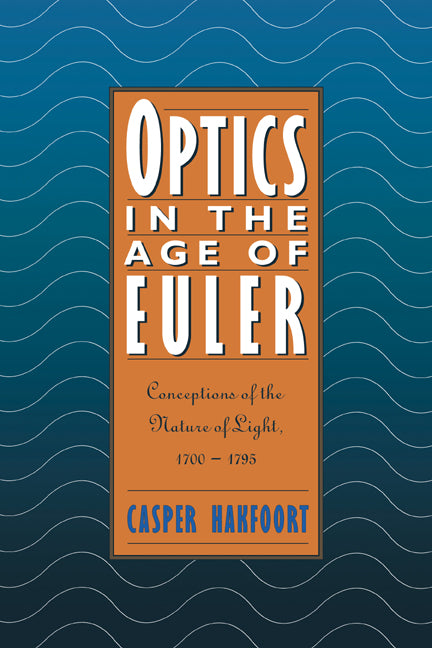
Optics in the Age of Euler
Conceptions of the Nature of Light, 1700–1795
What is light? This 1995 book studies the eighteenth-century origins and early phases of this key debate in optics.
Casper Hakfoort (Author)
9780521035071, Cambridge University Press
Paperback / softback, published 14 December 2006
256 pages, 13 b/w illus. 3 tables
22.8 x 15.2 x 1.7 cm, 0.388 kg
'Hakfoort's book is well researched. It is indispensable for anyone who wants to understand the growing field of research in eighteenth-century optics.' Kurt Moller Pedersen, Centaurus
According to received historiography, the fundamental issue in eighteenth-century optics was whether light could be understood as the emission of particles, or as the motion of waves in a subtle medium. Moreover, the emission theory of light was supposed to have been dominant in the eighteenth century, backed by Newton's physical arguments. This picture is enriched and qualified by focusing on the origins, contents and reception of the wave theory of light, published by Leonhard Euler in 1746, studied in depth in this 1995 book. Contrary to what has been assumed, the particle–wave debate only starts with Euler. When the emission view of light suddenly became dominant in Germany around 1795, it was new chemical experiments that proved crucial. Reflecting on the mathematical, experimental and metaphysical aspects of physical optics, a general picture of early modern science is outlined in the epilogue to the book.
Acknowledgements
1. Introduction
2. The debate on colours, 1672–1720
3. Theoretical traditions in physical optics, 1700–45
4. Euler's 'Nova theoria' (1746)
5. The debate in Germany on the nature of light, 1740–95
6. Epilogue: optics as a mirror of eighteenth-century science
Notes
Bibliography
Index.
Subject Areas: History of science [PDX]