Freshly Printed - allow 7 days lead
Couldn't load pickup availability
Ontological Prisms
Knowledge Engineering for Enterprise & Agentic Systems
Remy Fannader (Author)
9781394352623, Wiley
Hardback, published 2 June 2026
352 pages
23.1 x 15.8 x 2.5 cm, 0.59 kg
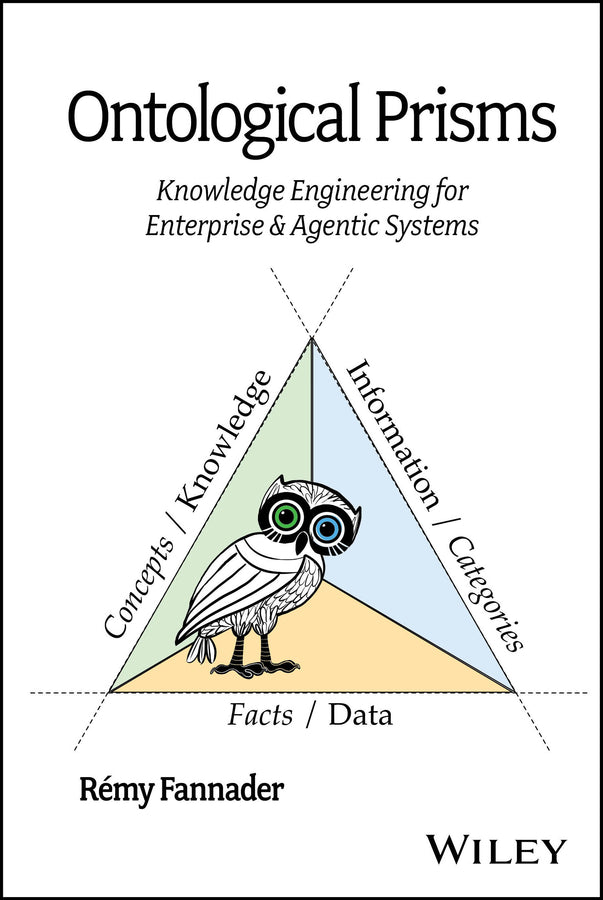
Ontological Prisms The expansion of generative AI has highlighted the limitations of purely neural approaches and the benefits of coupling them with symbolic counterparts epitomized by ontologies. While knowledge graphs emerge as the jack of all trades among agents dealing with language, knowledge, and orchestration, there is little consensus on the sources and roles of ontologies, in other words, knowledge. The book introduces ontological prisms, a game-changing paradigm that unfolds the geometry of knowledge into a triptych of observed worlds (facts), meanings (concepts), and shared representations (categories). This approach entails three major breakthroughs with regard to: These advances allow for a seamless integration of knowledge engineering between agentic and enterprise systems: facts, categories, and concepts for the former, mapped to data, information, and knowledge for the latter, respectively. That knowledge-driven integration of cognitive and systems capabilities paves the way to a holistic approach to collective learning weaving together individuals, organizations, and systems. The book is organized into three parts: principles, foundations, and architecture; cognitive functions: language, reasoning, and judgment; and systems and knowledge engineering. The third part introduces the KEOPS (Knowledge Engineering with Ontological Prisms) methodology, accompanied by a kernel developed with OWL/Prot??g??. This organization allows for differentiated readings for graduates, engineers, and consultants, ensuring a comprehensive understanding of agentic cognition, knowledge engineering and ontology development, as well as business intelligence and decision-making systems.
Preamble xxi Part I 1 1 Current Approaches and Paradigm Shift 3 2 Ontological Realms 25 3 Ontological Prisms and Interoperability 55 4 Ontological Prisms and Governance 79 Part II 109 5 Ontologies and Language 111 6 Reasoning with Ontological Prisms 131 7 Decision-making with Ontological Prisms 155 Part III 183 8 Knowledge-based System Engineering 185 9 The Engineering of Knowledge 223 10 KEOPS OWL Kernel 263 Key Points 288 Annexes 291 Index 315
About the Author xxiii
1.1 Ontologies and Artificial Intelligence 3
1.2 Ontologies and Knowledge 9
1.3 The Ontological Prisms Paradigm 18
2.1 Extensional Realm: Facts 26
2.2 Intensional Realm: Concepts 34
2.3 Logical Realm: Categories 41
2.4 Ontological Modalities 48
3.1 Alignment and Integration 55
3.2 Interoperability of Heterogeneous Ontologies 62
3.3 Interoperability and Collective Intelligence 74
4.1 Environments and Organizations 79
4.2 Data and Value Chains 85
4.3 Data Protection and Intellectual Property 92
4.4 Complexity Management 97
5.1 Anatomy of Languages 111
5.2 Generative Language Models 115
5.3 Languages and Knowledge 121
6.1 Ontologies and Reason 131
6.2 Formal Reasoning 133
6.3 Language Models and Logic 138
6.4 Empirical Reasoning 143
6.5 Reason and Knowledge 148
7.1 Decision-making Dimensions 155
7.2 Problem and Solution Spaces 158
7.3 Visibility and Time Frames 162
7.4 Parties and Structure 166
7.5 Agentic Decision-making 171
8.1 Systems and Organizations 185
8.2 Engineering Processes and Ontological Prisms 188
8.3 Anchoring Engineering to Ontologies 194
8.4 Requirements with Ontological Prisms 199
8.5 Engineering with Ontological Prisms (and Generative Artificial Intelligence) 209
9.1 Mapping Extensions 224
9.2 Mapping Intensions 247
9.3 Actionable Knowledge 255
10.1 OWL/Protégé Kernel 263
10.2 Representing Territories 269
10.3 Representing Intents 279
10.4 Representing Abstractions 284
Conclusion 289
Annex 1 Summary of Notations 293
Annex 2 Acronyms and Glossary 295
Annex 3 Bibliography 309
Subject Areas: Computer science [UY]