Freshly Printed - allow 7 days lead
Couldn't load pickup availability
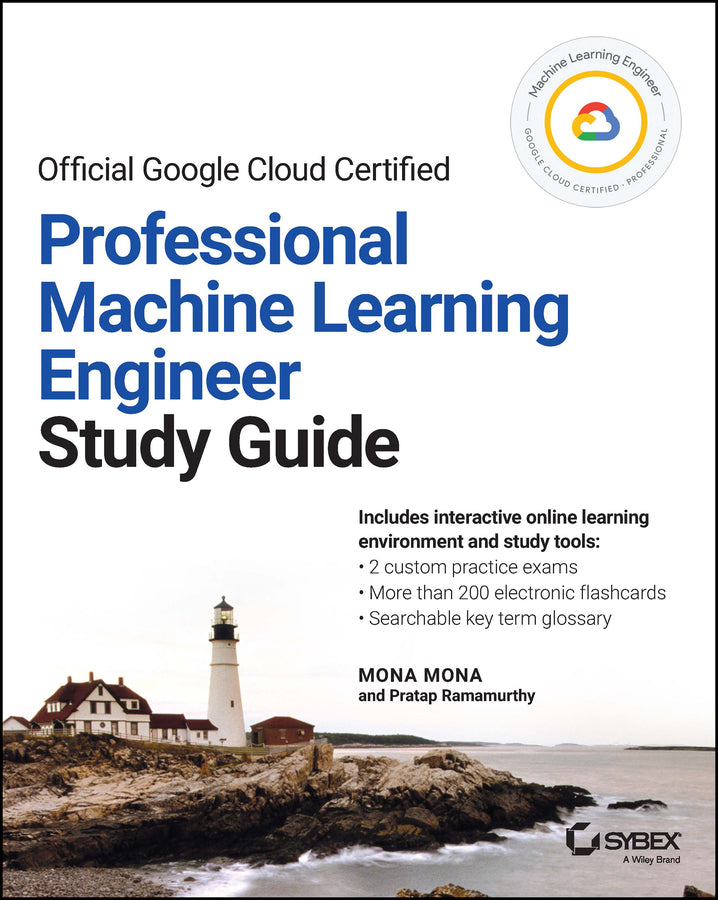
Official Google Cloud Certified Professional Machine Learning Engineer Study Guide
Mona Mona (Author), Pratap Ramamurthy (Author)
9781119944461, Wiley
Paperback / softback, published 14 December 2023
368 pages
23.1 x 18.5 x 2 cm, 0.522 kg
Expert, guidance for the Google Cloud Machine Learning certification exam In Google Cloud Certified Professional Machine Learning Study Guide, a team of accomplished artificial intelligence (AI) and machine learning (ML) specialists delivers an expert roadmap to AI and ML on the Google Cloud Platform based on new exam curriculum. With Sybex, you’ll prepare faster and smarter for the Google Cloud Certified Professional Machine Learning Engineer exam and get ready to hit the ground running on your first day at your new job as an ML engineer. The book walks readers through the machine learning process from start to finish, starting with data, feature engineering, model training, and deployment on Google Cloud. It also discusses best practices on when to pick a custom model vs AutoML or pretrained models with Vertex AI platform. All technologies such as Tensorflow, Kubeflow, and Vertex AI are presented by way of real-world scenarios to help you apply the theory to practical examples and show you how IT professionals design, build, and operate secure ML cloud environments. The book also shows you how to: A can’t-miss resource for everyone preparing for the Google Cloud Certified Professional Machine Learning certification exam, or for a new career in ML powered by the Google Cloud Platform, this Sybex Study Guide has everything you need to take the next step in your career.
Introduction xxi Assessment Testxxxii Chapter 1 Framing ML Problems 1 Translating Business Use Cases 3 Machine Learning Approaches 5 Supervised, Unsupervised, and Semi- supervised Learning 5 Classification, Regression, Forecasting, and Clustering 7 ML Success Metrics 8 Regression 12 Responsible AI Practices 13 Summary 14 Exam Essentials 14 Review Questions 15 Chapter 2 Exploring Data and Building Data Pipelines 19 Visualization 20 Box Plot 20 Line Plot 21 Bar Plot 21 Scatterplot 22 Statistics Fundamentals 22 Mean 22 Median 22 Mode 23 Outlier Detection 23 Standard Deviation 23 Correlation 24 Data Quality and Reliability 24 Data Skew 25 Data Cleaning 25 Scaling 25 Log Scaling 26 Z-score 26 Clipping 26 Handling Outliers 26 Establishing Data Constraints 27 Exploration and Validation at Big- Data Scale 27 Running TFDV on Google Cloud Platform 28 Organizing and Optimizing Training Datasets 29 Imbalanced Data 29 Data Splitting 31 Data Splitting Strategy for Online Systems 31 Handling Missing Data 32 Data Leakage 33 Summary 34 Exam Essentials 34 Review Questions 36 Chapter 3 Feature Engineering 39 Consistent Data Preprocessing 40 Encoding Structured Data Types 41 Mapping Numeric Values 42 Mapping Categorical Values 42 Feature Selection 44 Class Imbalance 44 Classification Threshold with Precision and Recall 45 Area under the Curve (AUC) 46 Feature Crosses 46 TensorFlow Transform 49 TensorFlow Data API (tf.data) 49 TensorFlow Transform 49 GCP Data and ETL Tools 51 Summary 51 Exam Essentials 52 Review Questions 53 Chapter 4 Choosing the Right ML Infrastructure 57 Pretrained vs. AutoML vs. Custom Models 58 Pretrained Models 60 Vision AI 61 Video AI 62 Natural Language AI 62 Translation AI 63 Speech- to- Text 63 Text- to- Speech 64 AutoML 64 AutoML for Tables or Structured Data 64 AutoML for Images and Video 66 AutoML for Text 67 Recommendations AI/Retail AI 68 Document AI 69 Dialogflow and Contact Center AI 69 Custom Training 70 How a CPU Works 71 GPU 71 TPU 72 Provisioning for Predictions 74 Scaling Behavior 75 Finding the Ideal Machine Type 75 Edge TPU 76 Deploy to Android or iOS Device 76 Summary 77 Exam Essentials 77 Review Questions 78 Chapter 5 Architecting ML Solutions 83 Designing Reliable, Scalable, and Highly Available ml Solutions 84 Choosing an Appropriate ML Service 86 Data Collection and Data Management 87 Google Cloud Storage (GCS) 88 BigQuery 88 Vertex AI Managed Datasets 89 Vertex AI Feature Store 89 NoSQL Data Store 90 Automation and Orchestration 91 Use Vertex AI Pipelines to Orchestrate the ML Workflow 92 Use Kubeflow Pipelines for Flexible Pipeline Construction 92 Use TensorFlow Extended SDK to Leverage Pre-built Components for Common Steps 93 When to Use Which Pipeline 93 Serving 94 Offline or Batch Prediction 94 Online Prediction 95 Summary 97 Exam Essentials 97 Review Questions 98 Chapter 6 Building Secure ML Pipelines 103 Building Secure ML Systems 104 Encryption at Rest 104 Encryption in Transit 105 Encryption in Use 105 Identity and Access Management 105 IAM Permissions for Vertex AI Workbench 106 Securing a Network with Vertex AI 109 Privacy Implications of Data Usage and Collection 113 Google Cloud Data Loss Prevention 114 Google Cloud Healthcare API for PHI Identification 115 Best Practices for Removing Sensitive Data 116 Summary 117 Exam Essentials 118 Review Questions 119 Chapter 7 Model Building 121 Choice of Framework and Model Parallelism 122 Data Parallelism 122 Model Parallelism 123 Modeling Techniques 125 Artificial Neural Network 126 Deep Neural Network (DNN) 126 Convolutional Neural Network 126 Recurrent Neural Network 127 What Loss Function to Use 127 Gradient Descent 128 Learning Rate 129 Batch 129 Batch Size 129 Epoch 129 Hyperparameters 129 Transfer Learning 130 Semi-supervised Learning 131 When You Need Semi-supervised Learning 131 Limitations of SSL 131 Data Augmentation 132 Offline Augmentation 132 Online Augmentation 132 Model Generalization and Strategies to Handle Overfitting and Underfitting 133 Bias Variance Trade- Off 133 Underfitting 133 Overfitting 134 Regularization 134 Summary 136 Exam Essentials 137 Review Questions 138 Chapter 8 Model Training and Hyperparameter Tuning 143 Ingestion of Various File Types into Training 145 Collect 146 Process 147 Store and Analyze 150 Developing Models in Vertex AI Workbench by Using Common Frameworks 151 Creating a Managed Notebook 153 Exploring Managed JupyterLab Features 154 Data Integration 155 BigQuery Integration 155 Ability to Scale the Compute Up or Down 156 Git Integration for Team Collaboration 156 Schedule or Execute a Notebook Code 158 Creating a User-Managed Notebook 159 Training a Model as a Job in Different Environments 161 Training Workflow with Vertex AI 162 Training Dataset Options in Vertex AI 163 Pre-built Containers 163 Custom Containers 166 Distributed Training 168 Hyperparameter Tuning 169 Why Hyperparameters Are Important 170 Techniques to Speed Up Hyperparameter Optimization 171 How Vertex AI Hyperparameter Tuning Works 171 Vertex AI Vizier 174 Tracking Metrics During Training 175 Interactive Shell 175 TensorFlow Profiler 177 What-If Tool 177 Retraining/Redeployment Evaluation 178 Data Drift 178 Concept Drift 178 When Should a Model Be Retrained? 178 Unit Testing for Model Training and Serving 179 Testing for Updates in API Calls 180 Testing for Algorithmic Correctness 180 Summary 180 Exam Essentials 181 Review Questions 182 Chapter 9 Model Explainability on Vertex AI 187 Model Explainability on Vertex AI 188 Explainable AI 188 Interpretability and Explainability 189 Feature Importance 189 Vertex Explainable AI 189 Data Bias and Fairness 193 ML Solution Readiness 194 How to Set Up Explanations in the Vertex AI 195 Summary 196 Exam Essentials 196 Review Questions 197 Chapter 10 Scaling Models in Production 199 Scaling Prediction Service 200 TensorFlow Serving 201 Serving (Online, Batch, and Caching) 203 Real- Time Static and Dynamic Reference Features 203 Pre-computing and Caching Prediction 206 Google Cloud Serving Options 207 Online Predictions 207 Batch Predictions 212 Hosting Third- Party Pipelines (MLFlow) on Google Cloud 213 Testing for Target Performance 214 Configuring Triggers and Pipeline Schedules 215 Summary 216 Exam Essentials 217 Review Questions 218 Chapter 11 Designing ML Training Pipelines 221 Orchestration Frameworks 223 Kubeflow Pipelines 224 Vertex AI Pipelines 225 Apache Airflow 228 Cloud Composer 229 Comparison of Tools 229 Identification of Components, Parameters, Triggers, and Compute Needs 230 Schedule the Workflows with Kubeflow Pipelines 230 Schedule Vertex AI Pipelines 232 System Design with Kubeflow/TFX 232 System Design with Kubeflow DSL 232 System Design with TFX 234 Hybrid or Multicloud Strategies 235 Summary 236 Exam Essentials 237 Review Questions 238 Chapter 12 Model Monitoring, Tracking, and Auditing Metadata 241 Model Monitoring 242 Concept Drift 242 Data Drift 243 Model Monitoring on Vertex AI 243 Drift and Skew Calculation 244 Input Schemas 245 Logging Strategy 247 Types of Prediction Logs 247 Log Settings 248 Model Monitoring and Logging 248 Model and Dataset Lineage 249 Vertex ML Metadata 249 Vertex AI Experiments 252 Vertex AI Debugging 253 Summary 253 Exam Essentials 254 Review Questions 255 Chapter 13 Maintaining ML Solutions 259 MLOps Maturity 260 MLOps Level 0: Manual/Tactical Phase 261 MLOps Level 1: Strategic Automation Phase 263 MLOps Level 2: CI/CD Automation, Transformational Phase 264 Retraining and Versioning Models 266 Triggers for Retraining 267 Versioning Models 267 Feature Store 268 Solution 268 Data Model 269 Ingestion and Serving 269 Vertex AI Permissions Model 270 Custom Service Account 270 Access Transparency in Vertex AI 271 Common Training and Serving Errors 271 Training Time Errors 271 Serving Time Errors 271 TensorFlow Data Validation 272 Vertex AI Debugging Shell 272 Summary 272 Exam Essentials 273 Review Questions 274 Chapter 14 BigQuery ML 279 BigQuery – Data Access 280 BigQuery ML Algorithms 282 Model Training 282 Model Evaluation 284 Prediction 285 Explainability in BigQuery ML 286 BigQuery ML vs. Vertex AI Tables 289 Interoperability with Vertex AI 289 Access BigQuery Public Dataset 289 Import BigQuery Data into Vertex AI 290 Access BigQuery Data from Vertex AI Workbench Notebooks 290 Analyze Test Prediction Data in BigQuery 290 Export Vertex AI Batch Prediction Results 290 Export BigQuery Models into Vertex AI 291 BigQuery Design Patterns 291 Hashed Feature 291 Transforms 291 Summary 292 Exam Essentials 293 Review Questions 294 Appendix Answers to Review Questions 299 Chapter 1: Framing ML Problems 300 Chapter 2: Exploring Data and Building Data Pipelines 301 Chapter 3: Feature Engineering 302 Chapter 4: Choosing the Right ML Infrastructure 302 Chapter 5: Architecting ML Solutions 304 Chapter 6: Building Secure ML Pipelines 305 Chapter 7: Model Building 306 Chapter 8: Model Training and Hyperparameter Tuning 307 Chapter 9: Model Explainability on Vertex AI 308 Chapter 10: Scaling Models in Production 308 Chapter 11: Designing ML Training Pipelines 309 Chapter 12: Model Monitoring, Tracking, and Auditing Metadata 310 Chapter 13: Maintaining ML Solutions 311 Chapter 14: BigQuery ML 313
Index 315
Subject Areas: Education [JN]